

An arched mirror can make a room feel softer, taller, and more considered, but the shape alone does not guarantee a good result. A beautiful mirror placed too high, squeezed above oversized furniture, or aimed at clutter can make an otherwise polished room feel awkward.
The better approach is to choose the mirror around the room it has to work in. Think about what it will reflect, how much wall space you have, whether you need it for everyday use, and which materials already define the space.
These 19 beautiful arch mirror ideas explore different ways to use the shape across entryways, bedrooms, bathrooms, living rooms, and smaller spaces. Each one focuses on a slightly different design problem so you can choose an approach that actually suits your home.
1. Center an Arched Mirror Over a Slim Entryway Console
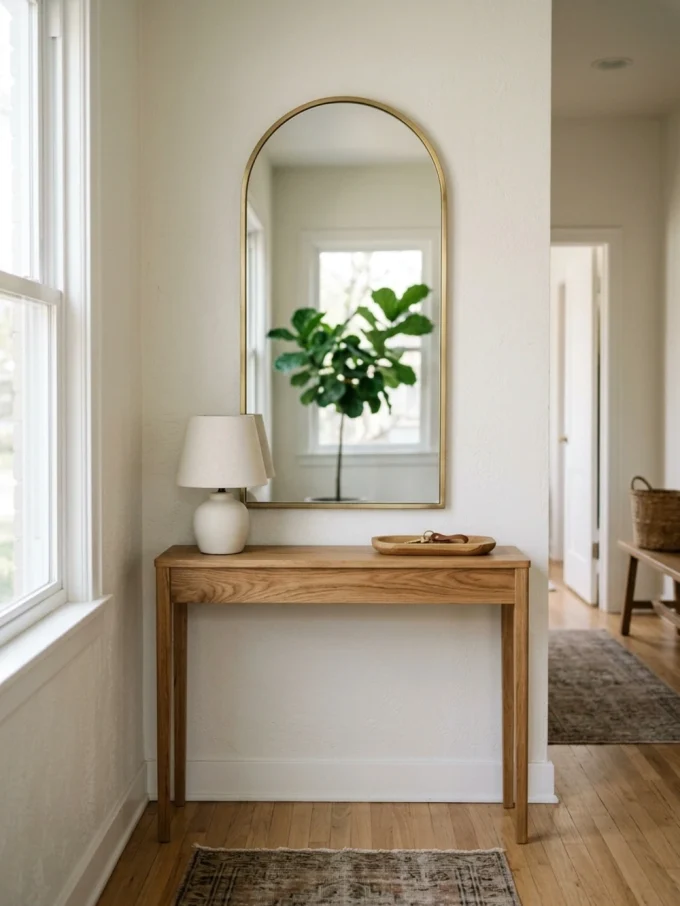
A classic entryway combination works because the two pieces perform different jobs. The console provides a landing spot for keys and everyday items, while the mirror gives the wall height and a useful last-look station before leaving.
Choose a mirror that relates to the width of the console rather than simply buying the largest one that fits. A narrow console benefits from a vertically proportioned arch, while a wider piece can support a broader frame.
Keep the console styling restrained. A tray, small lamp, vase, or one sculptural object is usually enough. Too many small accessories become especially distracting because the mirror reflects them.
The most important decision is what appears inside the reflection. A nearby window, attractive light fixture, plant, or clean architectural view can make the entryway feel brighter and deeper. A pile of shoes or an overfilled coat rack will have the opposite effect.
For more ideas around this area of the home, see our stunning hallway ideas.
2. Use a Full-Length Arch Beside the Wardrobe
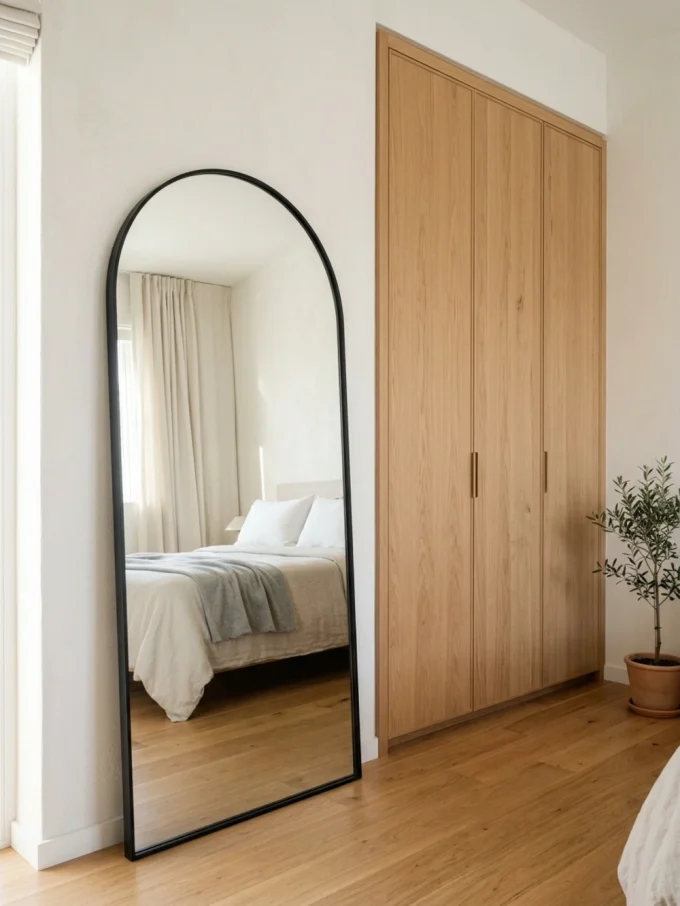
A full-length arched mirror makes sense when the mirror needs to be functional rather than purely decorative.
Place it beside a wardrobe or dressing area where you can step back far enough to see your entire outfit. The tall shape naturally draws the eye upward while the curved top softens the vertical lines of wardrobes and doors.
This is particularly useful in bedrooms where there is not enough room for a separate dressing area.
A wall-mounted version keeps the floor clear. A leaning mirror creates a more relaxed look but needs to be properly secured, especially in a busy bedroom or home with children.
Keep the surrounding area simple. The mirror is already a large vertical element, so it rarely needs a gallery wall or collection of accessories beside it.
3. Pair a Soft Wood Arch With Neutral Bedroom Materials
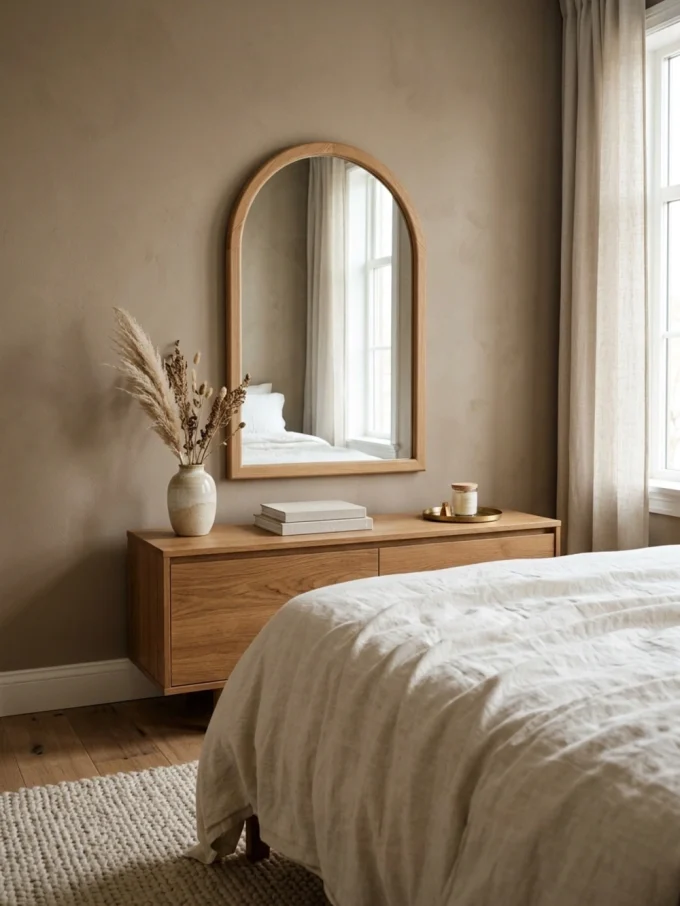
Warm wood and an arched silhouette work especially well in bedrooms because both introduce softness.
Try a medium or full-height wood-framed arch against a warm white, cream, beige, or muted taupe wall. Then repeat the wood elsewhere through a nightstand, bench, dresser, or small accent.
The goal is not to make every finish identical. Instead, repeat the material enough that the mirror feels connected to the room.
This approach works particularly well with linen bedding, woven textures, wool rugs, and other tactile materials. The arch gives the room a curved element without requiring another strong pattern.
For a more relaxed bedroom direction, you could combine this with the layered textures and calm palette used in our cozy Japandi bedroom ideas.
4. Create a Bathroom Focal Point With an Arched Vanity Mirror
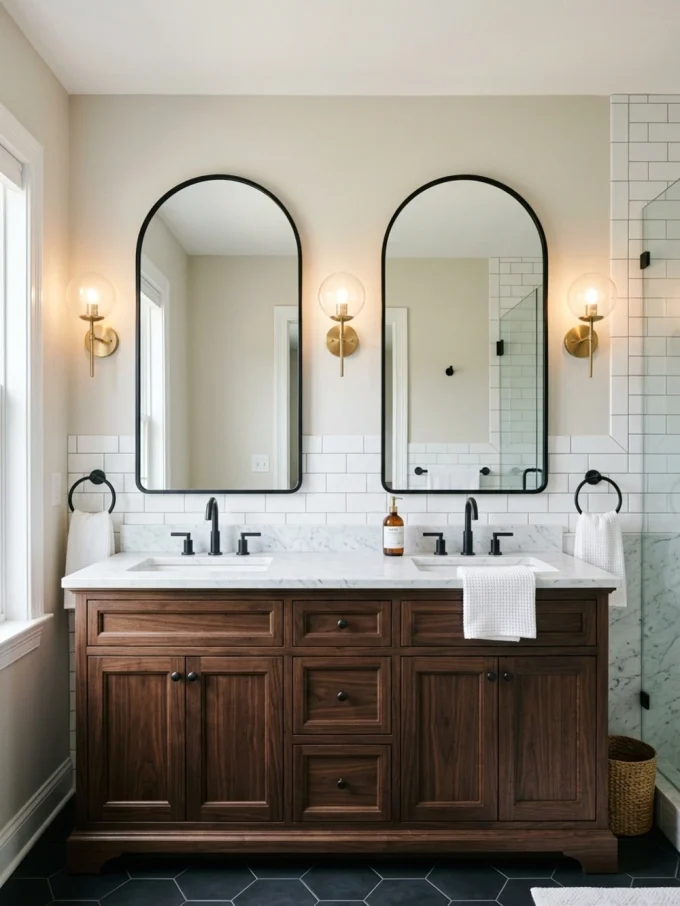
An arch can soften a bathroom filled with hard horizontal and vertical lines.
Instead of choosing a mirror simply because it fits above the vanity, look at the relationship between the mirror, vanity width, sconces, and ceiling height. A mirror that nearly fills the available wall can feel heavy, while one that is too small may look disconnected from the vanity.
For a 60-inch double vanity, two separate arched mirrors can create a more tailored arrangement, particularly when each basin has its own wall light. For smaller vanities, one centered arch often gives a cleaner result.
Lighting matters here more than decorative styling. If the mirror is being used for shaving, skincare, makeup, or other close-up tasks, make sure the surrounding lighting is useful rather than relying entirely on decorative light.
An arched mirror can also reinforce a vintage or traditional bathroom scheme. See our vintage bathroom ideas for more ways to introduce character without making a room feel dated.
5. Let a Black-Framed Arch Sharpen a Soft Interior
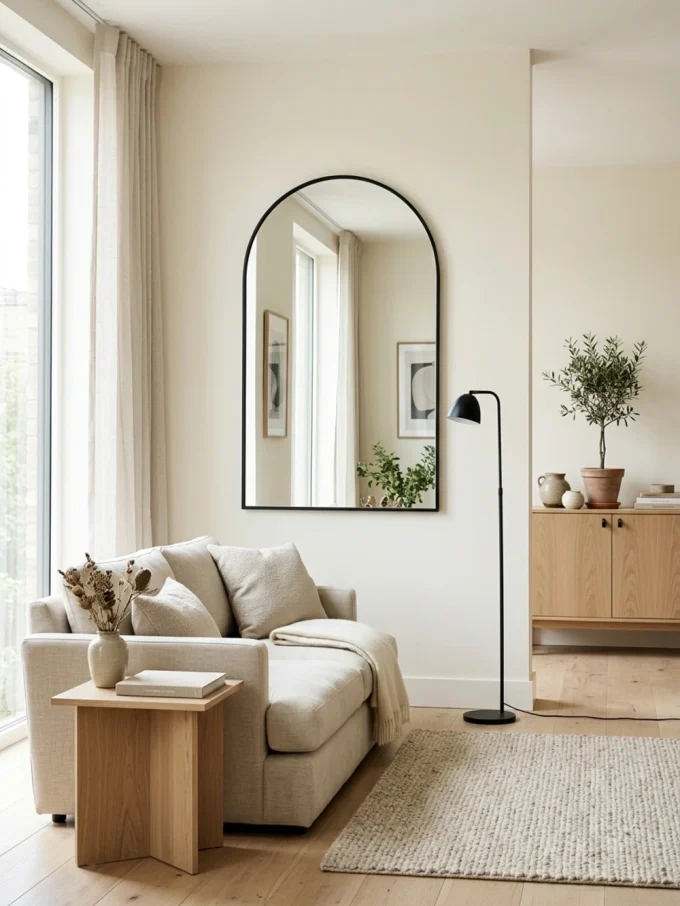
If your room contains pale walls, light upholstery, natural wood, and soft textiles, a thin black arch can provide useful contrast.
The frame does not need to dominate the room. In fact, a slim black outline often works better than a thick frame because it introduces definition without making the mirror visually heavy.
Repeat the black elsewhere in small doses—a floor lamp, cabinet pull, picture frame, curtain rod, or table base can be enough.
This is a particularly effective approach when the rest of the room feels slightly too soft or visually flat.
Avoid adding black accessories simply to match the mirror. The strongest rooms usually repeat the finish naturally through items that already have a practical purpose.
6. Turn an Empty Living Room Corner Into a Useful Vignette
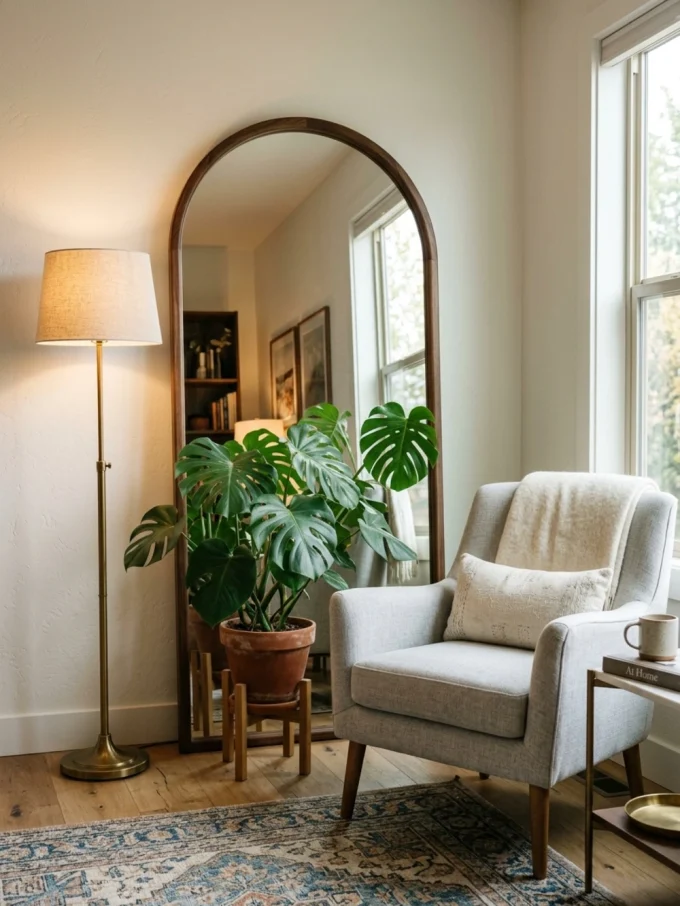
A tall arched floor mirror can give an empty corner a purpose without requiring another bulky piece of furniture.
Place the mirror beside a floor lamp, occasional chair, plant, or small side table. The combination creates a layered corner rather than leaving the mirror isolated against the wall.
A mirror near a light source can also reflect some of that illumination back into the room. In darker corners, combining a mirror with warm ambient lighting can make the area feel more active and inviting.
The reflection should still be considered before installation. Aim the mirror toward something worth seeing—perhaps greenery, artwork, a window, or an attractive part of the room.
If your living room already contains several decorative elements, resist the temptation to fill the corner further.
7. Layer an Arch Mirror Behind a Console in a Small Hallway
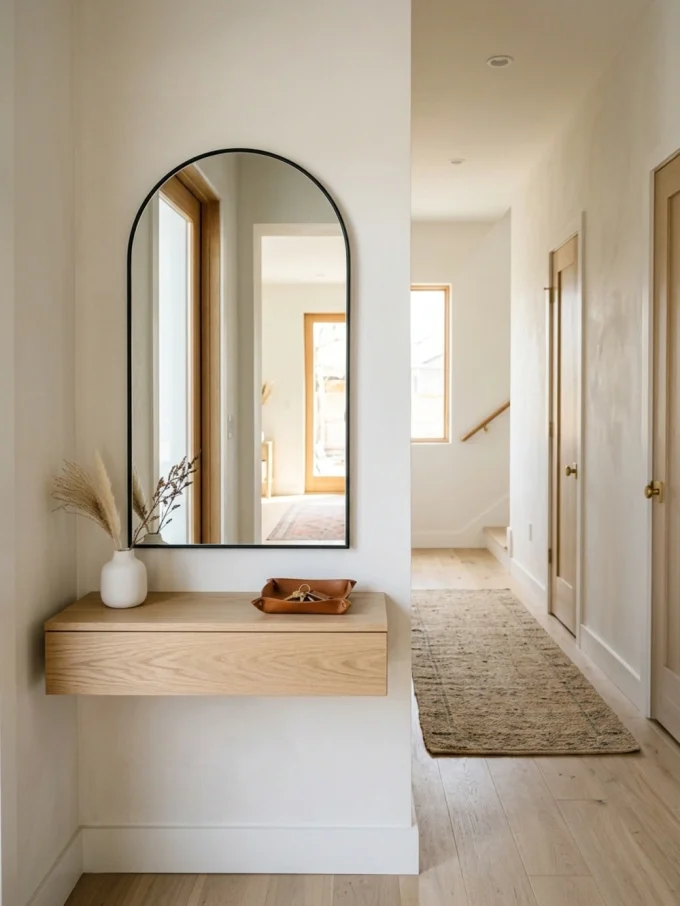
Small hallways often have limited floor space, so the combination of a narrow console and wall-mounted arch can deliver a lot without taking over the passage.
Choose a console shallow enough to preserve comfortable circulation. Then center the mirror above it, allowing enough visual breathing room around the frame.
Keep the surface practical:
- One catchall tray
- One small decorative object
- A compact lamp or vase
That’s usually enough.
The mirror should visually expand the hallway, not reflect every object stored there. Before hanging it, stand in the hallway and check exactly what the mirror will show.
If your hallway is particularly narrow, our chic narrow hallway decor ideas can help you think through the rest of the space without adding unnecessary bulk.
8. Use a Brass Arch for Quiet Old-Money Character
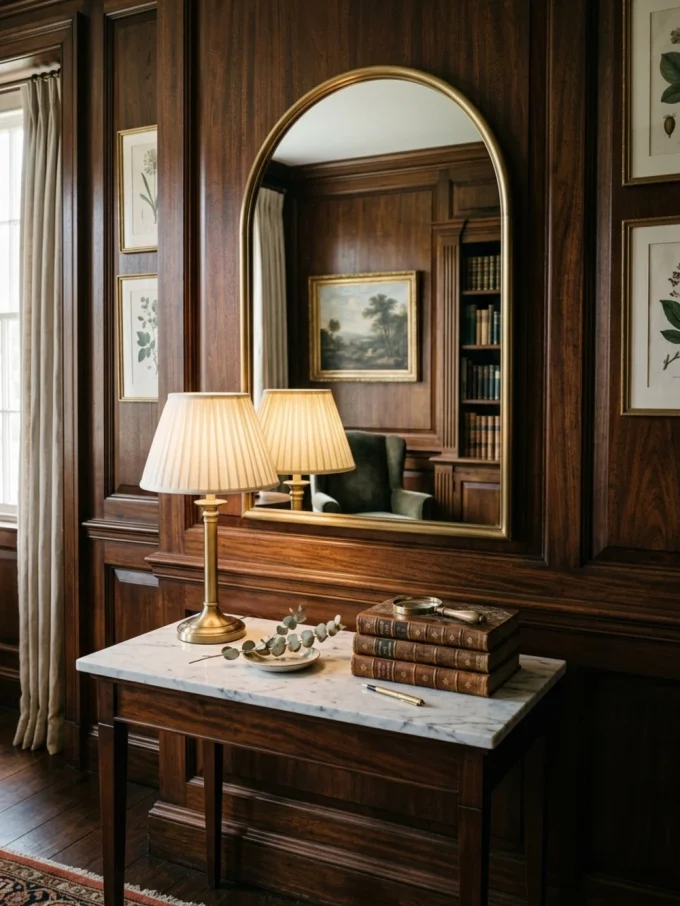
A brass-framed arch can work beautifully in a room inspired by traditional or old-money interiors, particularly when the finish is warm and restrained rather than overly shiny.
Pair it with:
- Dark or medium-toned wood
- Linen or cotton upholstery
- Stone or marble surfaces
- Traditional lamps
- Muted artwork
- A restrained color palette
The important part is balance. A brass mirror does not automatically make a room luxurious. If everything around it is equally shiny, the result can quickly become more decorative than sophisticated.
Use the mirror as one polished element within a room that relies primarily on good proportions and quality-looking materials.
For the broader design philosophy, see our old money living room ideas.
9. Frame an Arch With a Painted Wall Shape
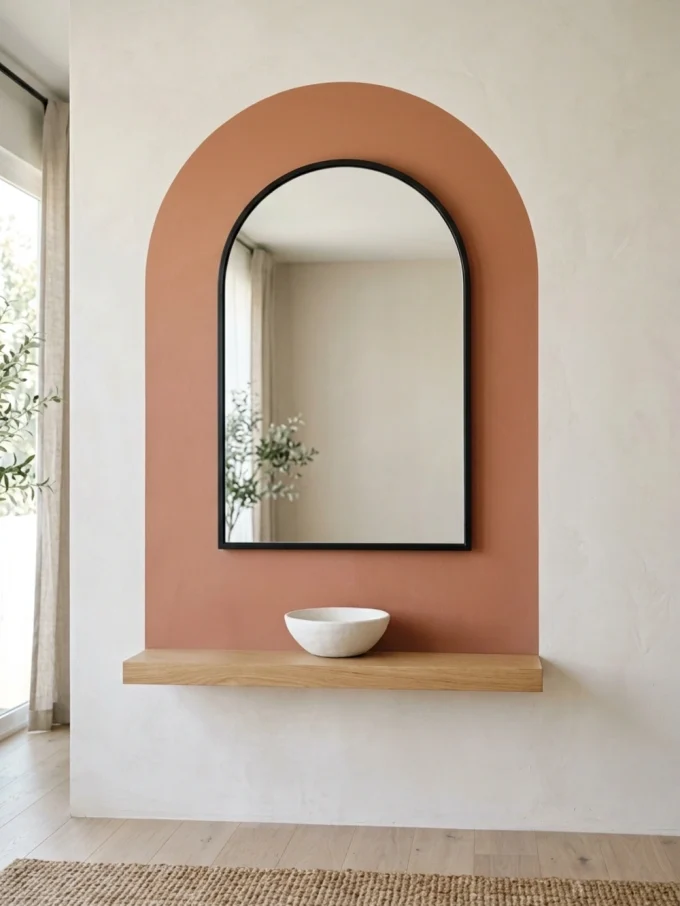
For a stronger statement, echo the mirror’s curved silhouette directly on the wall.
A painted arch slightly larger than the mirror can create the impression of an architectural niche or built-in feature. This is especially useful when the wall itself feels plain or when you want a more intentional backdrop without installing millwork.
The painted shape does not have to be dramatically different from the surrounding wall. A slightly deeper version of the same neutral can create a subtle effect, while muted green, terracotta, dusty blue, or another restrained color can make the mirror more prominent.
This idea is particularly useful for renters because paint can create architectural character without permanent construction.
The proportions matter. A painted shape that is only marginally larger than the mirror may look accidental. Give the arch enough surrounding space to read as a deliberate backdrop.
10. Combine Two Narrow Arches Over a Double Vanity
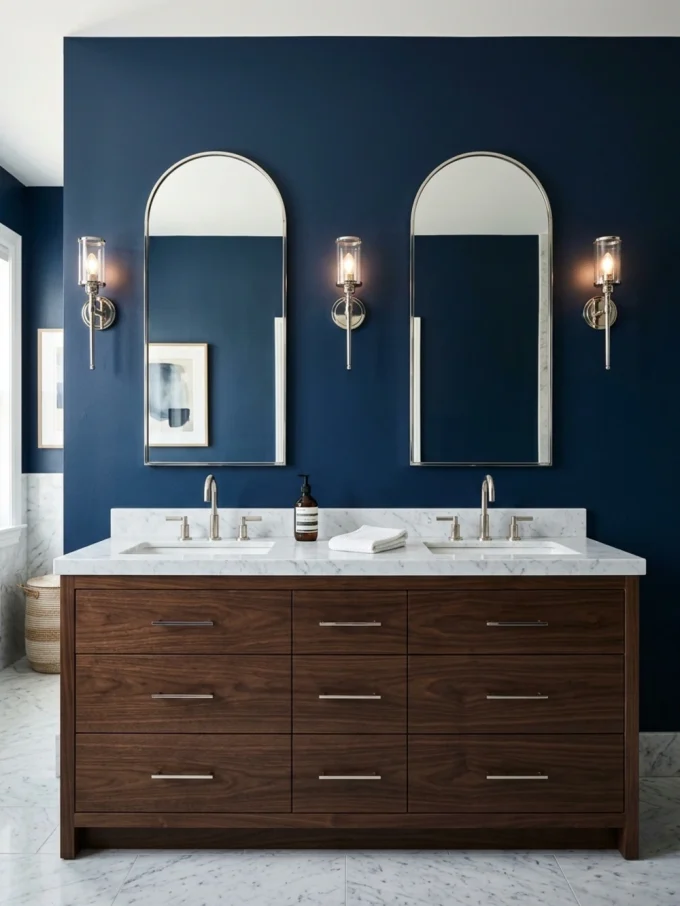
Instead of one wide mirror, use two narrower arched mirrors when a bathroom has two sinks.
This creates symmetry while giving each side of the vanity its own visual zone. It also leaves useful wall space for sconces between or beside the mirrors, depending on the vanity layout.
The two mirrors do not need to be enormous. Their combined width should relate comfortably to the vanity without pushing the composition from balanced to crowded.
This approach works especially well when the vanity has substantial drawers or a strong horizontal shape. The pair of arches breaks that horizontal line without fighting the furniture.
If the bathroom has a navy, blue, or other saturated palette, a simple metal or wood frame can keep the mirror from introducing yet another competing color. Our navy blue bathroom ideas offer additional ways to balance strong bathroom colors.
11. Choose a Frameless Arch for a Minimalist Room
A frameless arched mirror is useful when you want the silhouette without adding another strong material or color.
It works particularly well against:
- White walls
- Plaster finishes
- Minimalist bedrooms
- Contemporary bathrooms
- Soft neutral interiors
Because there is no strong frame to anchor the shape, the surrounding wall becomes more important. The mirror needs enough breathing room to stand out.
This is also a good choice when the room already contains several finishes. Instead of introducing another metal or wood tone, the frameless design keeps the focus on shape and reflection.
The trade-off is that it can feel less substantial than a framed mirror. If the wall is very large or visually empty, you may need furniture, lighting, or architectural detail nearby to give the composition enough weight.
12. Place a Tall Arch in a Tiny Bedroom
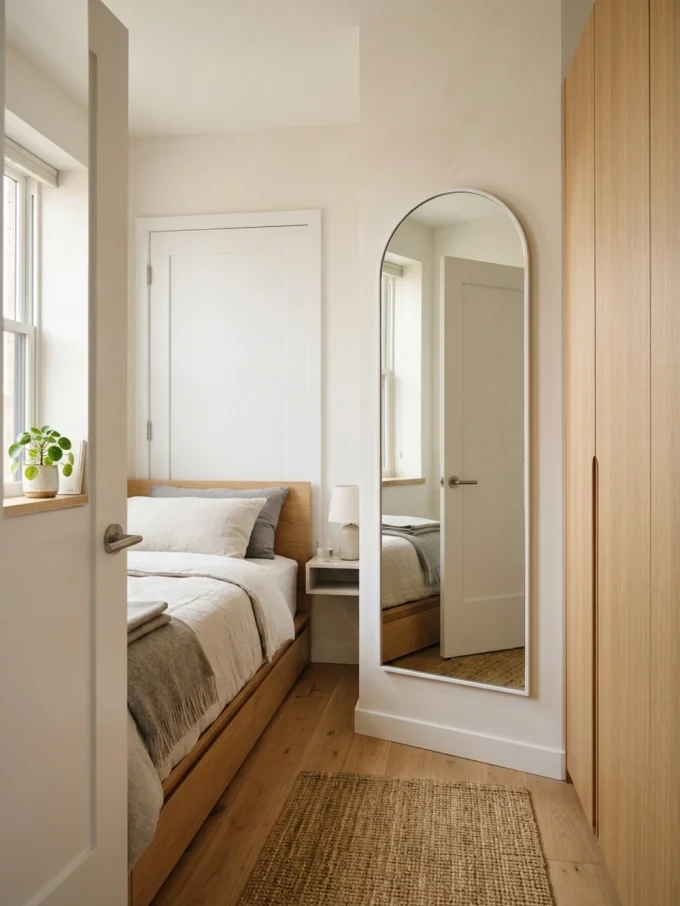
A tiny bedroom has little room for purely decorative furniture, which makes a full-length wall-mounted arch particularly useful.
Place it near the wardrobe, bedroom door, or dressing area where it supports an existing routine. Avoid putting it somewhere that interferes with drawers, doors, or the main walking route.
The vertical silhouette can make a short wall feel taller, but the effect depends on the surrounding composition. A mirror crowded between furniture pieces will not suddenly make the room feel spacious.
Use a slim frame and keep nearby furniture visually light.
If the room is extremely tight, our tiny bedroom ideas can help you think about the mirror as part of the entire layout rather than an isolated decoration.
13. Style an Arch Over a Bedroom Dresser
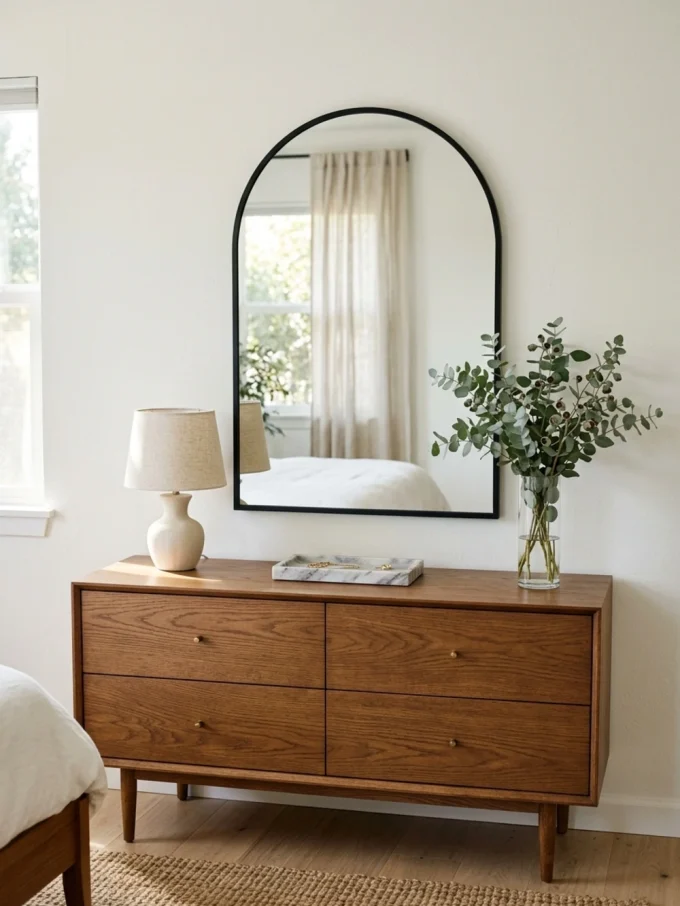
A medium arched mirror above a dresser creates a practical dressing station without requiring a separate vanity.
Center the mirror over the furniture and leave enough space between the top of the dresser and the bottom of the frame so the arrangement does not feel compressed.
Then treat the dresser surface as part of the composition.
A small lamp on one side, a tray or decorative box in the center, and one taller object on the opposite side can create asymmetry without visual chaos.
If the dresser has a particularly strong shape, choose a simpler mirror frame. If the dresser is visually plain, the arch can carry more of the decorative weight.
This is also a natural place to connect the mirror with other dressing-area elements, such as the ideas in our amazing dressing table ideas.
14. Use an Oversized Arch Above a Fireplace
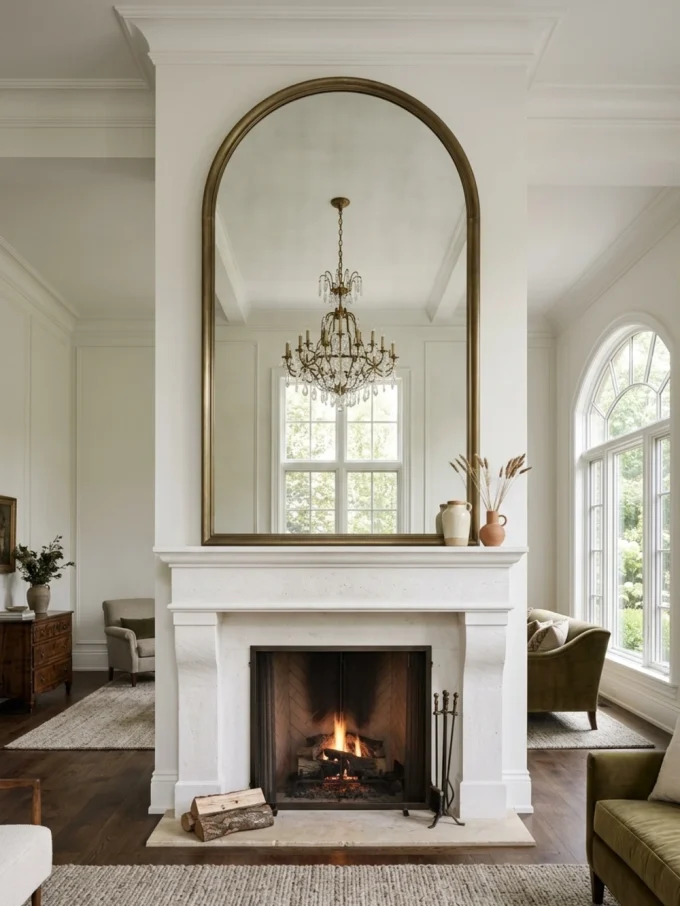
An oversized arch can become a strong focal point above a fireplace or mantel.
The height of the arch naturally draws attention upward, which can help connect a low fireplace with the rest of the wall. It also introduces a curved form into a composition dominated by the horizontal mantel and rectangular fireplace opening.
However, oversized does not mean filling every inch of wall.
The mirror should relate to the width and visual weight of the fireplace. A tiny arch above a substantial mantel can look lost, while an enormous mirror squeezed against the ceiling can make the entire wall feel top-heavy.
Keep mantel styling controlled. If the mirror already has a strong frame, you generally need fewer objects competing beneath it.
You can explore different fireplace proportions and focal-point treatments in our modern fireplace ideas.
15. Pair an Arch Mirror With a Wall Sconce
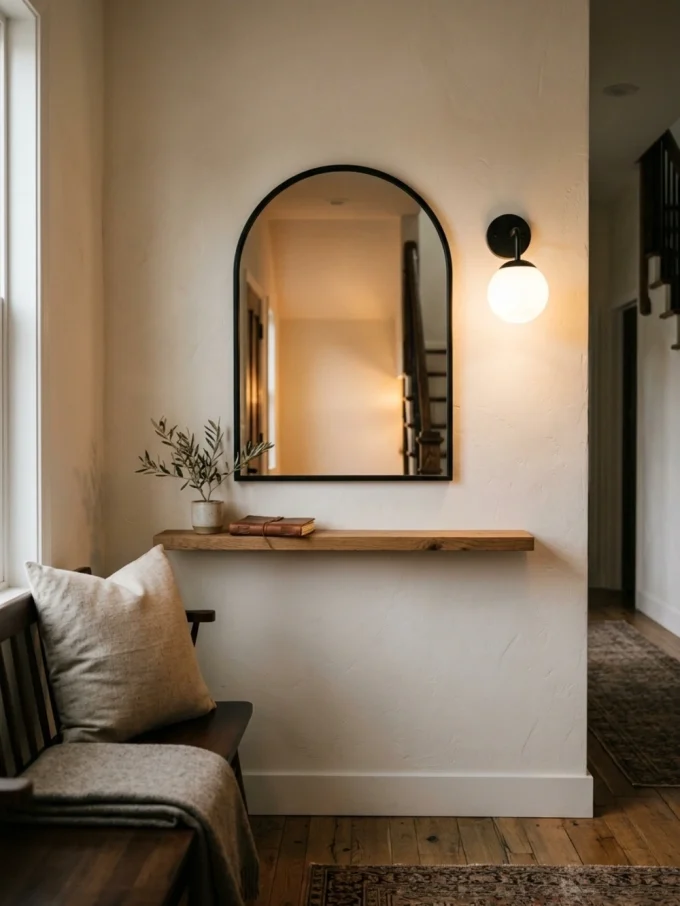
A mirror and sconce can create a simple lighting composition that feels more finished than a mirror alone.
Place the sconce beside the mirror where it can illuminate the surrounding wall and contribute to the room’s atmosphere. In a bedroom, this can create a softer dressing corner. In an entryway, it can give a previously dark wall some warmth.
The mirror also becomes part of the lighting effect by reflecting some of the light back into the room.
Choose the finish carefully. A black frame with a black sconce creates a crisp, coordinated look, while brass can add warmth to a more traditional setting.
Don’t use the mirror to compensate for inadequate task lighting. Decorative lighting and functional lighting are not always the same thing.
For more inspiration, see our guides to indoor wall-mounted light fixture ideas and wall sconce light fixtures ideas.
16. Lean a Large Arch in a Relaxed Bedroom Corner
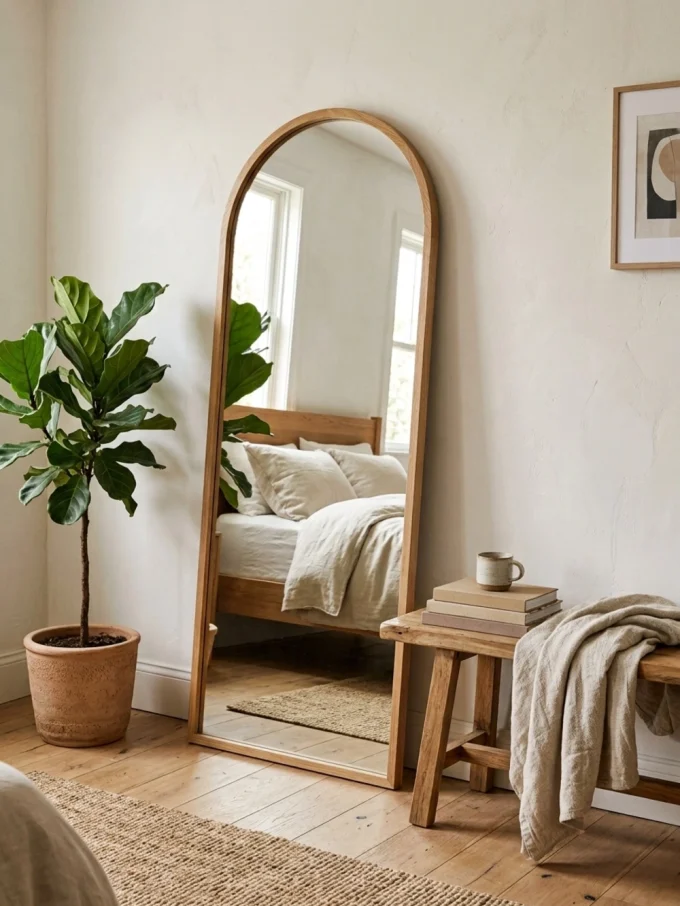
A leaning arch mirror has a more casual quality than a perfectly centered wall-mounted mirror.
Place it in a bedroom corner near a wardrobe, chair, bench, or dressing area. This works particularly well in interiors that feel collected rather than highly formal.
The benefit is flexibility. You can test the mirror’s position and reflection before committing to wall installation.
The drawback is stability.
A large leaning mirror should not simply be left unsecured because it looks attractive that way. Secure it appropriately for the wall and floor conditions, particularly in homes with children or pets.
Also check the base. A mirror that needs to lean at a steep angle may occupy considerably more floor space than expected.
17. Mix an Arched Mirror With Textured Walls
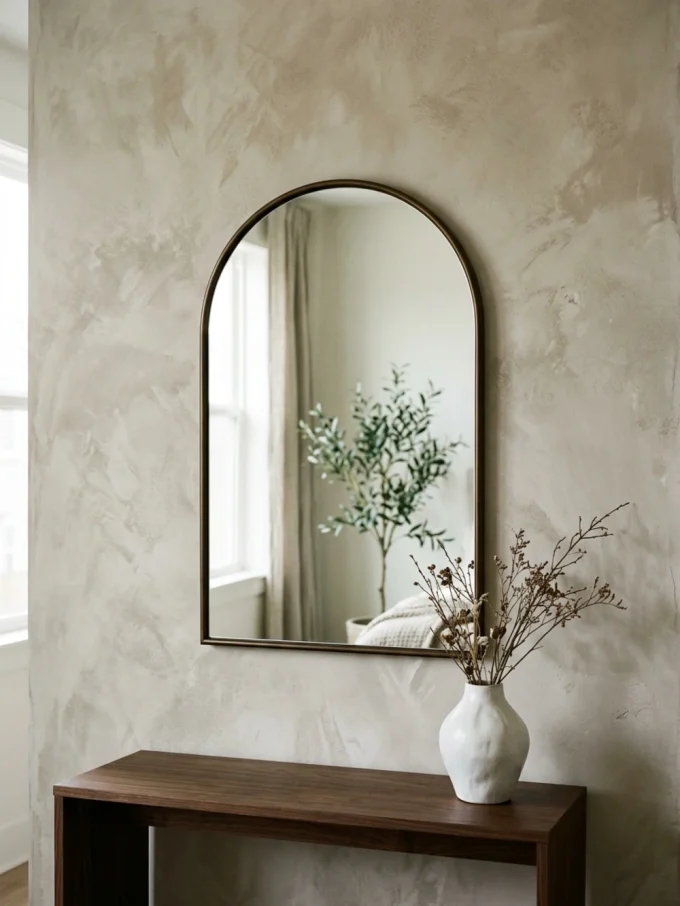
An arched mirror becomes especially interesting against a textured wall because the reflective surface provides contrast.
Try pairing it with limewash-style finishes, plaster, subtle wall paneling, or another tactile treatment. The mirror gives the eye a smoother, reflective surface while the wall provides depth.
This works best when the colors remain relatively restrained.
For example, a warm plaster wall with a bronze, brass, or wood-framed arch can feel layered without needing additional artwork.
Avoid combining a highly decorative mirror frame with extremely busy wall texture unless you intentionally want a maximalist effect. Usually, one element should lead while the other supports it.
Our wall texture design ideas can help you choose a backdrop that adds dimension without overwhelming the mirror.
18. Create an Arched Mirror Moment in a Rental
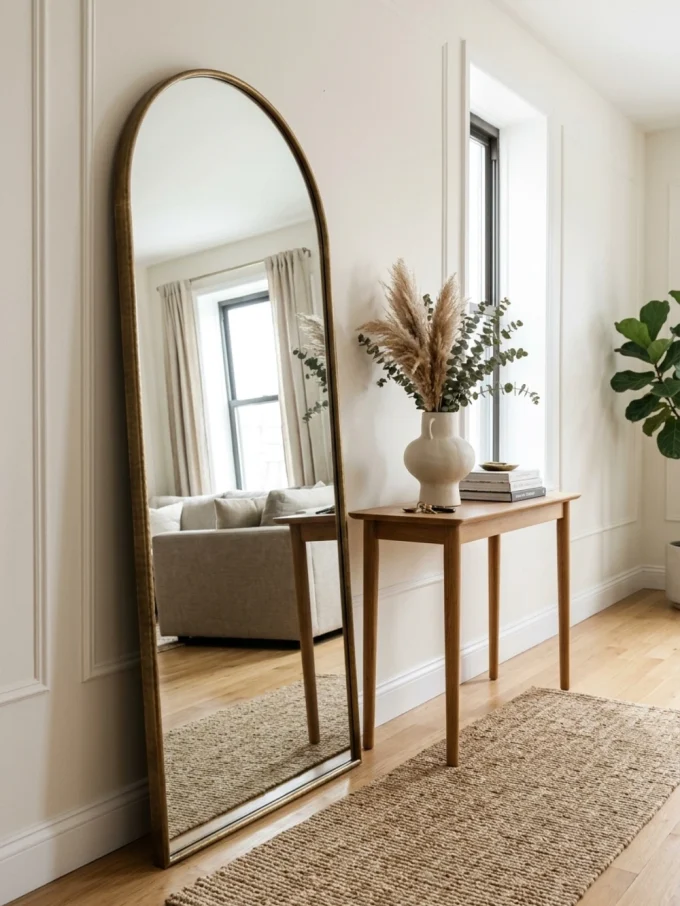
Renters do not need to give up on architectural-looking mirror arrangements.
A large leaning arch can create a focal point without requiring permanent wall changes. Alternatively, a smaller mirror can be paired with removable decor or a narrow freestanding console, depending on the space.
The key is to avoid making the mirror arrangement look temporary.
Choose one substantial piece rather than several small accessories. A beautiful frame, a useful location, and a clean reflection can make a rental feel much more intentional.
If you are working around rental restrictions, our rental apartment decorating ideas provide more approaches for adding personality without relying on major renovations.
19. Make the Mirror the Quiet Center of a Minimal Entryway
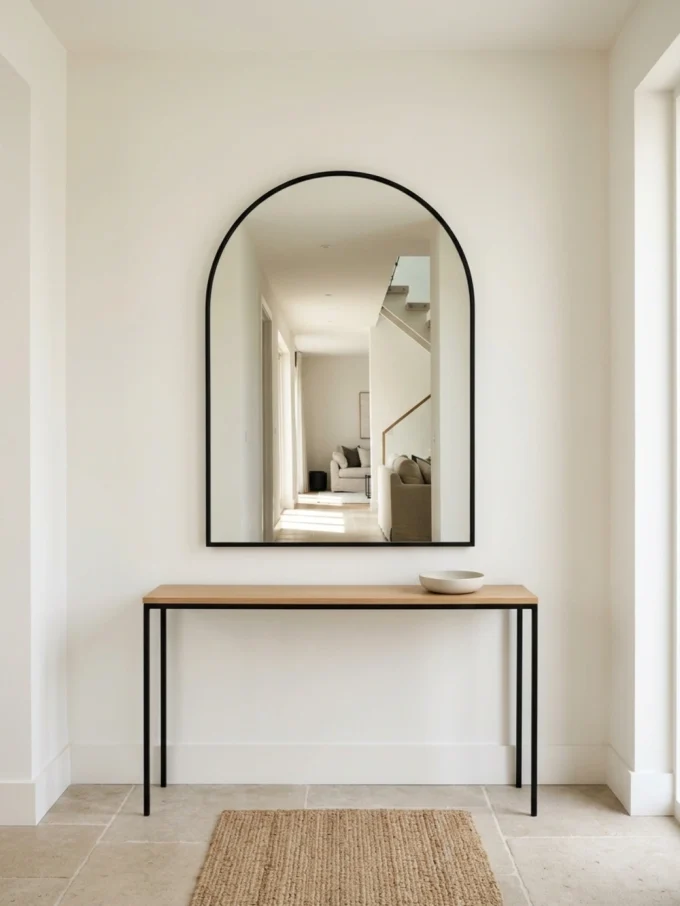
Sometimes the strongest approach is the simplest.
Place one beautiful arched mirror on a clean wall and give it enough empty space to breathe. Add only the furniture the entryway genuinely needs—a slim console, small bench, or narrow shelf.
This works because the curved silhouette already provides visual interest. You do not need to surround it with baskets, artwork, plants, candles, and decorative objects simply because there is available space.
The reflection becomes the decoration.
If possible, position the mirror so it captures a pleasant view of the home rather than a cluttered storage zone. A mirror does not create a better view; it repeats the one you give it.
This restrained approach is especially effective in homes where the rest of the decor already has plenty of texture and detail.
How to Choose the Right Arch Mirror for Your Space
The 19 ideas above work because they start with the room rather than the mirror. Before buying one, make four decisions.
Start With the Wall and Furniture Width
Measure the wall and the furniture below or beside the mirror.
An arch that is too narrow can look disconnected. One that is too wide can overwhelm the furniture beneath it.
For a vanity, the mirror generally needs to relate closely to the vanity width while leaving enough room for lighting and wall details. For an entry console, the mirror should feel intentionally centered rather than simply filling the biggest available area.
Decide Whether You Need a Decorative or Functional Mirror
A mirror beside a wardrobe needs to provide a usable full-body view.
A bathroom mirror needs to support daily grooming.
An entryway mirror can do both: provide a quick appearance check while becoming part of the room’s focal point.
A decorative mirror, on the other hand, can be chosen more freely around its shape and frame.
Knowing which job matters most prevents you from buying a mirror that looks beautiful but is frustrating to use.
Pay Attention to the Frame Material
The frame changes the character of the entire mirror.
Black metal: crisp, modern, graphic
Warm wood: relaxed, organic, traditional
Brass: polished, classic, warmer
Silver or chrome: cooler and more contemporary
Frameless: quiet and minimalist
Choose a finish that already has somewhere to belong in the room. It does not need to match everything, but it should not feel like a completely unrelated material.
Think About What the Mirror Will Reflect
This is one of the most overlooked decisions.
Before installing the mirror, stand at the proposed location and look directly across the room. That view will become part of the mirror’s composition.
Good reflections can include:
- A window
- Greenery
- Artwork
- An attractive light fixture
- Architectural details
- A clean view into another room
Less helpful reflections include:
- Cluttered shelves
- Shoe piles
- Laundry
- Busy work surfaces
- A television
- Harsh direct sunlight
Mirrors can visually repeat clutter just as easily as they repeat attractive details. Current design advice similarly recommends avoiding placements that reflect televisions, messy areas, or intense sunlight.
Common Arch Mirror Mistakes to Avoid
Choosing the Mirror Before Measuring
A mirror that looks perfect online may be completely wrong for your wall.
Measure first, then compare the mirror dimensions with the furniture and surrounding clearances.
Hanging It Too High
A mirror should feel connected to the furniture beneath it. Leaving a huge empty gap between a console or dresser and the mirror can break that relationship.
Ignoring the Reflection
The mirror does not just occupy wall space. It creates a second view of the room.
Always check what it will reflect before making the final installation.
Overdecorating Around It
An arched mirror already has a distinctive silhouette. Adding too many accessories can make the area feel busy rather than sophisticated.
Using a Decorative Mirror Where You Need a Functional One
A beautiful small mirror above a wardrobe will not help much if you need to see a full outfit.
Choose based on the job first, then the style.
Forgetting Scale
The same mirror can look elegant in one room and undersized in another.
Consider ceiling height, wall width, furniture size, and the visual weight of the frame together.
Final Thoughts
The best beautiful arch mirror ideas are not really about finding the prettiest mirror. They are about finding the right relationship between the mirror, the room, and the way you live in it.
A full-length arch can turn an unused bedroom wall into a useful dressing area. A slim black frame can sharpen a soft living room. A brass arch can add quiet character to a traditional interior. A pair of mirrors can organize a double vanity, while a simple leaning mirror can give a rental apartment a stronger focal point without permanent changes.
Whatever style you choose, start with scale, reflection, lighting, and function. Once those decisions are right, the arch itself does much of the visual work.
That is what makes an arched mirror more than a decorative trend: it can solve a practical problem while giving a room a softer, more intentional shape.