
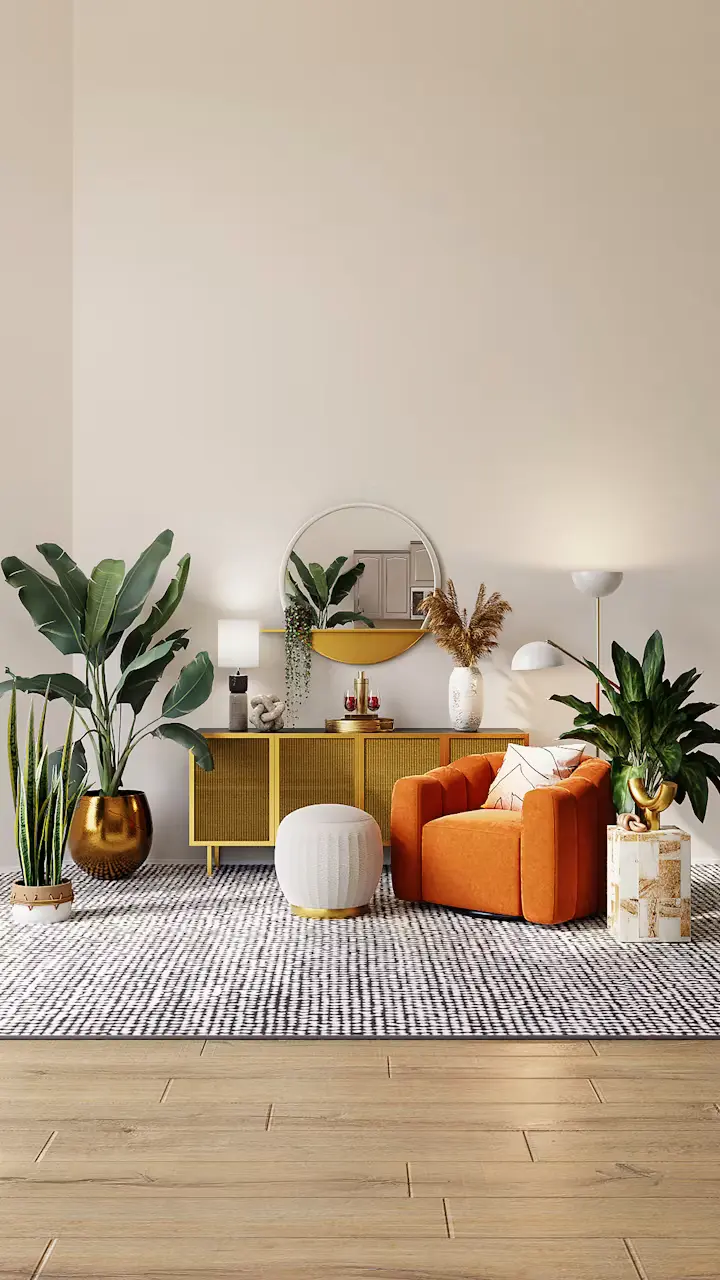
A studio apartment has to do a lot with very little space. Your bedroom, living room, dining area, workspace, and sometimes even your entryway may all share the same few hundred square feet.
That can make decorating tricky. Add too much furniture and the apartment feels crowded. Keep everything too small and it can look unfinished. Skip storage and everyday clutter quickly takes over.
The better approach is to decorate around how you actually use the space. Define the main zones, choose furniture that earns its footprint, use the walls and vertical space, and repeat a few colors or materials so the apartment still feels like one home.
These studio apartment decor ideas focus on those decisions rather than simply adding more things. From floating furniture and visual room dividers to mirrors, layered lighting, hidden storage, and compact dining areas, each idea is designed to make a small studio feel more functional without sacrificing personality.
1. Start With Zones Before Buying Decor
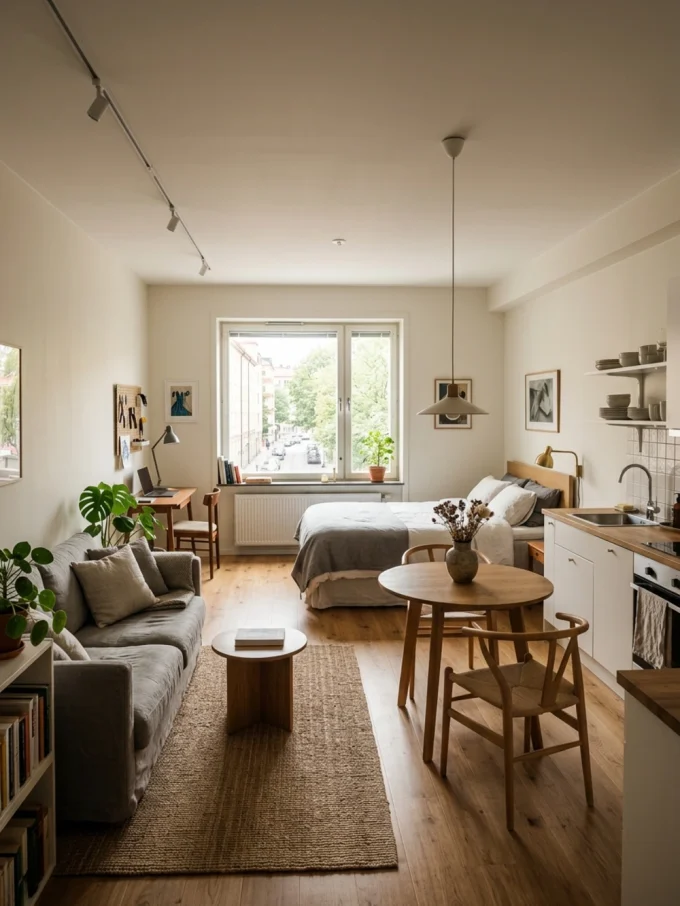
The most useful studio apartment decor idea may be the one that happens before you buy anything.
Instead of treating the apartment as one large room, decide where you want each activity to happen. You might have a sleeping zone, living zone, dining area, work corner, and kitchen.
You don’t need walls to make those areas feel distinct. A sofa can establish the living area, a rug can anchor the bed, and a small table can create a dining zone.
Think about circulation, too. You should be able to move between the kitchen, bathroom, entry, and sleeping area without weaving around furniture.
Why it works: A studio feels larger when its layout is easy to understand. Every area has a purpose without visually cutting the room into too many pieces.
Avoid: Buying furniture first and trying to force a layout around it.
2. Float the Sofa to Separate the Living Area
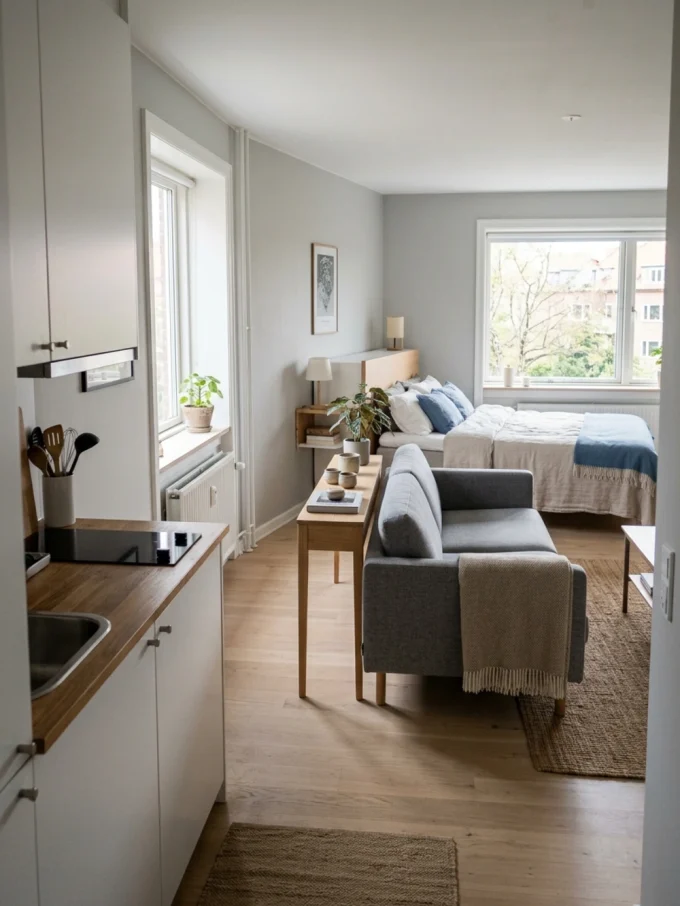
Pushing every piece of furniture against a wall can leave the center of a studio strangely empty while doing little to define the space.
If your floor plan allows it, float the sofa slightly away from the wall and let its back create a subtle boundary between the living and sleeping areas.
Place a slim console, narrow bookcase, or small table behind it if you need additional storage.
The key is keeping the piece shallow enough that it doesn’t interrupt circulation.
Best for: Studios where the living room and bed occupy the same open space.
A compact sofa can also make the apartment feel more intentional than a collection of chairs scattered around the room.
3. Use an Area Rug to Define the Living Zone
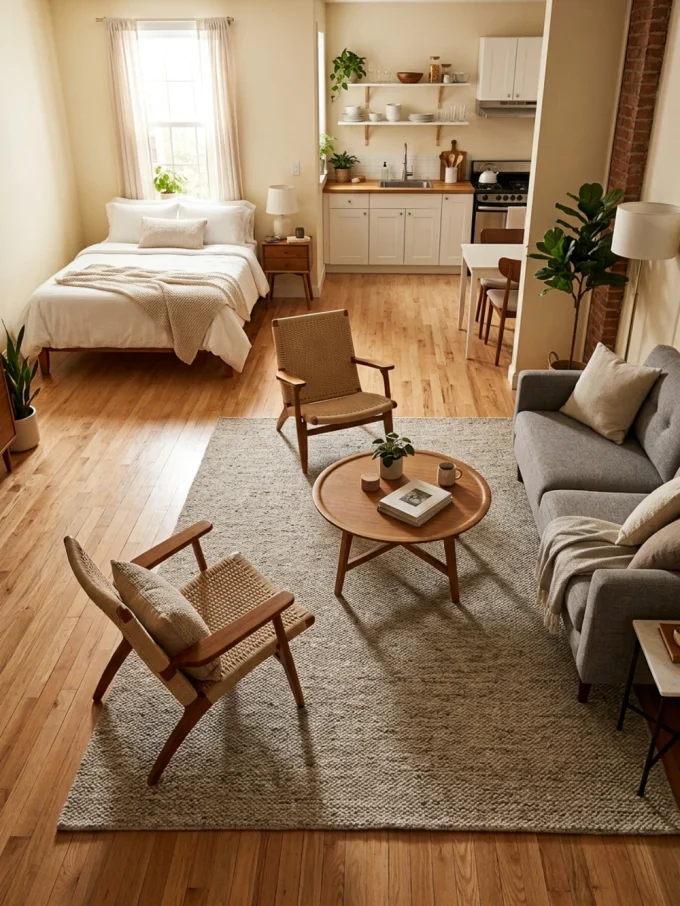
An area rug gives a studio apartment an instant sense of structure without requiring a permanent divider.
Choose a rug large enough for at least the front legs of the sofa and nearby seating to sit comfortably on it. This visually groups the furniture into one living area.
You can repeat the same principle around the bed with another rug, but don’t choose completely unrelated patterns and colors. The two zones should feel different while still belonging to the same apartment.
This is particularly effective because designers often use rugs to establish boundaries in open studios without adding walls.
Avoid: Several tiny rugs scattered across the floor. They can make the apartment feel chopped up instead of organized.
4. Give the Bed Its Own Visual Identity
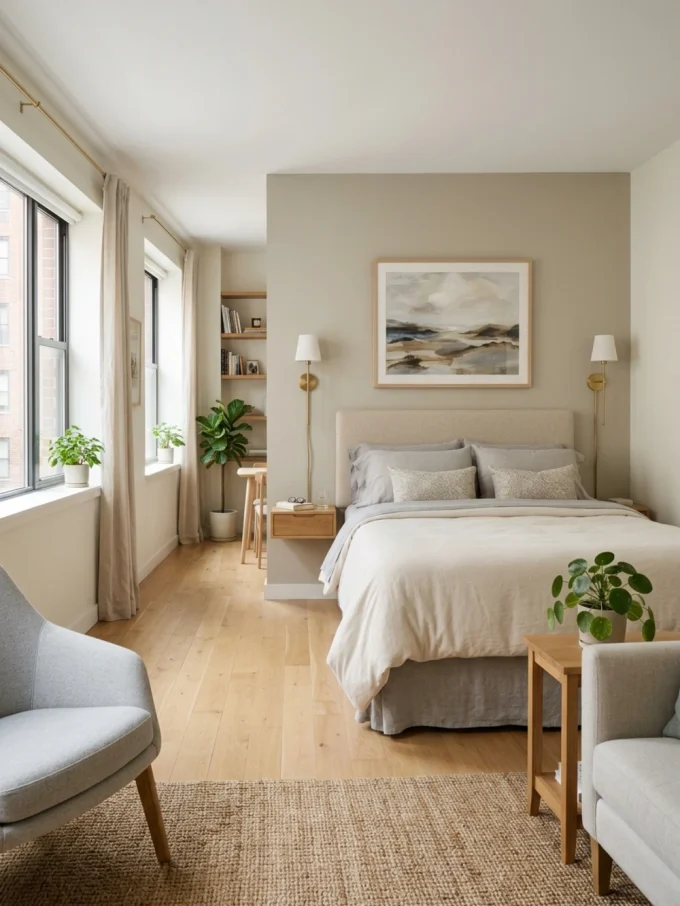
Your bed is usually the largest single piece of furniture in a studio, so trying to make it disappear isn’t always the best solution.
Instead, make the sleeping area feel deliberate.
A simple upholstered headboard, large piece of artwork, pair of narrow sconces, or a cohesive bedding palette can visually establish the bedroom zone.
If space permits, place the bed against the farthest wall from the entrance so the first view into the apartment isn’t dominated by the bed.
For a softer bedroom atmosphere, you can also borrow ideas from these cozy Japandi bedroom ideas and adapt the restrained palette rather than copying the entire style.
5. Choose Furniture That Does More Than One Job
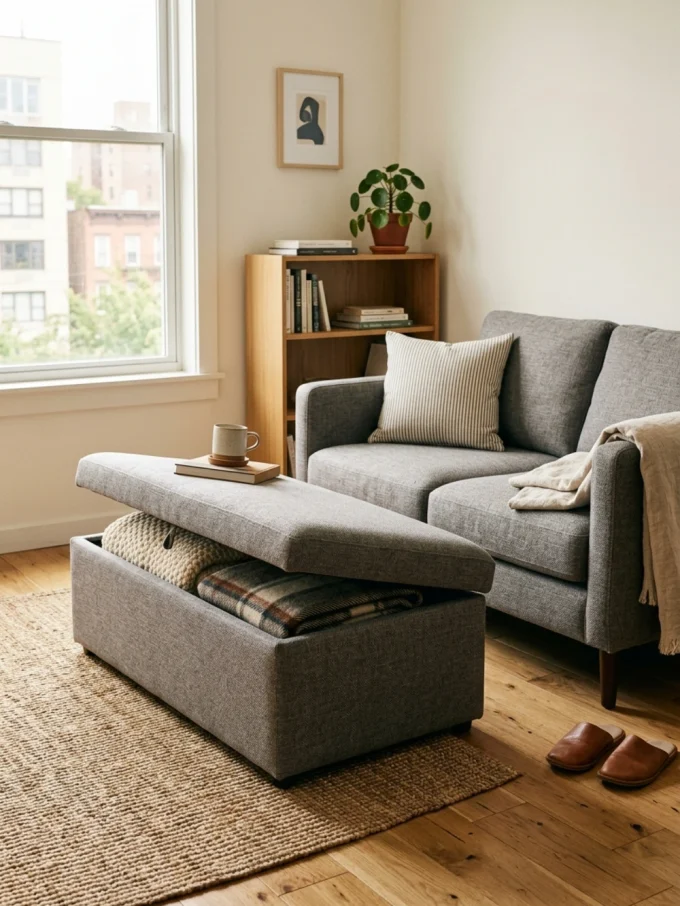
In a studio, furniture should earn its floor space.
A storage ottoman can provide seating, act as a footrest, and hide blankets. A dining table can double as a work desk. A console can become an entryway drop zone. A bed with drawers underneath can replace a separate dresser.
This doesn’t mean every item needs to perform three functions. Too much multifunctional furniture can make the apartment feel mechanical.
Choose dual-purpose pieces where the second function solves a genuine problem.
A good test: If removing the furniture would create a storage, seating, or work problem, it’s probably earning its footprint.
6. Make Vertical Storage Part of the Decor
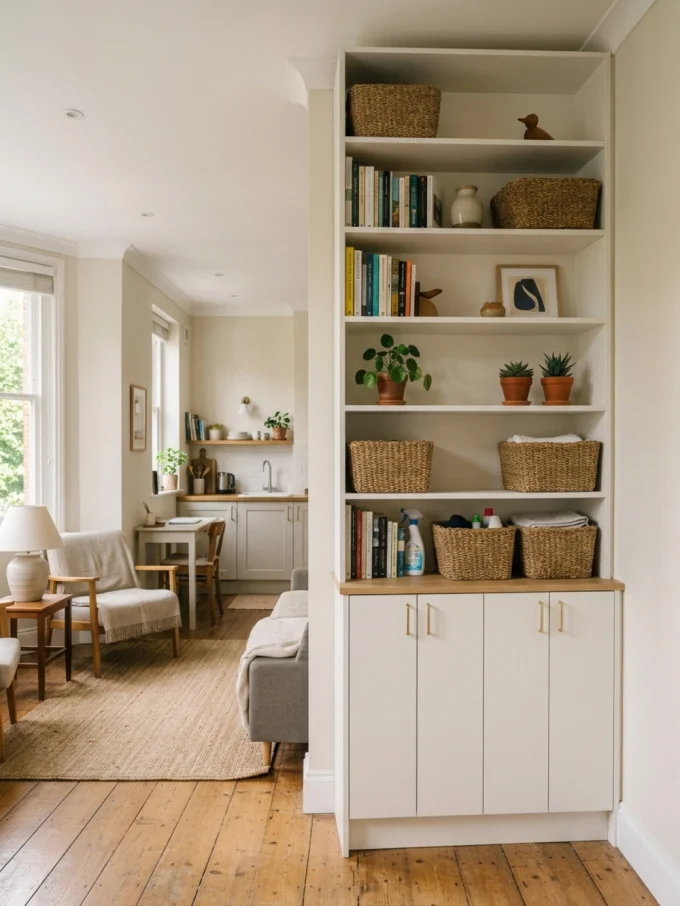
When floor space is limited, look upward.
Tall shelving, wall-mounted cabinets, floating shelves, and vertical bookcases can use space that would otherwise remain empty.
The trick is to keep the arrangement visually controlled. A tall shelf packed with random objects can become a wall of clutter.
Group books, baskets, ceramics, plants, and artwork into intentional sections. Leave some empty shelf space so the storage doesn’t become visually heavy.
Vertical storage is especially useful in studios because designers consistently recommend making better use of wall height and built-in or storage furniture when floor area is limited.
7. Use a Large Mirror to Bounce Light Around the Apartment
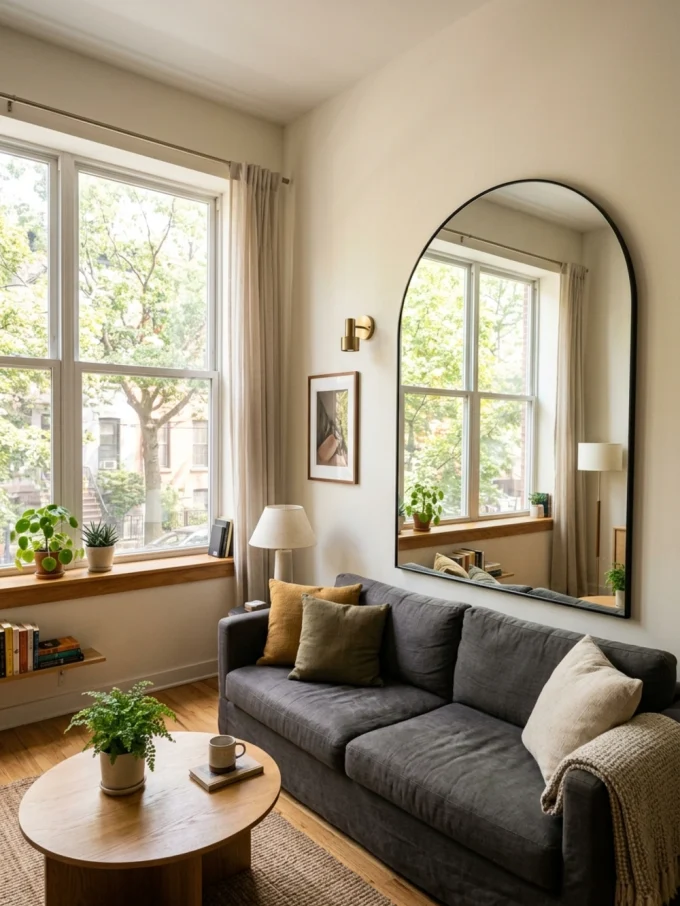
Mirrors are one of the easiest ways to create more visual depth in a studio.
Instead of covering several walls with small decorative mirrors, consider using one substantial mirror where it can reflect daylight, an attractive architectural feature, or a well-styled part of the room.
An arched mirror can be particularly effective when you want to soften a studio filled with straight furniture lines.
Explore these beautiful arch mirror ideas if you want more ways to use an arched shape without overwhelming a small room.
Avoid: Positioning a mirror directly opposite an unattractive clutter zone. It will simply double what you don’t want to see.
8. Create a Sleeping Divider Without Building a Wall
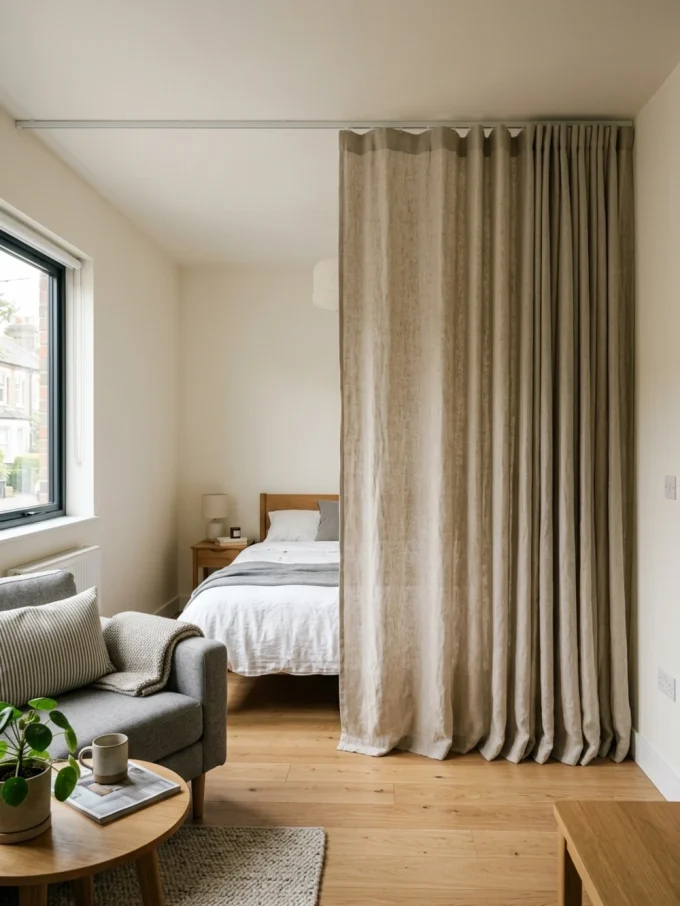
A studio doesn’t need a permanent wall between the bed and living area.
A ceiling-height curtain, open shelving unit, folding screen, slatted divider, or strategically placed bookcase can create separation while allowing light to move through the room.
Open-backed shelving is particularly useful because it provides some privacy without completely blocking the visual connection between zones.
For renters, choose options that don’t require permanent construction.
The goal isn’t complete isolation. It’s simply giving the sleeping area a stronger sense of privacy and purpose.
9. Keep One Color Story Running Through the Apartment
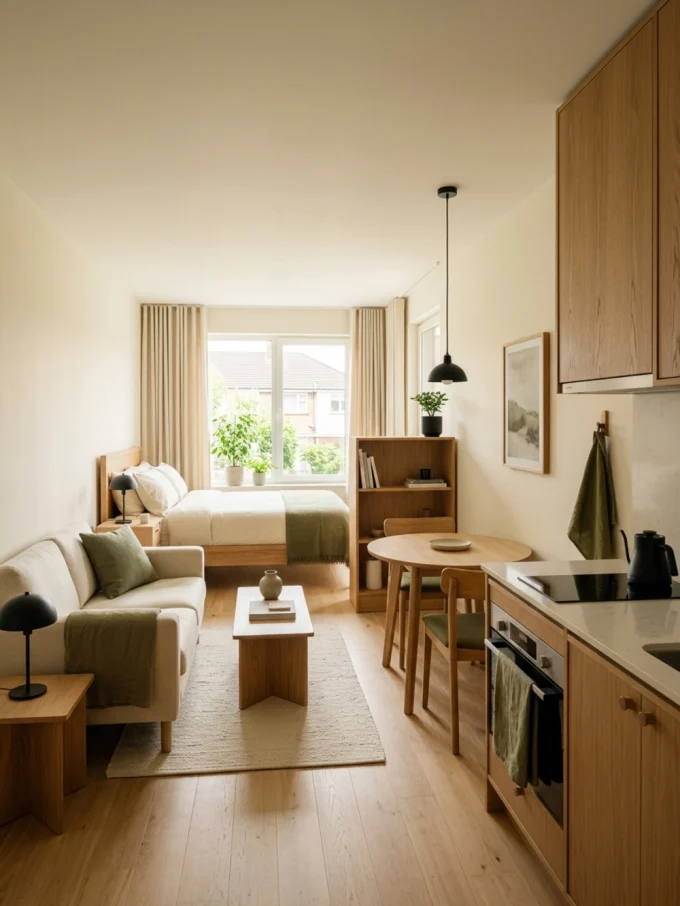
A studio can look cluttered even when it isn’t physically crowded if every zone uses a different color scheme.
Choose a small palette and repeat it throughout the space.
For example, warm white walls can work with natural wood, muted olive, black accents, and cream textiles. You don’t have to use every color equally. Let one or two shades dominate and use the others as accents.
This creates visual continuity between the kitchen, living room, and sleeping area.
A cohesive palette can also make different furniture pieces look as though they belong together, which is especially useful when furnishing a studio gradually.
10. Let Natural Light Guide the Layout
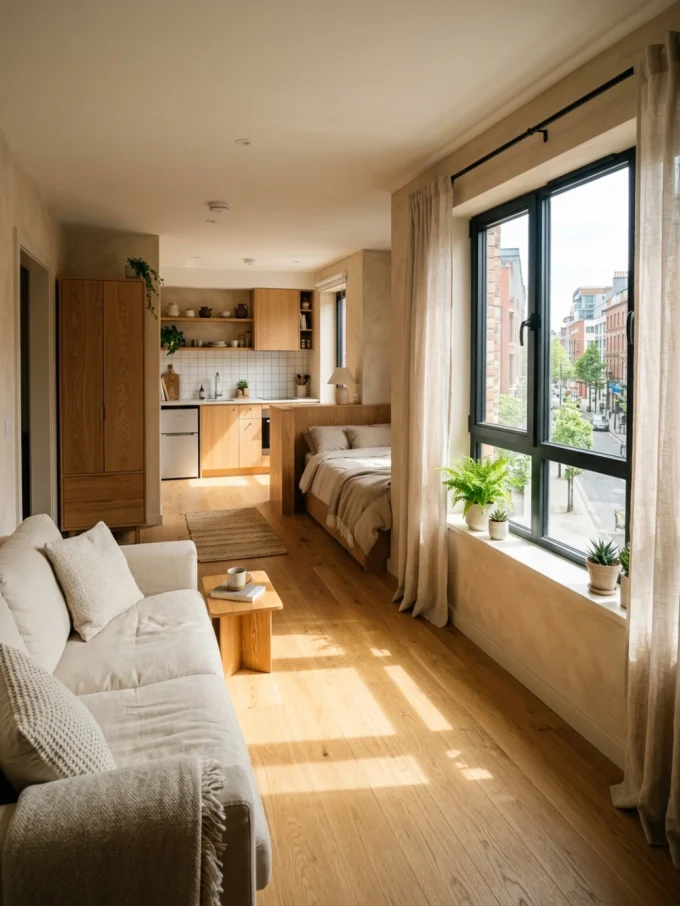
Don’t treat windows as an afterthought.
If your studio has one strong source of daylight, consider placing the sofa, dining table, or workspace where you can benefit from it during the day. Keep the darker areas for activities that don’t depend as heavily on natural light.
Architectural Digest’s recent studio-apartment guidance similarly emphasizes arranging functional areas around available windows and daylight.
Use lightweight window treatments when privacy allows, and avoid placing tall furniture directly in front of the main window unless storage needs make it unavoidable.
Why it works: Natural light can make the entire studio feel more open, so protecting its path through the room is often more valuable than adding another decorative object.
11. Use a Narrow Console as a Flexible Boundary
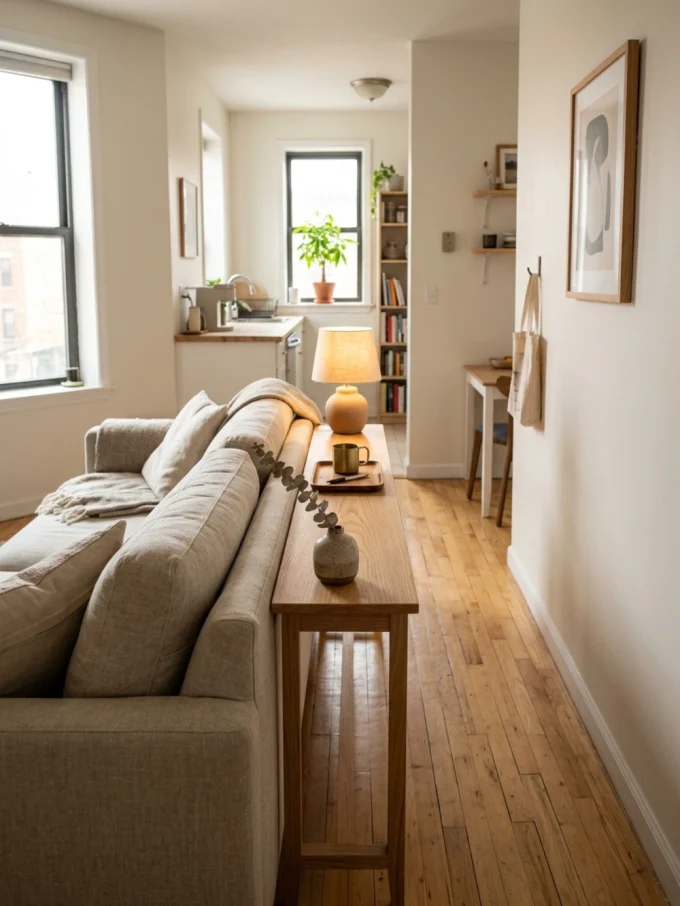
A narrow console table can solve several studio problems at once.
Place one behind a sofa, along an open wall, or near the entry to create a visual boundary and a surface for everyday items.
Keep the depth modest. A studio doesn’t have room for furniture that looks good but creates an obstacle.
Style the console with only a few useful pieces: a lamp, tray, small artwork, or decorative bowl.
If you’re creating a more defined entrance, these stunning entryway ideas can provide additional inspiration for making a small arrival zone feel intentional.
12. Build a Small Dining Area Instead of Forcing a Full Table
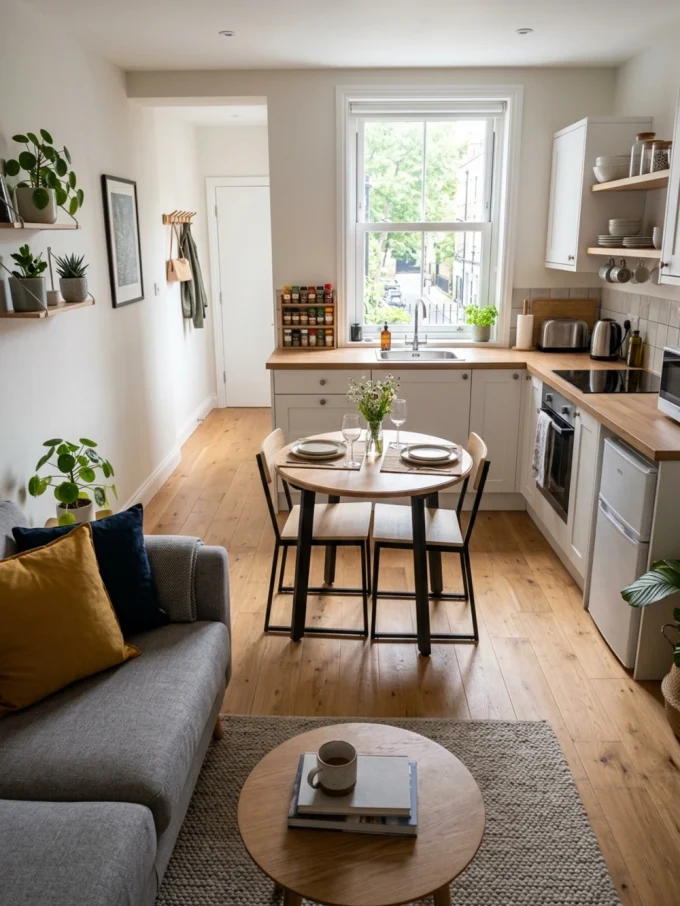
You don’t necessarily need a traditional four-seat dining table.
A round bistro table, wall-mounted drop-leaf table, narrow rectangular table, or compact banquette can provide a proper eating area without consuming the center of the apartment.
Round tables are especially useful where circulation is tight because they eliminate sharp corners.
If your kitchen opens directly into the main living area, a small dining zone can also help transition between the kitchen and living room.
For another compact eating-space approach, see these best breakfast nook ideas.
13. Turn an Awkward Corner Into a Workstation
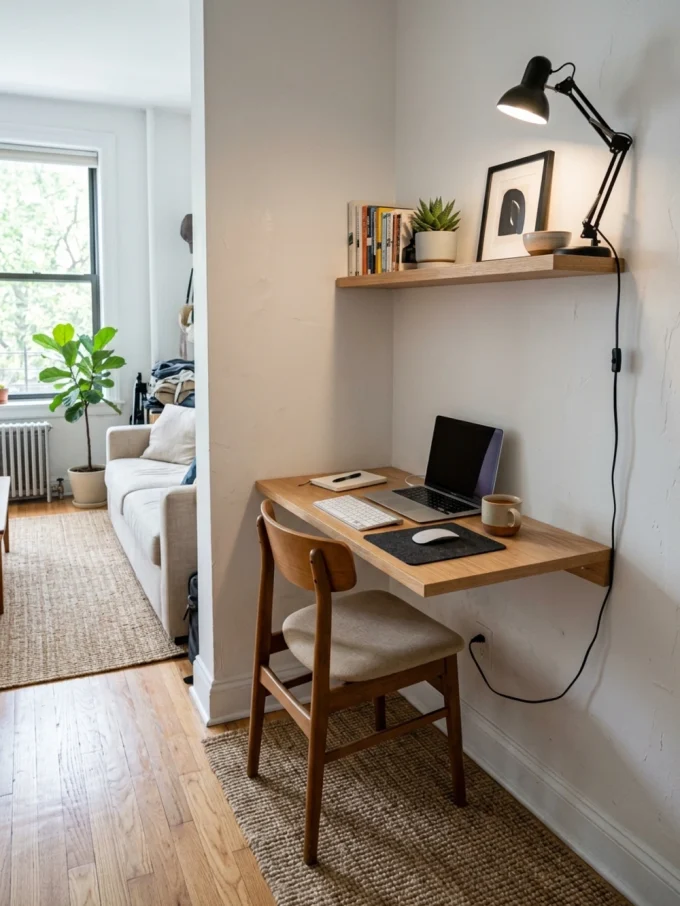
A studio often has one awkward corner that doesn’t seem large enough for anything useful.
That can be the perfect location for a compact desk.
Choose a narrow desk or floating work surface and pair it with a chair that can slide completely underneath when you’re finished.
Use wall-mounted shelves above the desk rather than a bulky cabinet beside it.
If the workspace is visible from the living area, treat it as part of the decor. A simple lamp, framed print, and restrained accessories can make it look intentional rather than like an office dropped into the bedroom.
14. Layer Lighting Instead of Relying on One Ceiling Fixture
One ceiling light rarely creates the best atmosphere in a studio.
Use several smaller sources at different heights:
- A floor lamp beside the sofa
- A table lamp on a console
- Bedside sconces
- Under-cabinet kitchen lighting
- A small pendant over the dining area
This creates separate pools of light that reinforce your different zones.
Warm, layered lighting can also make the apartment feel more sophisticated at night. Wall-mounted fixtures are particularly useful because they provide light without taking up valuable surface space.
For more options, explore these indoor wall mounted light fixture ideas.
Avoid: Filling the studio with bright, identical overhead lighting. It can flatten the room and make every zone feel like the same space.
15. Use the TV Wall as a Designed Feature
A television doesn’t have to become the visual centerpiece of your studio.
Mounting the TV can free up floor space, while a slim console underneath can provide storage without creating a bulky media unit.
You can also use a textured wall, wood paneling, paint, or carefully selected artwork to integrate the television into the room.
If the TV is visible from the bed, sofa, and kitchen, keeping its surrounding design restrained will prevent it from dominating the entire apartment.
See these beautiful TV wall ideas for ways to make the media area feel more intentional.
16. Choose Curtains That Reach Close to the Ceiling
Short curtains can visually emphasize the limited height of a studio.
Instead, hang curtains higher and allow them to fall close to the floor. This draws the eye upward and gives the room a taller, more finished appearance.
Choose a fabric that works with the rest of your palette rather than introducing another strong pattern.
If privacy is important, use a sheer layer beneath a heavier curtain so you can control daylight without making the window feel heavy.
Small detail, big effect: Keep the curtain line clean. Excess fabric pooling dramatically on the floor can be impractical in a compact apartment.
17. Use One Strong Wall Instead of Decorating Every Wall
Small spaces don’t need decoration on every available surface.
One carefully chosen feature wall can give the studio personality without creating visual noise.
Try:
- A muted paint color
- Subtle wall texture
- Removable wallpaper
- Large-scale artwork
- Vertical wood detailing
- A gallery arrangement
The key is scale. Several tiny pieces can look busier than one larger artwork.
For more inspiration, explore these wall texture design ideas.
You can also adapt ideas from these unique bedroom feature wall ideas when defining the sleeping zone.
18. Keep the Kitchen Visually Connected
When the kitchen occupies one edge of the studio, it should feel like part of the overall design rather than a separate room.
Repeat one or two materials or colors from the living area.
For example, if you have warm wood furniture, introduce a similar wood tone through kitchen accessories or shelving. If your living area uses black accents, repeat that finish in cabinet hardware or lighting.
Open kitchens benefit particularly from this approach because the kitchen remains visible from the rest of the apartment.
For more inspiration on connecting cooking and living areas, see these open kitchen design ideas.
Avoid: Adding too many countertop appliances or decorative objects. In a studio, visible kitchen clutter quickly becomes whole-room clutter.
19. Add Personality With a Few Oversized Pieces
Decorating a studio doesn’t mean everything needs to be miniature.
In fact, designers increasingly recommend being selective with scale rather than filling small spaces with lots of tiny objects. Recent small-space advice emphasizes that larger, more intentional elements can create a stronger sense of cohesion than collections of small accessories.
Try one oversized piece of art, a substantial mirror, a distinctive pendant, or a generously sized rug.
Then keep the surrounding accessories simple.
This gives the apartment a focal point without requiring a large collection of decor.
20. Make Every Surface Work Harder
In a studio, horizontal surfaces disappear quickly.
The kitchen counter becomes a drop zone. The dining table becomes a desk. The bedside table collects chargers, books, and glasses.
Instead of adding more furniture, control those surfaces.
Use trays to group small objects, baskets for loose items, wall hooks for everyday essentials, and closed storage for things you don’t need to see.
This is where restraint matters.
A studio can feel messy even when it has enough storage if every surface is constantly occupied.
If you need help deciding what belongs in the apartment, use these home decor items as a starting point, but choose only pieces that serve your space.
21. Finish With a Small, Edited Collection of Decor
The final layer should make the apartment feel like home, not like a showroom.
Add a few things that reveal personality: artwork you genuinely like, a plant, books, ceramics, a textured throw, photographs, or one unusual vintage piece.
Then stop.
One of the biggest studio decorating mistakes is continuing to add accessories because an empty corner feels unfinished. In reality, some negative space is useful. It gives the eye somewhere to rest and makes the pieces you have chosen more noticeable.
Think of the final edit as part of the design.
Keep what adds function, character, texture, or meaning. Remove what only fills space.
That principle is especially important in a studio because the limited footprint makes unnecessary purchases much more visible.
How to Make a Studio Apartment Feel Bigger Without Making It Boring
Making a studio feel larger doesn’t mean covering everything in white and buying the smallest furniture you can find.
Instead, focus on visual continuity and breathing room.
Use a consistent color palette, keep major walking paths clear, choose furniture that fits the proportions of the room, and use mirrors or reflective surfaces where they can actually reflect light.
You can also use darker colors successfully when they’re applied deliberately. Recent designer guidance suggests that using a deeper shade across connected surfaces can sometimes blur boundaries and create more visual depth rather than automatically making a small room feel closed in.
The bigger goal is not to trick the eye into thinking your studio is huge.
It is to make the available space feel calm, coherent, and intentional.
Common Studio Apartment Decorating Mistakes to Avoid
Even good decorating ideas can fail when they’re used without considering the layout.
Buying Furniture Before Measuring
A beautiful sofa that blocks the main walkway is still the wrong sofa.
Measure doorways, walls, furniture depth, and circulation paths before buying large pieces.
Using Too Many Tiny Pieces
Small art, tiny rugs, miniature furniture, and dozens of accessories can make the room feel fragmented.
Use fewer, stronger pieces instead.
Blocking Natural Light
Tall shelving or furniture placed directly in front of the main window can make the entire studio feel darker.
Creating Too Many Visual Zones
Zoning is useful, but every zone doesn’t need its own color, rug, lighting style, and furniture collection.
The apartment still needs to read as one home.
Ignoring Hidden Storage
Open shelving looks attractive when edited carefully, but not everything needs to be displayed.
Use baskets, drawers, cabinets, and under-bed storage to keep everyday clutter out of sight.
Decorating for Photographs Instead of Daily Life
A studio has to work when you’re cooking, sleeping, working, getting dressed, and having guests over.
The prettiest arrangement isn’t useful if you have to move furniture every day.
For a broader checklist, see these home decor mistakes to avoid.
Frequently Asked Questions About Studio Apartment Decor
How Can I Decorate My Studio Apartment Without Making It Look Cluttered?
Start with the layout rather than the accessories. Define sleeping, living, dining, and working zones, then choose furniture that fits those functions. Keep the color palette controlled, use closed storage for everyday clutter, and leave some open space around major furniture pieces.
How Do You Make a Studio Apartment Look Expensive?
Focus on proportion, lighting, materials, and restraint rather than buying expensive decor. A well-sized rug, attractive lighting, quality-looking textiles, a substantial mirror, and a cohesive color palette can make a studio feel more refined without filling it with expensive objects.
What Furniture Is Best for a Studio Apartment?
Prioritize furniture that fits the room while serving more than one useful purpose. Storage ottomans, beds with drawers, narrow consoles, compact dining tables, floating desks, and slim shelving can work particularly well.
How Do You Separate a Bedroom From a Living Room in a Studio?
Use a curtain, open bookcase, folding screen, slatted divider, sofa placement, or area rug. The best option depends on how much privacy you need and whether you want to preserve natural light.
What Colors Make a Studio Apartment Look Bigger?
Light, cohesive colors can help create an open feeling, but you aren’t limited to white or beige. A controlled palette of warm neutrals, muted colors, or even deeper shades can work when the colors flow consistently through the apartment.
Should a Studio Apartment Have More Than One Rug?
It can. Separate rugs can help establish the living and sleeping zones, but they should relate through color, texture, or pattern. Too many small rugs can make the floor feel visually fragmented.
How Do I Add Storage Without Making My Studio Feel Smaller?
Use vertical storage, under-bed drawers, wall-mounted shelving, multifunctional furniture, and closed cabinets. Keeping some storage visually concealed is particularly useful for maintaining a calm appearance.
What Is the Best Way to Decorate a Very Small Studio Apartment?
Start by measuring the space and defining the activities that need to happen there. Then prioritize essential furniture, create clear zones, protect natural light, use vertical storage, and add decor gradually. A very small studio usually benefits more from careful editing than from adding more furniture.
Final Thoughts
The best studio apartment decor ideas don’t try to hide the fact that the space is small.
They work with it.
A well-placed sofa can define a living area. A rug can create a bedroom boundary. A mirror can bring more light into a dark corner. A narrow console can add storage without consuming the room. And the right lighting can make the entire apartment feel warmer after sunset.
The real difference comes from making deliberate choices.
Give every major piece a purpose, let the zones connect visually, protect your walking space, and edit your decor before the apartment starts to feel crowded.
When those decisions work together, even a compact studio can feel stylish, comfortable, and genuinely yours.