

A bedroom can contain pale oak, cream bedding, a beautifully simple nightstand, and almost nothing else—and still feel cold.
That is the difficult part of Japandi.
The style is commonly described as a meeting of Japanese restraint and Scandinavian comfort, with natural materials, streamlined furniture, quieter palettes, and an emphasis on uncluttered space. Current bedroom guidance continues to emphasize timber, tactile bedding, restrained furniture, and filtered light as important ingredients.
But ingredients do not make the room.
What makes Japandi convincing is the relationship between them: rough against smooth, pale against dark, straight lines beside softer forms, clear surfaces beside objects that genuinely deserve to remain.
And for a bedroom to feel cozy, warmth needs to exist where you actually experience it—underfoot, against the skin, beside the bed, and in the light you use after sunset.
These 19 cozy Japandi bedroom ideas focus on those decisions rather than simply adding more decor.
1. Start With a Warm Neutral That Changes Gracefully With the Light
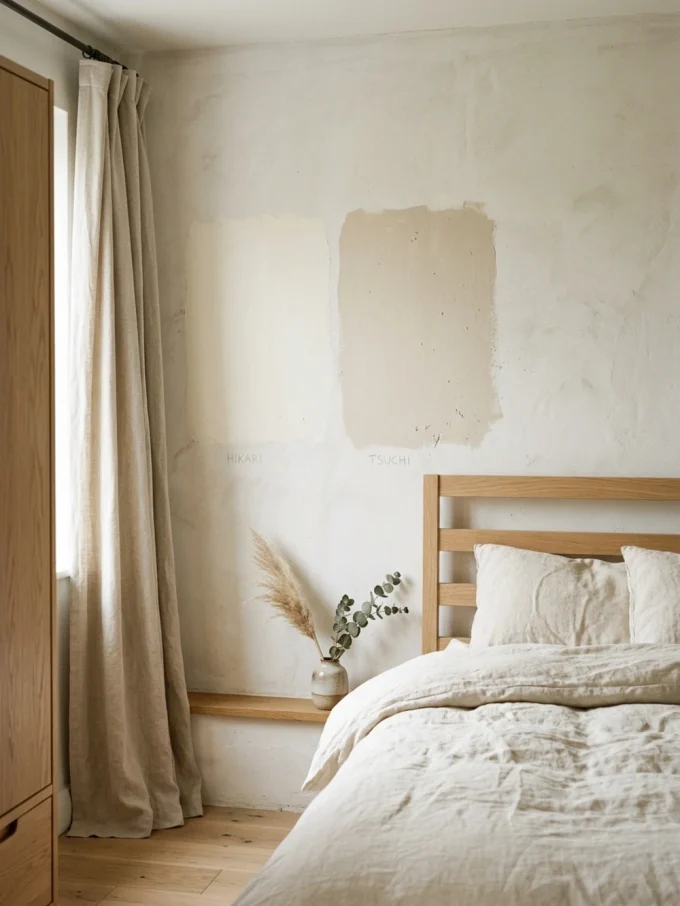
Pure white is not compulsory.
In fact, a stark white wall can make pale timber and cream bedding look surprisingly flat, particularly in a bedroom with weak daylight or cool artificial lighting.
Try warmer backgrounds such as soft ivory, mushroom, oatmeal, putty, pale taupe, or a restrained clay-tinted neutral. These shades provide enough temperature to support timber and natural textiles without demanding attention themselves.
The important step happens before you paint the entire room.
Put a sample beside the actual flooring, curtains, wardrobe, headboard, and bedding. Then look again in the evening.
Paint is affected by everything around it. A neutral that looks beautifully warm in a sunlit photograph may become gray in a north-facing room or yellow beside honey-toned flooring.
Do not choose the wall color in isolation.
If the bedroom already has a difficult existing finish, solve that relationship first. The prettiest paint chip will not rescue a palette whose largest surfaces disagree.
2. Let Wood Do More of the Warming Than Decor
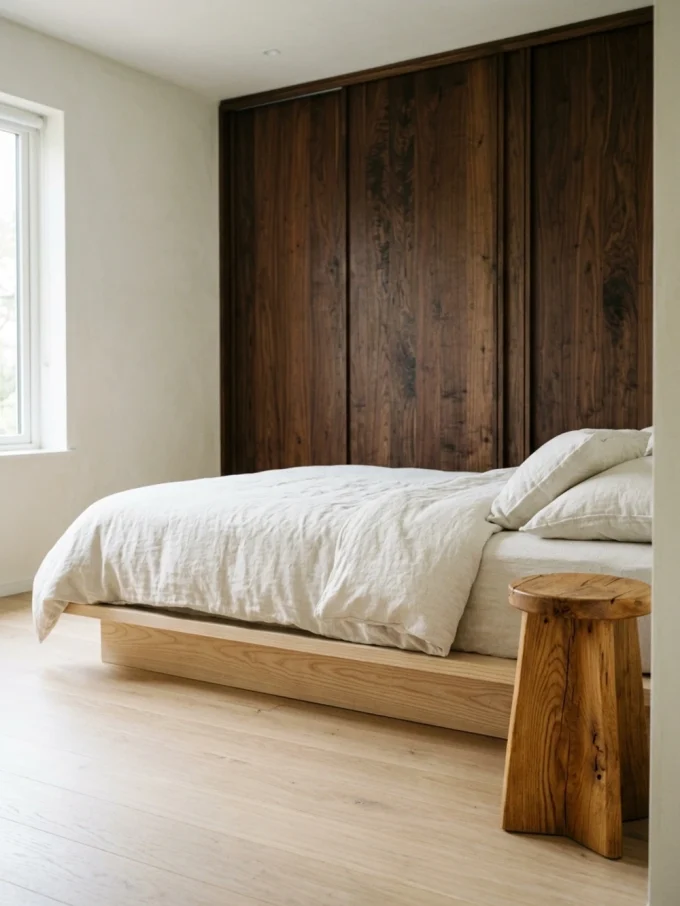
Natural timber gives a restrained room both color and visible texture without adding pattern.
That makes it particularly valuable in Japandi interiors.
But avoid translating “natural wood” into “buy an entire matching bedroom suite.”
Start by identifying the largest existing wood surface. It may be the floor, bed, wardrobe, or built-in cabinetry. Treat that as the dominant direction and choose additional pieces that relate to it.
They do not need to be identical.
A pale oak bed can sit beside a slightly deeper timber stool. Walnut can add useful weight to a bedroom dominated by lighter finishes. Small variations in grain and tone often feel more natural than perfect matching.
Problems usually start when several unrelated undertones compete: orange flooring, gray-washed drawers, red timber, yellow oak, and very dark walnut all fighting in the same compact room.
You do not need one wood species.
You need a visual relationship.
3. Choose a Low Bed for Proportion, Not Because Japandi “Requires” One
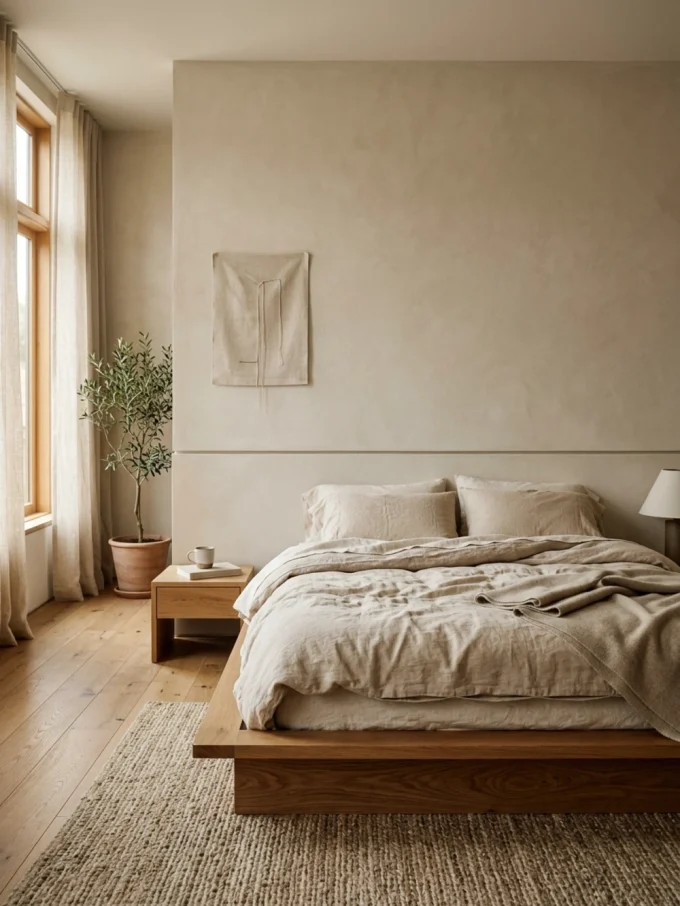
Low platform beds appear so often in Japandi rooms that they can look like an entry requirement.
They are not.
A lower bed exposes more wall and reduces the visual mass occupying the center of the bedroom. That horizontal emphasis can feel particularly calm in a room with simple architecture.
But proportion is only part of the decision.
Can you sit down and stand comfortably? Do you depend on storage below the bed? Does the mattress need a particular support system? Will the lower height make the bedside furniture awkward?
A slightly lower conventional bed may give you much of the visual effect without sacrificing useful storage or comfort.
The strongest Japandi choice is rarely the most extreme version of an idea.
It is the version that still makes sense at 7 a.m. on an ordinary Tuesday.
4. Make the Bed the Softest Surface in the Room
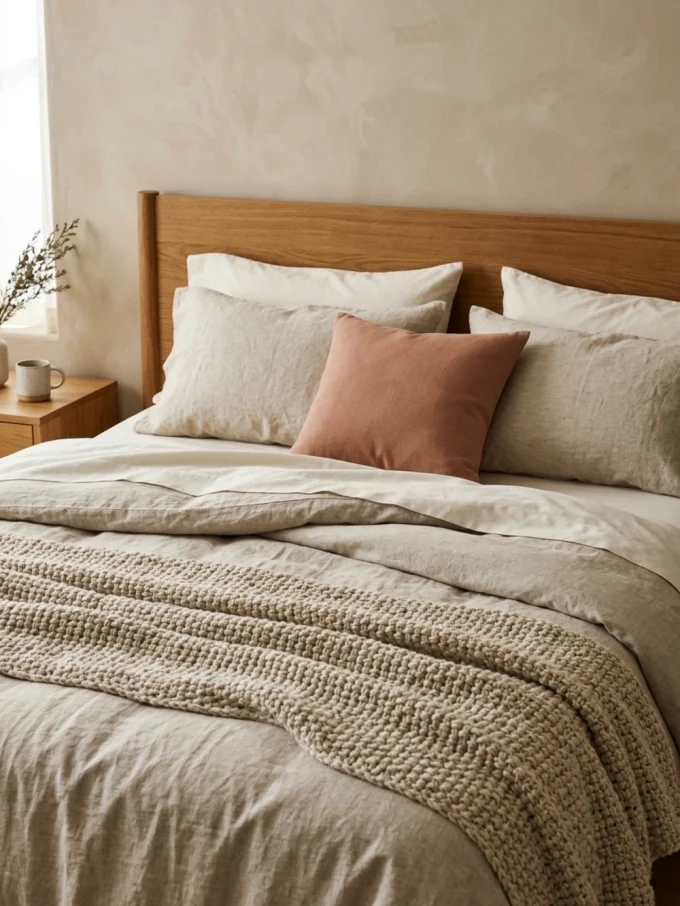
When most of the bedroom is wood, painted plaster, glass, ceramic, and uncluttered furniture, the bed has to carry a large share of the softness.
Fortunately, this does not require a mountain of decorative cushions.
Start with the textiles you touch.
A relaxed linen or cotton duvet, smooth sheets, useful pillows, and one blanket with a visibly different weave can create considerably more tactile depth than an elaborate arrangement that has to be dismantled every evening.
Keep the palette relatively controlled while allowing the surfaces to change.
Cream cotton, flax-colored linen, an oatmeal woven blanket, and perhaps one muted clay or olive cushion can all sit together without the bed looking busy.
The distinction matters.
In a cozy Japandi bedroom, texture provides richness that pattern and decoration would provide in a more layered interior.
The room stays restrained, but the bed does not feel unfinished.
5. Use a Rug to Connect the Bed to the Room
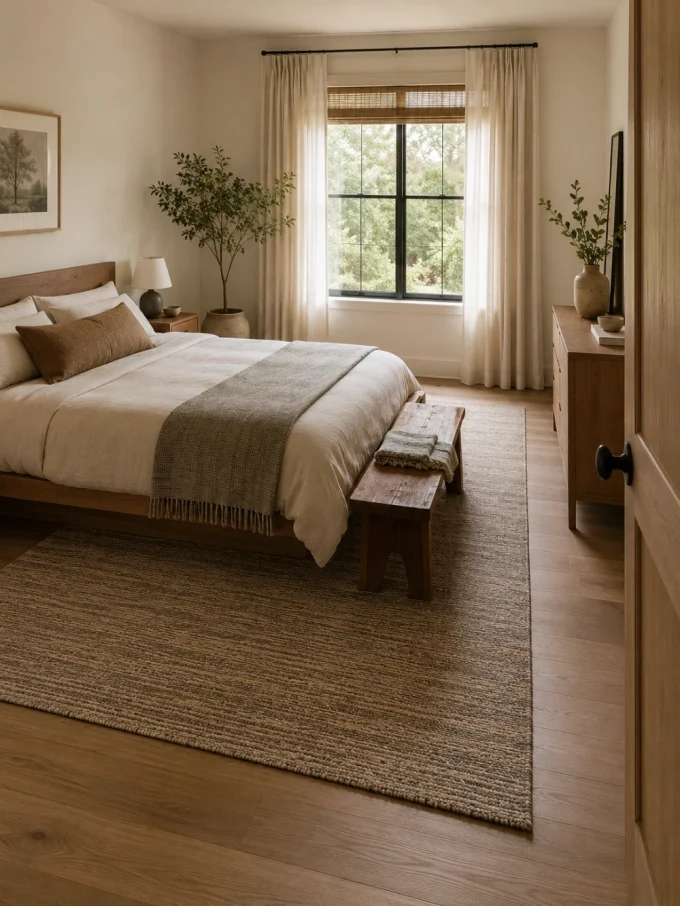
Hard flooring can make a minimalist bedroom look clean while making it feel less comfortable the moment bare feet hit the floor.
A rug changes that physical experience immediately.
It also changes how the furniture reads.
When enough of the bed and nearby furniture relate to one rug, those objects begin to feel like one sleeping zone rather than separate pieces floating around the room.
Do not automatically assume bigger is always better, though.
Check the bedroom door, wardrobe clearance, floor vents, dresser drawers, and cleaning access before choosing the rug dimensions.
Material matters too.
A deep plush rug may feel wonderful but collect pet hair and require considerably more upkeep. A flatter wool or woven rug may create enough softness while remaining easier to live with.
The best rug is not simply the one that photographs well beneath the bed.
It is the one you still appreciate when it needs cleaning.
6. Give One Wall Enough Texture to Carry the Room
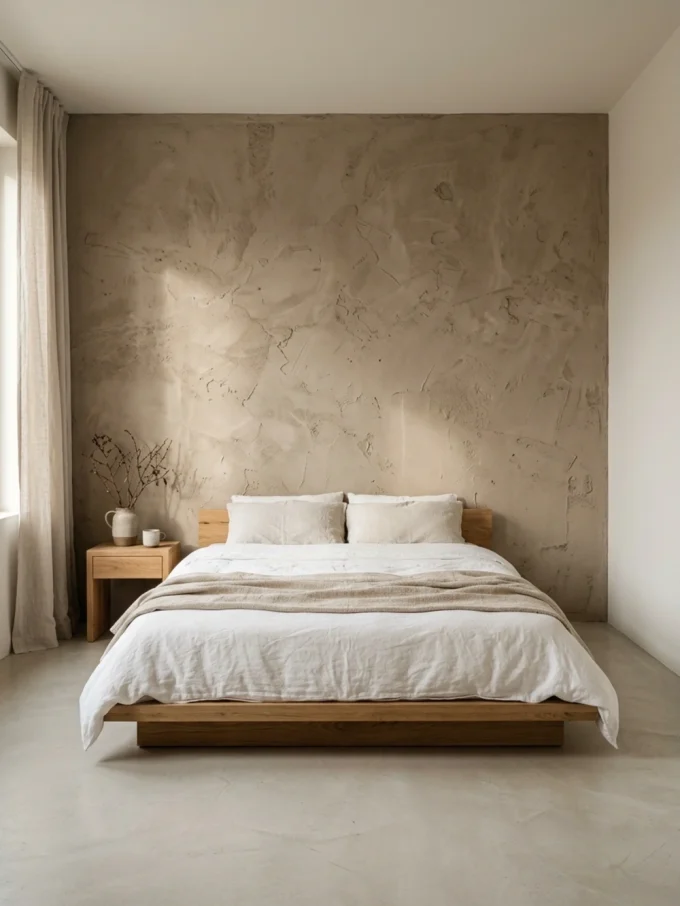
A quiet palette becomes much more interesting when light has something to move across.
That is where texture earns its place.
Instead of adding multiple decorative colors, consider introducing depth through a plaster-like finish, subtle wallpaper, timber treatment, woven panel, or restrained dimensional surface.
The wall behind the bed is often the logical place because it can establish a focal plane without needing several competing artworks.
For more ways to use surface depth intentionally, explore these wall texture design ideas.
The key word is one.
If the headboard is heavily textured, the wall is slatted, the rug is shaggy, the bedding is heavily woven, the curtains are visibly nubby, and every accessory has an irregular finish, texture stops feeling quiet.
Japandi restraint applies to surfaces too.
Choose where you want the eye to notice material, then let the surrounding areas become calmer.
7. Build the Lighting Around What the Bedroom Feels Like at Night
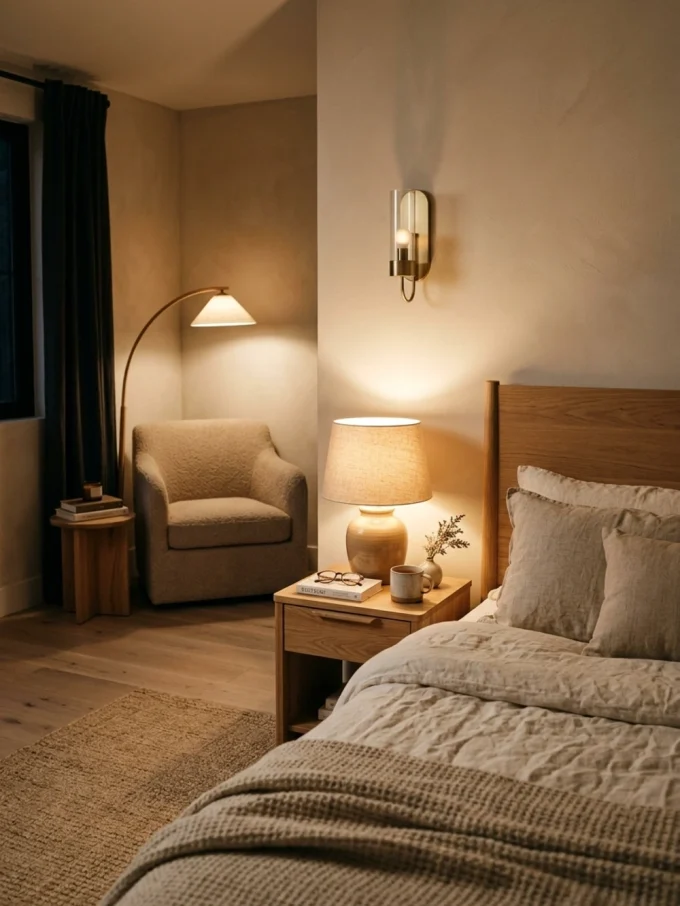
A bedroom designed only in daylight is only half designed.
One bright ceiling fixture can flatten warm materials and make a carefully restrained space feel surprisingly hard after sunset.
Bring some of the light closer to where it is actually used.
A bedside lamp can create a soft pool around the bed. Wall sconces can free a narrow nightstand. A small floor lamp can make a reading corner usable without flooding the entire bedroom with light.
Current expert bedroom guidance also favors layered, softer lighting rather than relying exclusively on strong overhead illumination.
If the nightstands are small, browse these wall sconce light fixture ideas before automatically placing lamps on both sides.
Consider the view from the pillow as well.
A fixture may look sculptural from the doorway and expose an uncomfortable bulb directly to someone lying in bed.
Coziness is partly about what the room stops doing to you.
Glare is a good place to start.
8. Filter Daylight Instead of Blocking It All Day
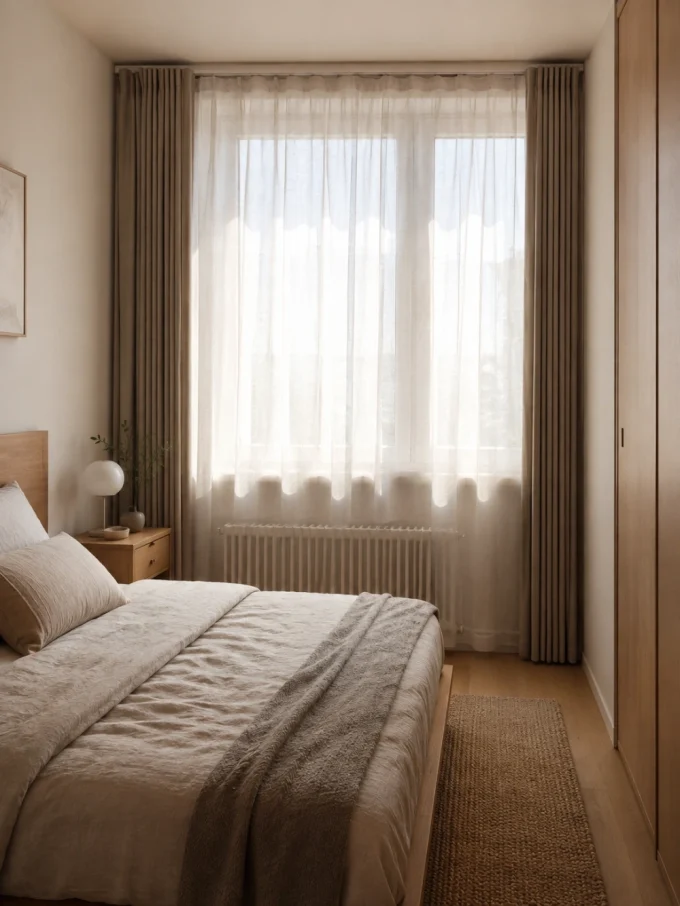
Bare windows can look suitably minimal but give you little control over glare and privacy.
Heavy curtains solve those problems but can make a compact bedroom feel visually dense.
Layering gives you more flexibility.
A lighter inner treatment can soften strong daylight and create daytime privacy, while a more opaque layer handles darkness when needed. Japanese-inspired bedroom guidance published in 2026 similarly recommends combining a light-filtering treatment with a blackout layer rather than asking one window covering to do everything.
Pay attention to how much fabric collects beside the window when the curtains are open.
In a narrow bedroom, bulky stacks of material can crowd a wardrobe, radiator, nightstand, or the window itself.
Japandi window treatments should make light easier to live with.
They do not need to become the main event.
9. Build Storage for the Things Minimalist Photographs Remove
Bedrooms collect ordinary things.
Chargers. Glasses. Medication. Books. Hand cream. Clothes that have been worn once. Spare bedding. Laundry. Bags. Headphones.
If those things have nowhere sensible to go, the room has two possible futures: visible clutter or constant tidying.
Neither is particularly restful.
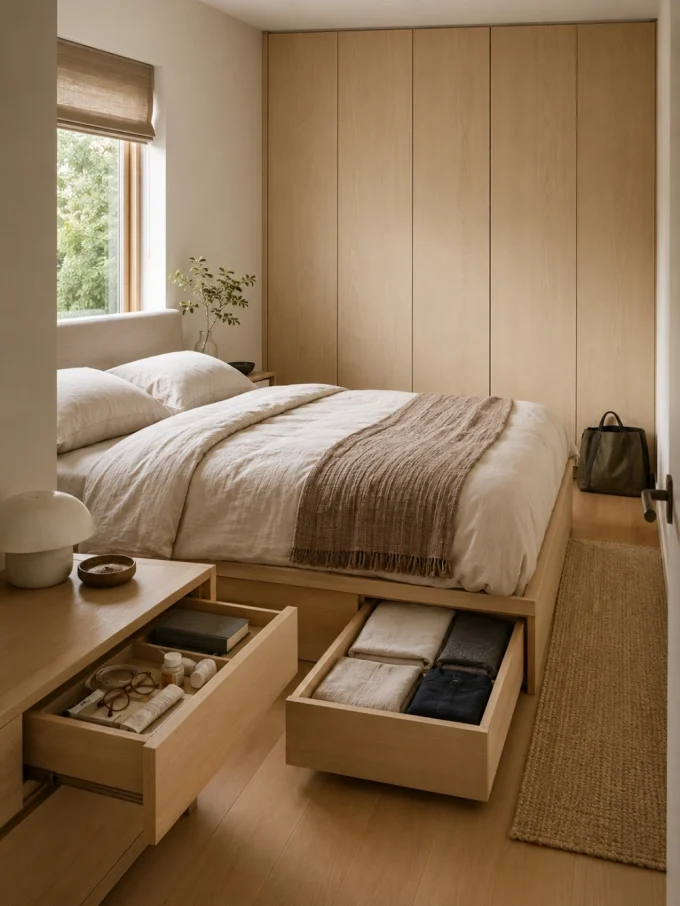
This is why concealed storage is more important to a Japandi bedroom than the sparse photographs may suggest.
A nightstand with one useful drawer may serve you better than a beautiful open stool. A plain-front wardrobe can hold a tremendous amount while remaining visually quiet. Under-bed storage may be worth keeping in a small room even if an open platform looks lighter.
If clothing is the main pressure point, these modern wardrobe design ideas can help you think through a storage wall before buying more freestanding furniture.
Good storage protects minimalism.
Without it, empty surfaces are difficult to maintain.
10. Use Negative Space Where the Eye Can Appreciate It
Negative space does not mean deliberately leaving useful areas empty.
You do not need to remove the nightstand you use every night simply to make the bedroom “more Japandi.”
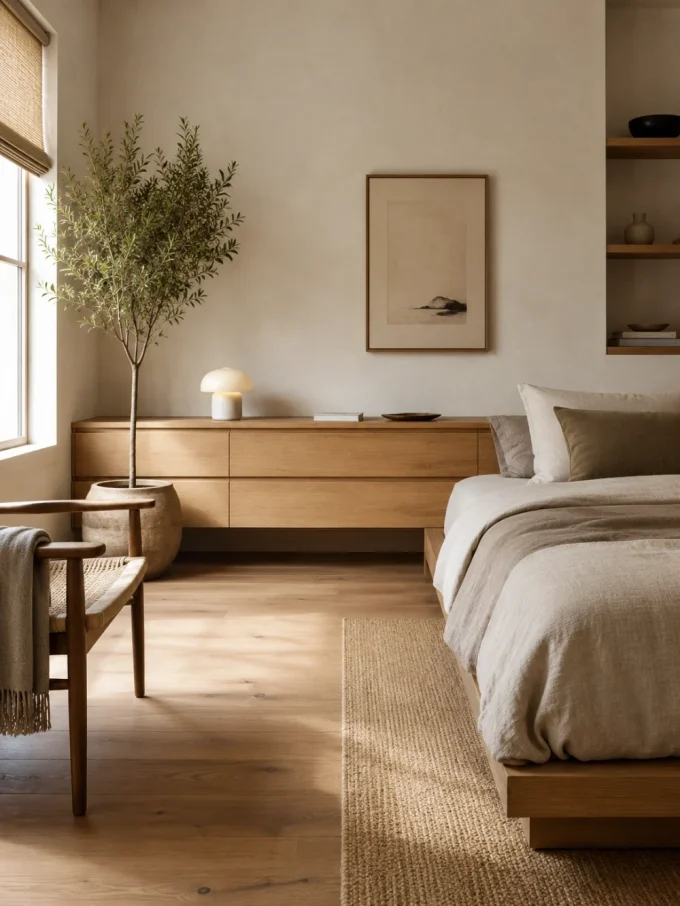
Instead, create breathing room in visible places.
Leave part of the dresser top uncovered.
Give a piece of artwork enough wall around it.
Do not push a basket into every furniture gap.
Allow some floor between the bed and a chair instead of occupying the last available square foot.
Keep one side of a shelf quiet.
The difference is subtle but important.
A room with functional furniture and edited surfaces can feel considerably calmer than a room with fewer pieces but poor storage.
Negative space works because it gives objects visual separation.
Once every surface and corner contains something, even attractive objects begin to merge into visual noise.
11. Ground a Pale Bedroom With One Darker Note
An entirely pale room can lose definition.
Cream wall. Pale oak bed. Beige rug. Oatmeal duvet. Light curtains. Sand-colored lamp.
Nothing is necessarily wrong, but nothing has enough visual weight to sharpen the composition either.
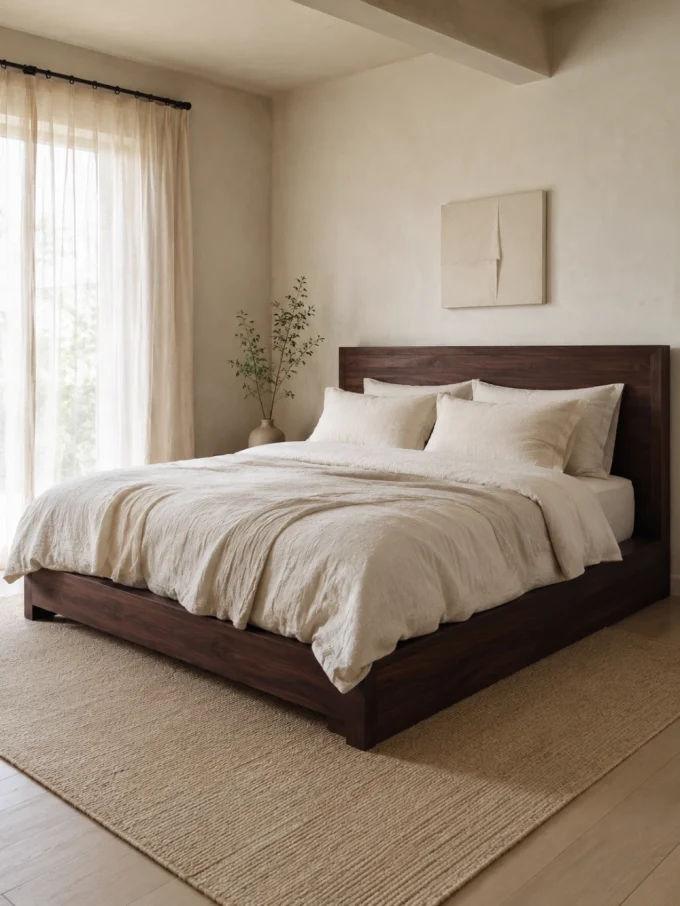
Try one darker anchor.
Walnut bedside furniture, charcoal linen, a dark ceramic lamp, black picture framing, smoked timber, or a muted deep-brown bench can all provide contrast.
You do not need to distribute small black accessories throughout the bedroom.
One meaningful dark element usually looks more deliberate than six tiny ones.
This is also a useful way to make softer materials appear softer.
Put cream linen against a dark wood frame and the difference in texture and value becomes much easier to see.
Contrast does not make Japandi less calm.
Used carefully, it prevents calm from becoming washed out.
12. Break Up Straight Lines With One Softer Shape
Japandi furniture tends to favor clean silhouettes, but a bedroom made entirely from hard rectangles can start to feel overly architectural.
Bed.
Wardrobe.
Nightstands.
Window.
Rug.
Artwork.
Another rectangle.
Introduce softness without turning the room decorative.
A rounded mirror, slightly curved headboard, cylindrical lamp, oval stool, rounded ceramic vessel, or gently irregular shade is often enough.
The purpose is not to create a “curved furniture trend.”
It is to interrupt the repetition of straight edges.
Place the softer shape where it can actually be noticed rather than scattering rounded objects throughout the bedroom.
One confident curve against several quieter straight lines usually creates more impact than an entire collection.
13. Let Handmade Objects Add Variation That Factory-Matched Decor Cannot
The quickest way to make a neutral room look generic is to buy every accessory from the same coordinated collection.
Instead, choose a small number of objects whose surfaces contain subtle irregularity.
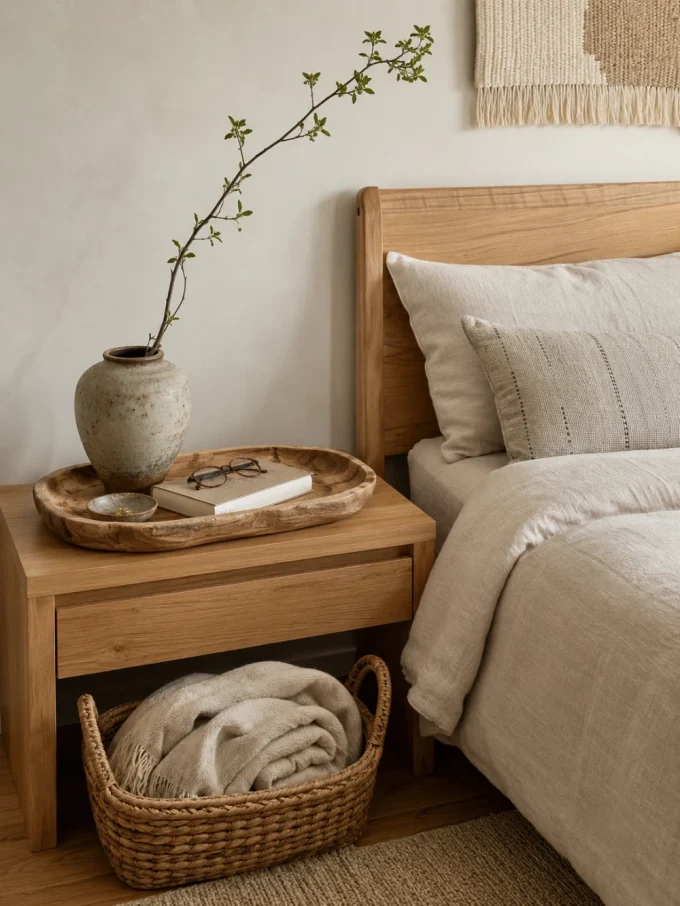
A hand-thrown ceramic vessel, woven basket, carved timber tray, linen shade, or restrained fiber artwork introduces changes in grain, edge, and texture without needing bright color.
If fiber art suits the wall, some of these DIY macrame wall hanging ideas can be adapted into simpler pieces with more open space and less fringe.
Do not add handmade-looking objects simply to prove that the bedroom is “organic.”
They still need jobs.
A ceramic vessel can hold one branch. A basket can conceal an extra blanket. A shallow tray can prevent bedside essentials from spreading across the nightstand.
Character becomes more convincing when it is useful.
14. Bring in Nature Without Filling the Bedroom With Plants
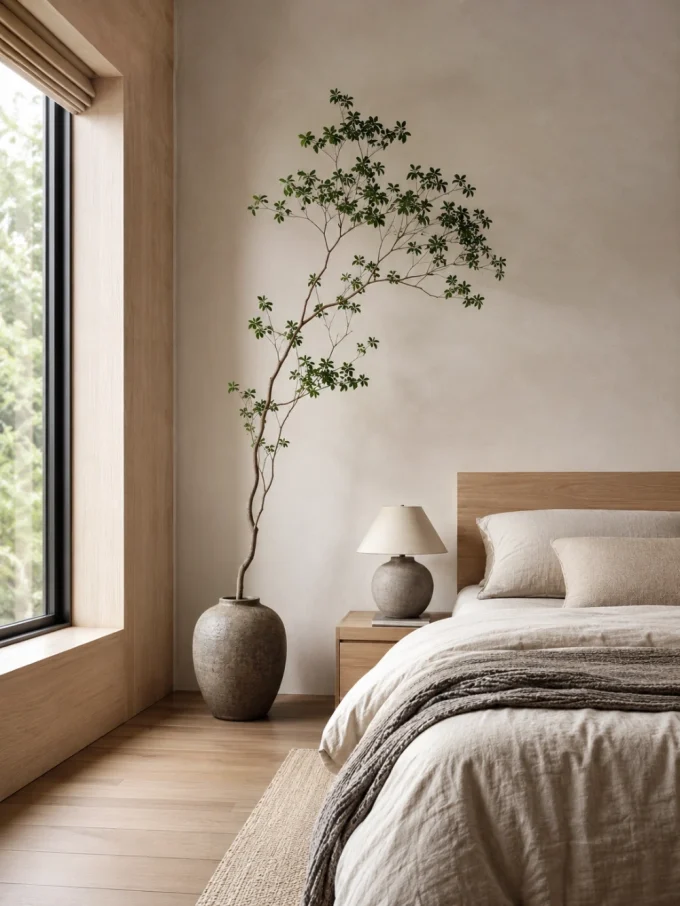
One plant can provide something a neutral bedroom otherwise lacks: living color and an irregular silhouette.
Five plants can become another maintenance system.
Choose based on the actual conditions in the bedroom rather than the photograph you are trying to reproduce.
Consider daylight, available floor area, pets, watering access, and whether a large pot will interrupt circulation.
If the room receives poor light or living plants are impractical, a branch in a simple vessel can provide similar visual movement without turning the bedroom into a collection of pots.
The objective is not “add greenery.”
It is to introduce one natural element that interrupts all the manufactured geometry around it.
And there is no requirement that every Japandi bedroom contain a plant.
A good room does not fail because you left one Pinterest ingredient out.
15. Position a Mirror According to What It Will Reflect
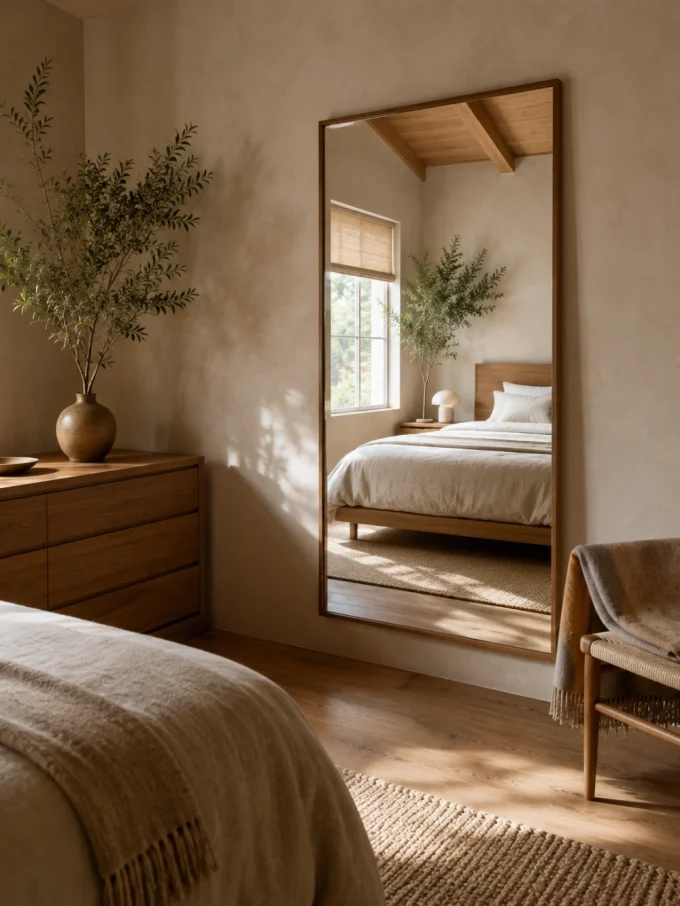
A mirror should be chosen with the room behind you in mind.
Stand where the mirror will go and look toward the future reflection.
Does that direction contain a window, attractive timber, soft bedding, or another calm surface?
Good.
Does it contain an open wardrobe, exercise equipment, laundry pile, or the bedroom door leading into a busy hallway?
You may simply double the least attractive part of the room.
The shape matters much less than this decision.
A well-positioned mirror can return daylight into a darker portion of the bedroom or prevent a wall from feeling overly heavy without introducing another artwork.
For additional placement and sizing inspiration, see these contemporary bedroom mirror decor ideas.
Use a mirror to improve the view.
Not because an arch mirror appears on a Japandi checklist.
16. Make Chargers and Technology Visually Disappear
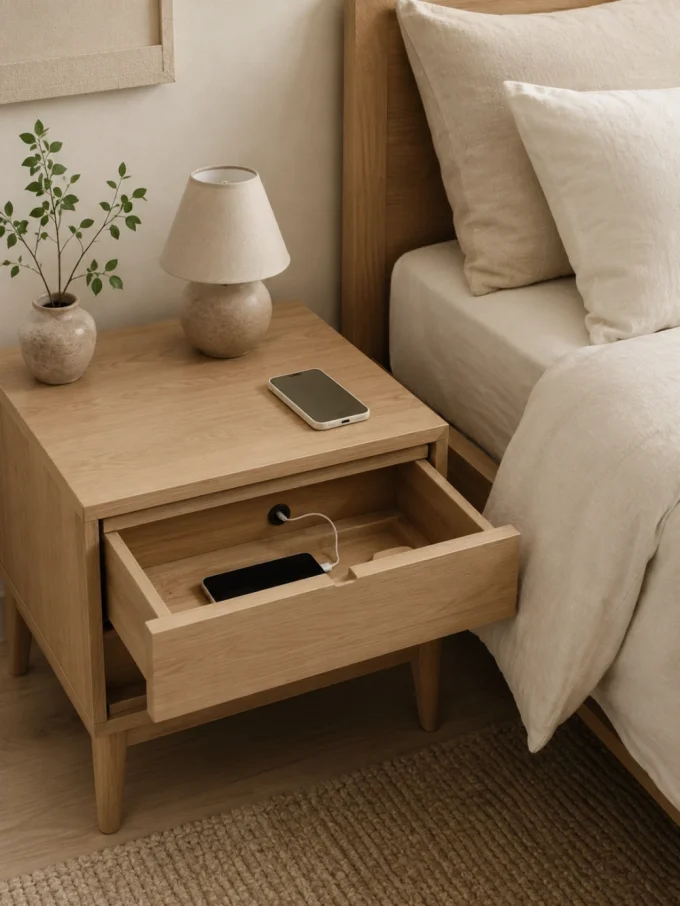
A restrained bedroom can be undone surprisingly quickly by black chargers, extension leads, phone cables, router lights, television wires, and electronic accessories spreading across pale furniture.
You do not necessarily have to remove technology.
You have to decide where it lives.
Keep charging close to the place where devices are actually used. Route cables behind furniture instead of stretching them across visible floor. Use a nightstand with a drawer or discreet cable opening if charging clutter is a recurring problem.
Avoid creating a decorative solution more complicated than the problem.
A large organizer containing six adapters is still visual clutter if all you needed was one accessible charging point.
If the television is essential, treat it as a real design constraint rather than pretending it is invisible.
Japandi works best when daily life has been considered, not edited out.
17. In a Tiny Bedroom, Fix Furniture Depth Before Styling
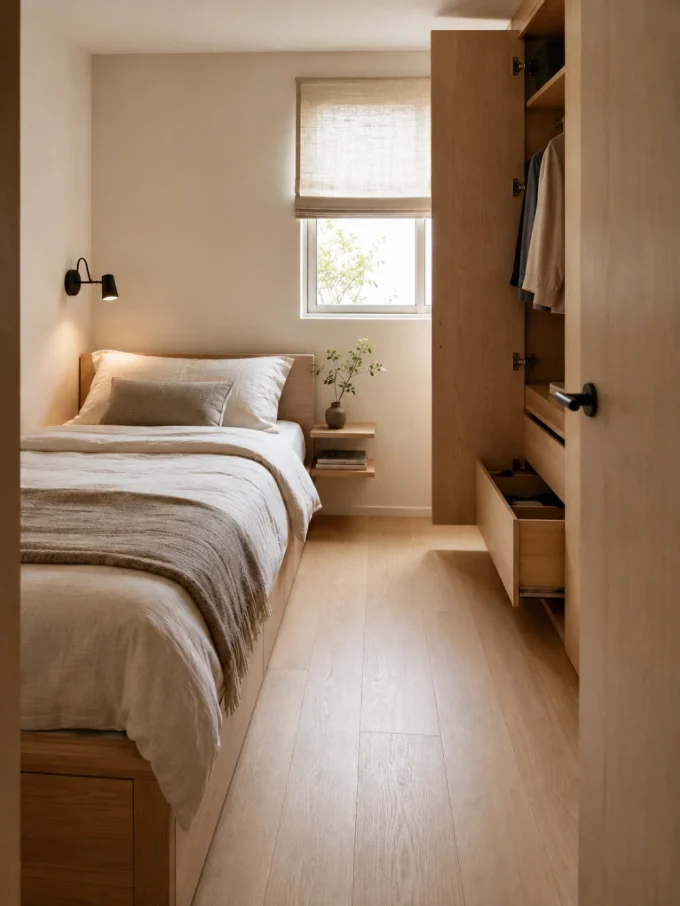
A small bedroom does not become spacious simply because the furniture is beige.
Measure the route through the room.
Can the door open properly?
Can wardrobe drawers extend?
Can you move around the bed comfortably?
Does the nightstand project farther than necessary?
Does a deep upholstered headboard consume space that would be more valuable as circulation?
These questions should come before wall art.
A shallow bedside shelf, wall-mounted light, narrower bed frame, or better wardrobe configuration can release more usable room than any visual trick.
For bedrooms where every inch matters, these tiny bedroom ideas explore compact layouts and storage decisions in more depth.
Do not shrink every piece automatically, though.
Too many tiny furniture pieces can make a small bedroom feel fragmented.
Use fewer pieces, but make sure each one performs a clear job.
18. Make Japandi Rental-Friendly by Spending on Movable Layers
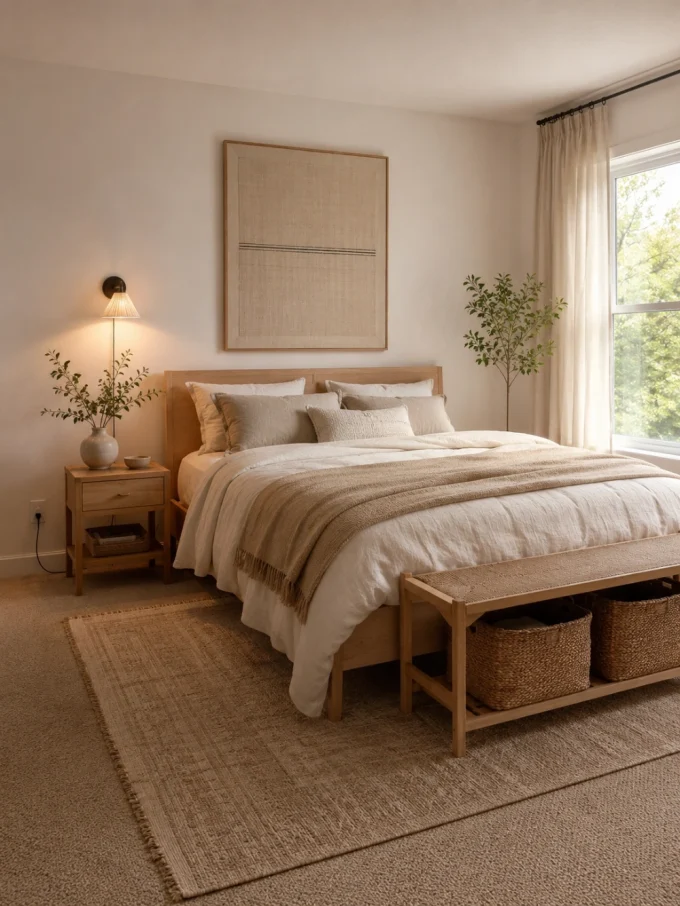
Japandi does not require permanent timber paneling or a newly plastered wall.
Renters can achieve most of the atmosphere through elements that leave with them:
bedding, curtains where permitted, a rug, lamps, portable storage, artwork, ceramics, baskets, and simple freestanding furniture.
Spend more attention on the relationships between those pieces than on disguising every landlord finish.
If the existing carpet is slightly warmer than you prefer, choose textiles that connect to it rather than filling the floor with additional layers in an attempt to hide it.
A plug-in sconce may solve bedside lighting without electrical work. A large textile or framed piece can give the bed wall visual weight without permanent paneling.
For more reversible approaches, see these rental apartment decorating ideas.
A rental restriction can actually encourage a useful Japandi principle:
make fewer, better changes.
19. Remove Something Before You Buy the Final Accessory
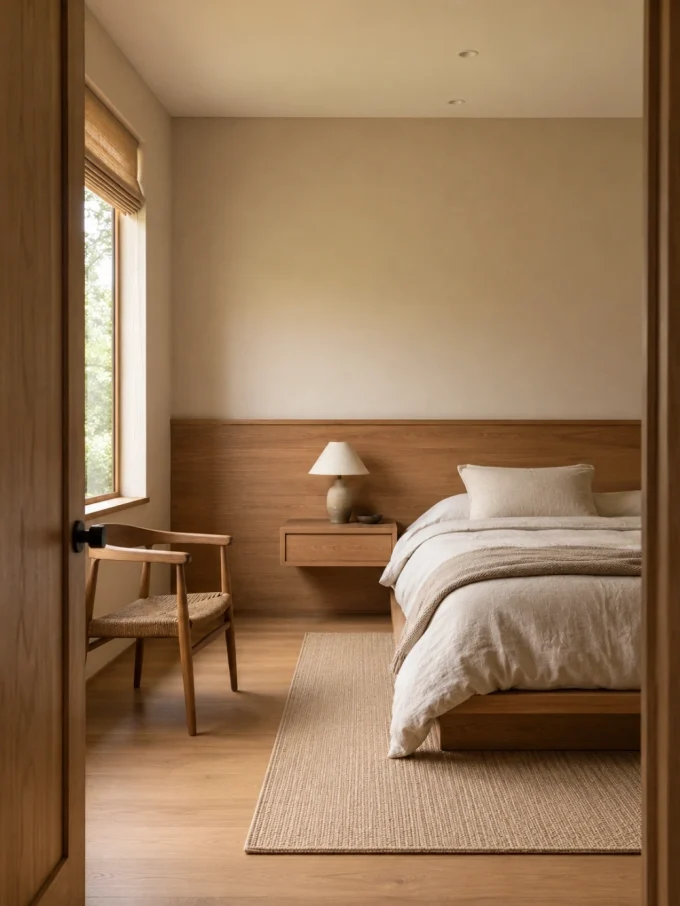
The last step is not shopping.
Stand at the bedroom door and look for repetition.
Do you have three small vases doing the work of one?
Does every surface contain an object?
Are several different wood finishes competing?
Are there decorative cushions nobody uses?
Is the wall treatment already strong enough without artwork over it?
Is a chair acting only as a permanent clothing rack?
Remove one questionable element and look again.
This is where a Japandi bedroom often starts to feel intentional.
If something still seems wrong, these home decor mistakes to avoid may help identify proportion, clutter, lighting, and placement problems before you add anything else.
The goal is not an empty bedroom.
It is a bedroom where every visible element has enough room to be understood.
And once the room feels warm, useful, and calm, stop decorating it.
What Makes a Japandi Bedroom Cozy Rather Than Cold?
The answer is not more accessories.
Warmth normally comes from the interaction between a few larger decisions:
Wood adds visual temperature.
Its grain prevents simple furniture from feeling completely flat.
Textiles add tactile softness.
The bed, rug, and curtains balance harder surfaces.
Light changes how every material is perceived.
Soft bedside illumination generally reveals texture more gently than relying on a bright ceiling fixture.
Storage removes visual friction.
A quiet room is easier to maintain when ordinary belongings have actual homes.
Contrast creates depth.
One deeper wood, ceramic, textile, or frame can stop an otherwise pale palette from disappearing.
Editing provides breathing room.
The remaining objects look more intentional because they are not fighting for attention.
That is the useful tension inside cozy Japandi design.
Keep enough restraint for the room to feel quiet, but enough material warmth that you still want to get into bed.
FAQs
Can a Japandi bedroom use dark colors?
Yes. Japandi does not have to mean an entirely pale bedroom. Walnut, charcoal, deep brown, muted olive, and other restrained darker tones can provide useful visual weight. The key is controlling their proportion so the room remains calm rather than high-contrast.
Do I need a platform bed for a Japandi bedroom?
No. A low platform bed suits the horizontal proportions associated with many Japandi interiors, but a conventional bed can work perfectly well if its shape is simple and the rest of the room remains visually restrained. Comfort, storage, and appropriate height matter more than copying a particular bed type.
What is the difference between a Japandi bedroom and a Scandinavian bedroom?
Both may use practical furniture, natural materials, and relatively simple decoration. Japandi generally introduces stronger Japanese-influenced restraint, lower visual profiles, deeper natural tones, and a greater emphasis on carefully edited objects, while Scandinavian interiors can lean lighter, brighter, and more overtly casual or cozy. In practice, contemporary interiors often overlap rather than following rigid stylistic boundaries.
How can I create a Japandi bedroom on a small budget?
Start with subtraction before replacement. Remove unnecessary surface clutter, simplify bedding colors, improve lamp placement, and reorganize visible storage. Then spend selectively on one or two changes with a large visual effect, such as a better duvet cover, bedside lamp, rug, or simple timber nightstand. A room does not need an entire matching furniture collection to communicate Japandi restraint.