
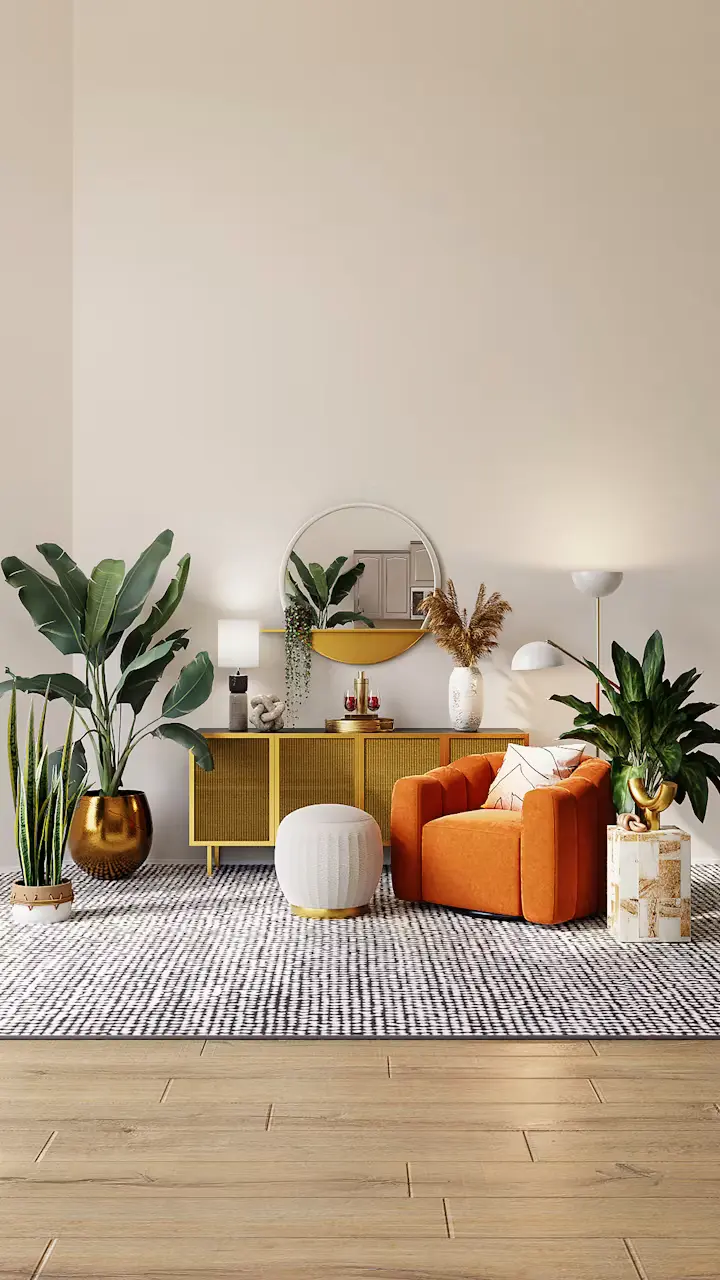
If the wardrobe door hits the bed, the problem is not your choice of throw pillows.
A genuinely tiny bedroom forces ordinary furniture to compete for the same few areas of floor. The bed wants most of one wall. A dresser wants another. The door needs somewhere to swing. Drawers need room to open. You still need a place for a phone, clothes, lighting, perhaps a laptop, and all the small things that accumulate in a bedroom because there is nowhere else for them to go.
That is why the most useful tiny bedroom ideas start with space allocation rather than visual tricks.
Current small-bedroom advice repeatedly points toward carefully edited layouts, storage, appropriately scaled furniture, wall-mounted solutions, and reduced visual interruption. Those principles are useful, but the details decide whether they work in an actual occupied room.
Here is where I would start.
1. Map the space the furniture needs to use, not just the space it occupies
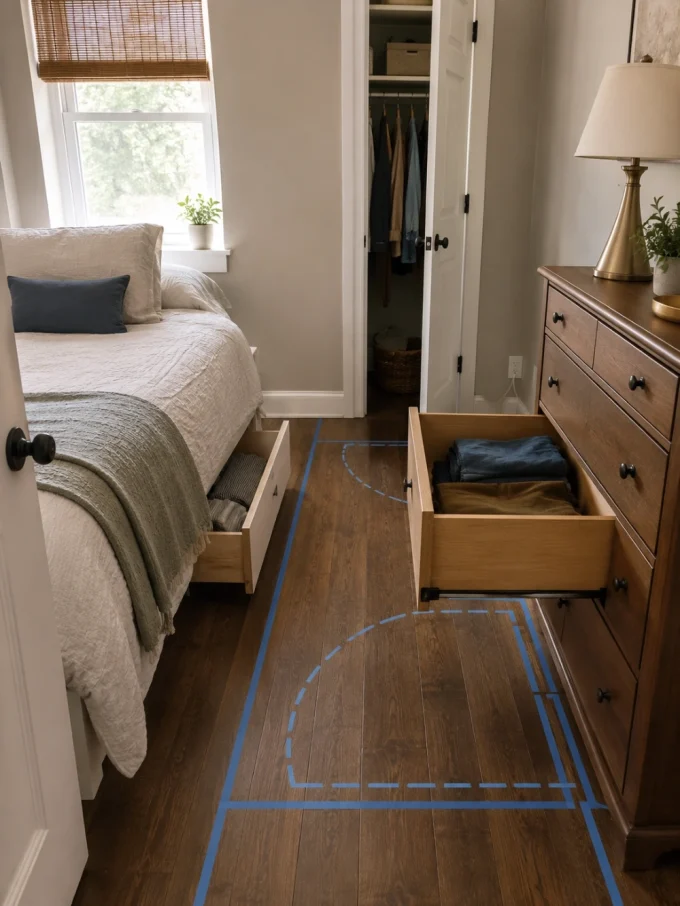
A floor plan can tell you that a dresser fits against a wall. It cannot tell you whether the drawers will open once the bed is in front of it.
That distinction matters.
Before adding anything, identify the room’s moving parts:
- bedroom door;
- wardrobe or closet door;
- drawers;
- windows;
- under-bed drawers if you have them;
- chair or stool;
- access to electrical outlets.
Then imagine those things open rather than closed.
A narrow chest may occupy little floor space but become frustrating if you must stand sideways to pull out a drawer. A beautifully fitted vanity is not useful if its stool blocks the wardrobe every morning.
Marking furniture footprints with painter’s tape before buying is crude but effective. Include the depth of an open drawer or the space occupied by a chair when someone is sitting in it.
The goal is not a room that photographs neatly when everything is shut.
It is a room that still works when somebody is using it.
2. Put the bed where circulation works, even if the layout becomes asymmetrical
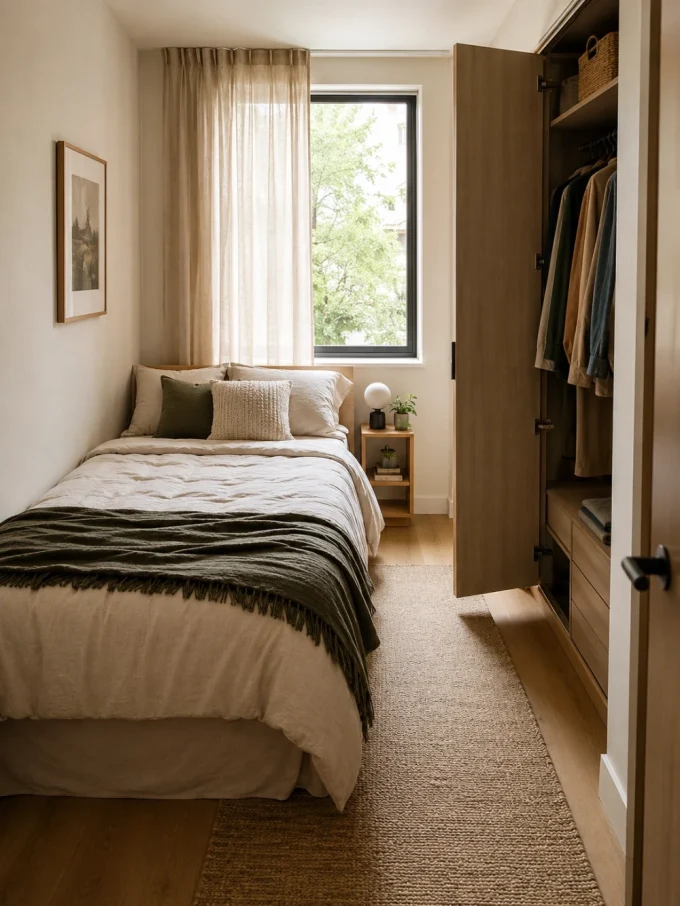
Centering a bed against the main wall can look balanced. In a very small bedroom, symmetry can also leave two passages that are both too narrow to be useful.
Moving the bed toward one side can sometimes turn those two scraps of space into one workable route.
Current small-bedroom layouts regularly use wall-adjacent or corner bed placement when circulation demands it.
There is a cost.
A bed against a wall is harder to make, and it is less convenient for two sleepers because one side loses direct access.
That is a genuine trade-off, not a design mistake.
If both sides of the bed need daily access, preserve them if the room permits. If only one person uses the room and shifting the bed creates enough space to open a wardrobe properly, the asymmetrical arrangement may be the much better room.
Judge the plan while moving through it, not while looking at it from the doorway.
3. Shrink the bed frame before automatically shrinking the mattress
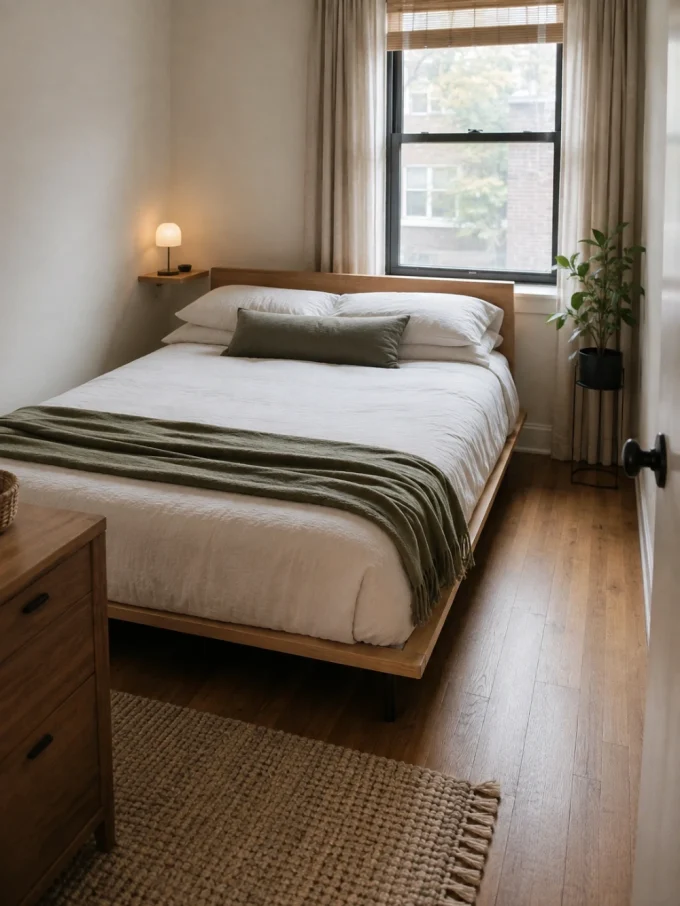
“Small room, small bed” sounds logical until the bedroom becomes less comfortable every night just to gain a few inches around a decorative frame.
Look at the structure surrounding the mattress first.
A bed with a deep upholstered headboard, wide side rails, chunky footboard, and projecting frame can occupy noticeably more room than the mattress itself.
A simpler platform or slim-frame bed keeps the sleeping surface while reducing visual and physical bulk.
That does not mean everyone should keep the largest mattress possible. If the bed truly prevents the door from opening or leaves no usable route, the mattress size itself may be wrong for the room.
But do not sacrifice sleeping comfort before checking whether it is actually the frame consuming the unnecessary space.
Small rooms need selective reduction, not miniature versions of everything.
4. Make the area under the bed solve a real storage problem
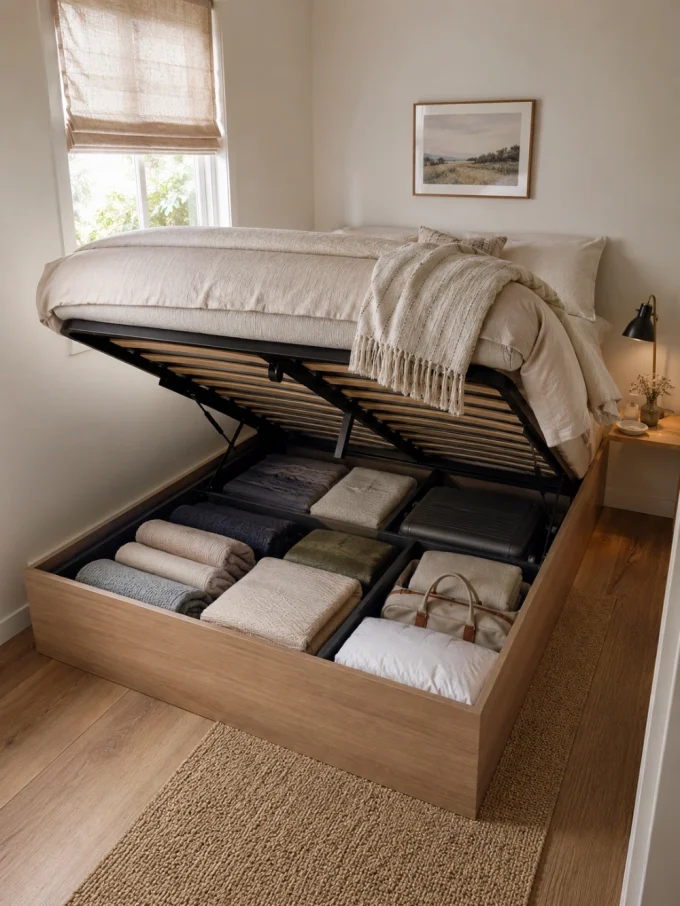
The bed covers a large area of floor whether the void underneath is useful or not.
Storage beds, drawers, and under-bed containers can therefore replace another piece of furniture rather than merely adding hidden capacity. Under-bed storage remains one of the dominant strategies in current small-bedroom coverage for precisely this reason.
The mechanism matters.
Side drawers are poor choices when the bed nearly touches a wall.
End drawers do not help if the foot of the bed faces a dresser.
Lift-up storage avoids horizontal drawer clearance, but retrieving something requires raising the platform.
Loose boxes are inexpensive, but they become irritating when frequently used belongings are buried behind three other containers.
Match access frequency to location. Bedding, luggage, spare blankets, or seasonal clothing make more sense underneath than something you need every morning.
And resist the temptation to fill the space simply because it exists. Storage is successful when it removes another problem from the room.
5. Stop treating matching nightstands as compulsory bedroom furniture
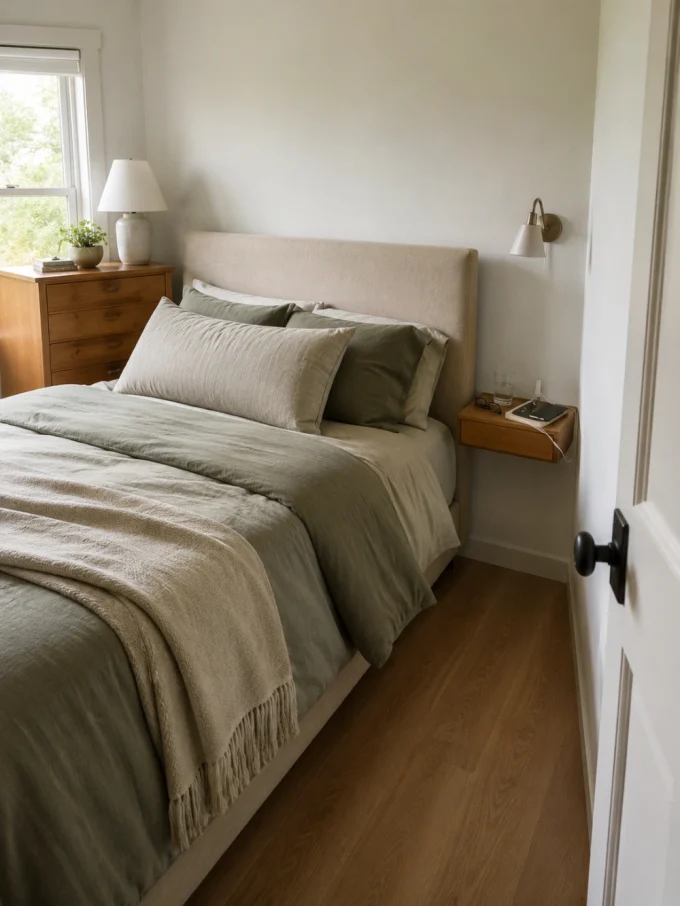
Matching nightstands can create pleasing balance. They can also occupy the only useful strips of floor beside the bed.
Start with what actually needs to happen there.
Perhaps you need:
- a phone;
- glasses;
- water;
- medication;
- one book;
- a charger.
That collection may need eight inches of shelf, not a full cabinet.
A floating ledge keeps the floor clear. A tiny wall-mounted drawer hides small clutter. A dresser positioned beside the bed can become the nightstand. If you need substantial bedside storage, one useful cabinet may be better than two undersized decorative tables.
The point is not to eliminate bedside furniture.
It is to stop allocating floor space according to what a conventional bedroom set says should be there.
6. Move the bedside lamp onto the wall
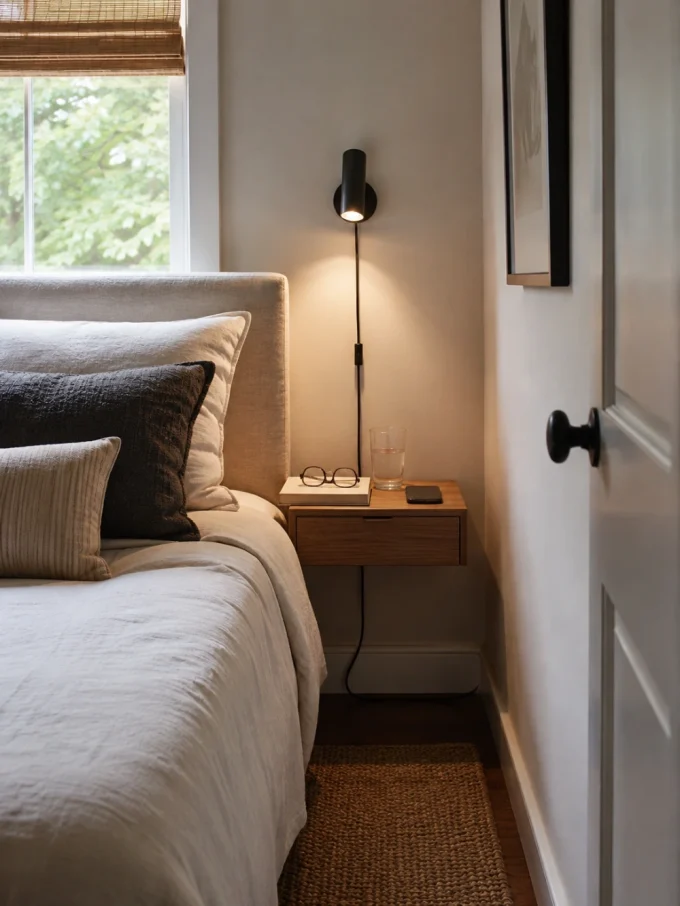
When the nightstand is small enough that a lamp occupies half of it, the lamp base has become expensive real estate.
A wall sconce solves that particular problem cleanly.
DecorAlcove’s guide to indoor wall-mounted light fixtures makes the same practical distinction: bedroom wall lights can release nightstand space, while slim and plug-in versions are especially useful where the room is compact or hardwiring is impractical.
Choose the fixture according to the activity.
A reading light should direct useful light onto a book without shining into your eyes. A broad decorative glow may create atmosphere but perform poorly for reading.
Projection also matters. In a cramped passage, an oversized swing-arm fixture can simply move the obstruction from the floor to shoulder height.
Renters do not necessarily need permanent wiring. A well-positioned plug-in sconce can achieve much of the same floor-saving effect.
7. Build storage upward, but give your eyes somewhere to rest
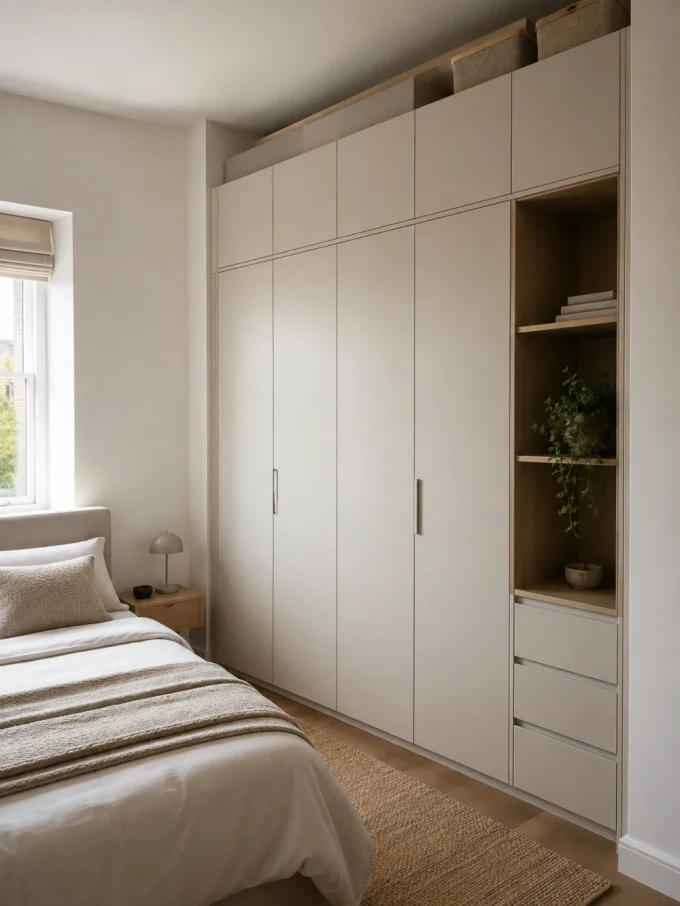
Vertical storage is useful because wall height is often the largest untapped dimension in a tiny bedroom.
That does not mean covering every wall with exposed shelves.
Tall wardrobes and upper cupboards can take advantage of height while keeping their contents behind calm surfaces. Open shelving is more visually demanding because every book, basket, bottle, folded sweater, and cable becomes part of the room’s composition.
Use the topmost storage for things you rarely need.
Keep daily belongings within comfortable reach.
And if children live in or regularly use the room, secure appropriate freestanding furniture according to the manufacturer’s instructions. The U.S. Consumer Product Safety Commission specifically recommends anchoring top-heavy furniture such as dressers to reduce tip-over hazards.
For a room where clothing storage is the main pressure point, DecorAlcove’s modern wardrobe design ideas are the more useful next read than adding another decorative storage basket.
8. Put a lot of storage on one wall instead of a little storage everywhere
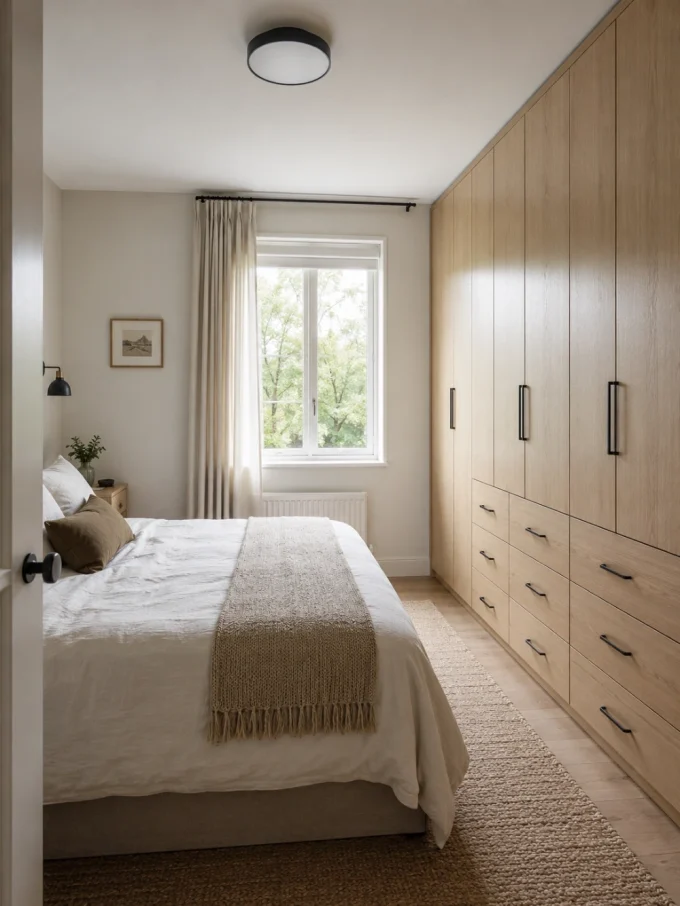
A room can technically be organized and still look restless.
Imagine one version with:
- a small chest beside the door;
- three floating cubes above the bed;
- a rail beside the window;
- a bookcase opposite;
- baskets at the foot of the bed.
Now imagine roughly the same capacity organized into one coherent wall of wardrobes and drawers.
The second solution is visually heavier in one place but quieter everywhere else.
Concentrating storage gives the eye a chance to stop processing containers on every surface. It also leaves other walls available for the bed, a mirror, artwork, or simply nothing.
This approach will not suit every rental or every budget. Full built-ins can be expensive and difficult to reverse.
Freestanding pieces can still imitate the principle. Group the wardrobe and dresser rather than scattering them automatically.
One deliberate storage zone often reads more calmly than six clever hacks.
9. Make the wardrobe work harder before buying another dresser
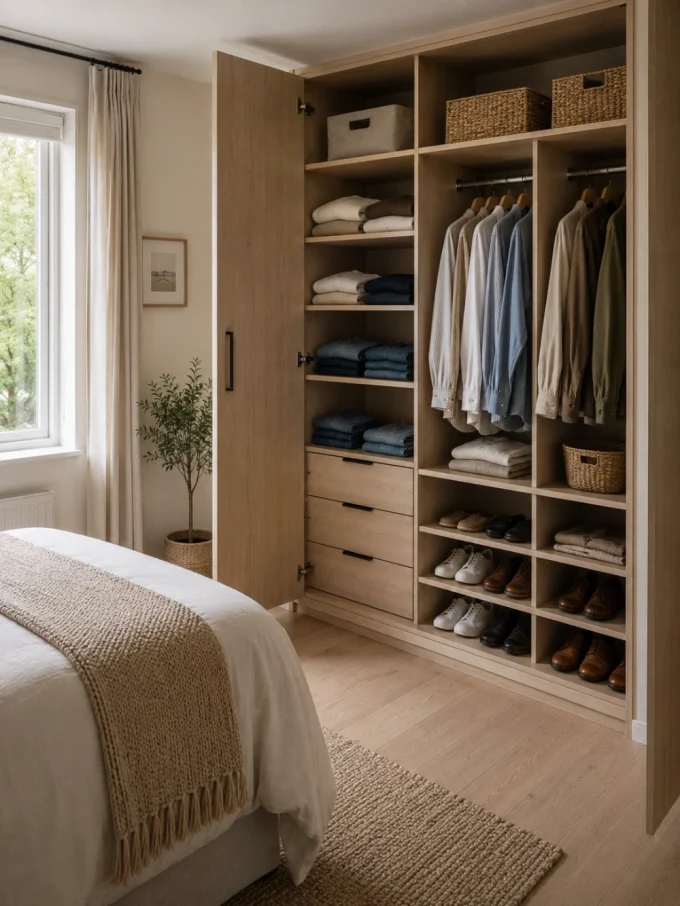
Insufficient clothing storage often leads to the same response: add furniture.
First look inside what you already have.
A poorly arranged wardrobe can waste height above a hanging rail, leave shoes spreading across the floor, and use one long hanging section for garments that would fit perfectly well in two shorter zones.
The useful intervention depends on what you own.
Someone with many dresses needs hanging height.
Someone with T-shirts, knitwear, and jeans may gain more from shelves and drawers.
Someone with twenty pairs of shoes has a different problem again.
Do not optimize the wardrobe for an imaginary minimalist. Optimize it for your clothes.
If improving the interior allows you to remove a freestanding dresser, you gain something more valuable than storage capacity: floor.
10. Let one surface be a desk, vanity, and bedside table when necessary
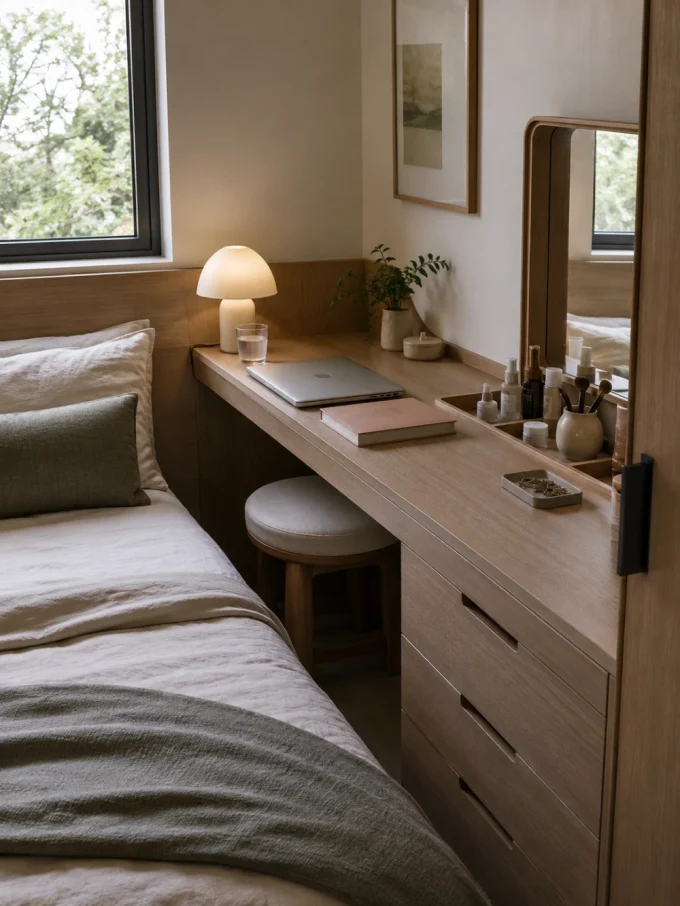
A tiny bedroom rarely has enough spare floor area for a desk, dressing table, nightstand, and dresser to behave as four independent pieces of furniture.
Give them overlapping jobs.
A slim desk beside the bed can hold a lamp and glass of water after the laptop closes.
A narrow dresser can support a dressing mirror.
A shallow floating surface can work as a laptop station during the day and disappear visually at night.
If a vanity is genuinely part of the room’s daily routine, the important detail is not how pretty it looks—it is whether the stool tucks away, drawers clear nearby furniture, and products have somewhere to disappear. DecorAlcove’s dressing table ideas explore those exact practical conflicts.
One caution: multifunctional does not mean mediocre at every function.
If you work at the desk for eight hours each day, an uncomfortably shallow decorative console is not a smart space-saving solution.
Daily use deserves more space than occasional use.
11. Use the awkward slivers of space—but don’t turn every sliver into storage
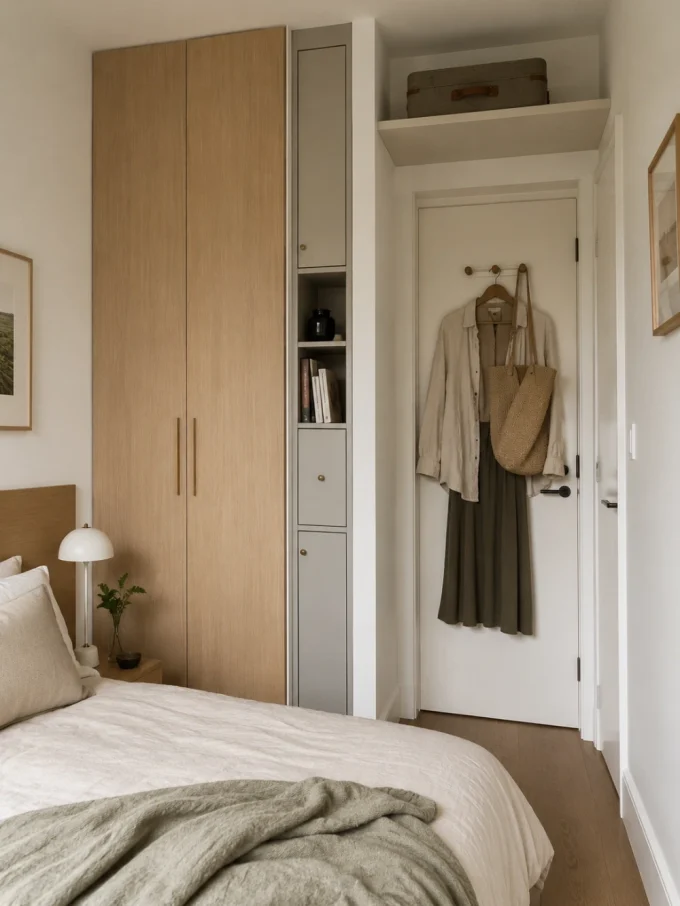
The narrow strip beside a wardrobe, the wall behind a door, and the space above a doorway often escape attention because normal furniture does not fit there.
That can make them useful.
A few hooks behind the door can hold tomorrow’s outfit.
A shallow shelf high above a doorway can hold luggage or an infrequently used box.
A narrow vertical cabinet may fit beside a wardrobe where a normal chest cannot.
But tiny-bedroom organization can become absurd when every blank six-inch patch receives another hook, rack, shelf, pocket organizer, or basket.
The result may be spatially efficient and visually exhausting.
Use awkward space for a specific recurring problem.
If you cannot name what needs to live there, leave it alone.
12. Protect the window before trying to make the room “brighter”
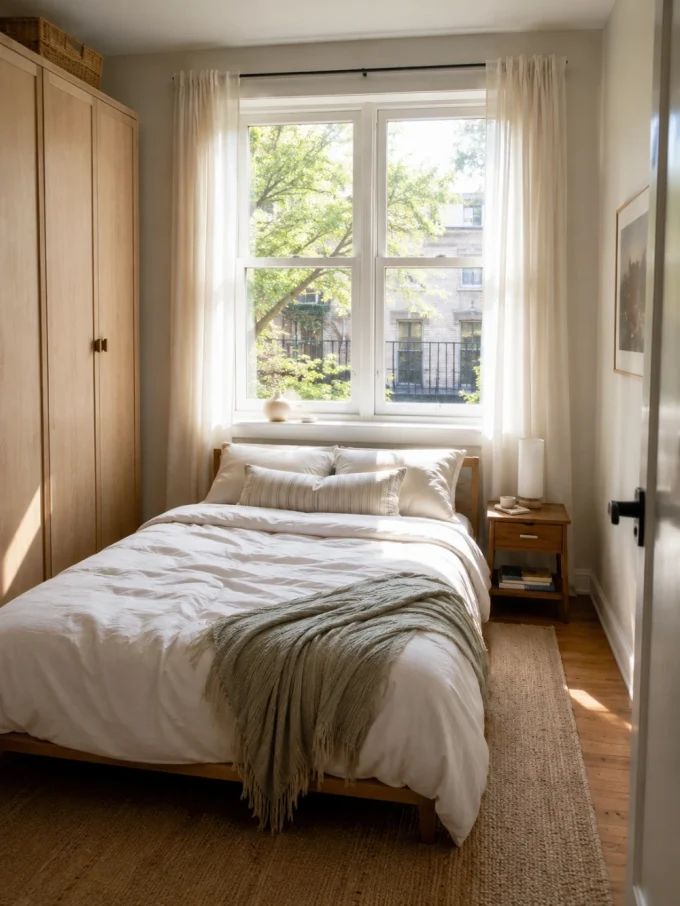
Natural light cannot help a room when furniture, heavy window treatments, or piles of objects interfere with it.
Current small-bedroom design advice repeatedly emphasizes preserving useful daylight and avoiding unnecessary visual barriers around windows.
That does not mean nothing can sit beneath a window.
Sometimes the window wall is the only sensible location for a bed or low piece of furniture. A headboard below the sill may be perfectly workable if the window remains safe, accessible, and functional.
What matters is what happens to the light after it enters.
A tall wardrobe directly beside the window may throw more shadow than a low bed beneath it.
A dense plant collection on the sill may make a pretty photograph while reducing usable daylight.
Think of the window as part of the floor plan rather than an isolated decorating feature.
13. Keep the window treatment proportional to the problem
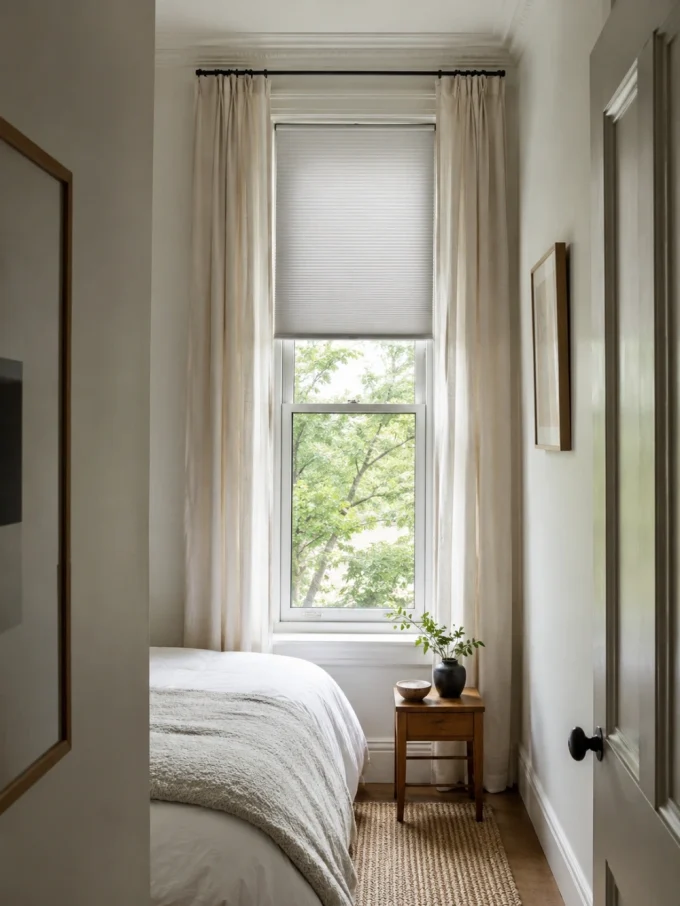
Long curtains can add softness and height. In a narrow bedroom, bulky folds of fabric can also occupy wall space, trap dust behind furniture, and make the corner around the window feel heavier.
Choose the treatment according to what you need it to do.
If privacy and blackout are priorities, a fitted shade or blind can handle much of the functional work while curtains provide softness.
If there is barely any clear wall beside the window, generous stacks of fabric may be the wrong compromise.
If the window is tall and the room otherwise feels visually chopped up, floor-length curtains can create a useful continuous line.
There is no universal “hang curtains high and wide” command that overrides the architecture.
The window still has to open. Furniture still has to fit. Fabric still needs somewhere to fall.
14. Decide what the mirror will reflect before deciding where to hang it
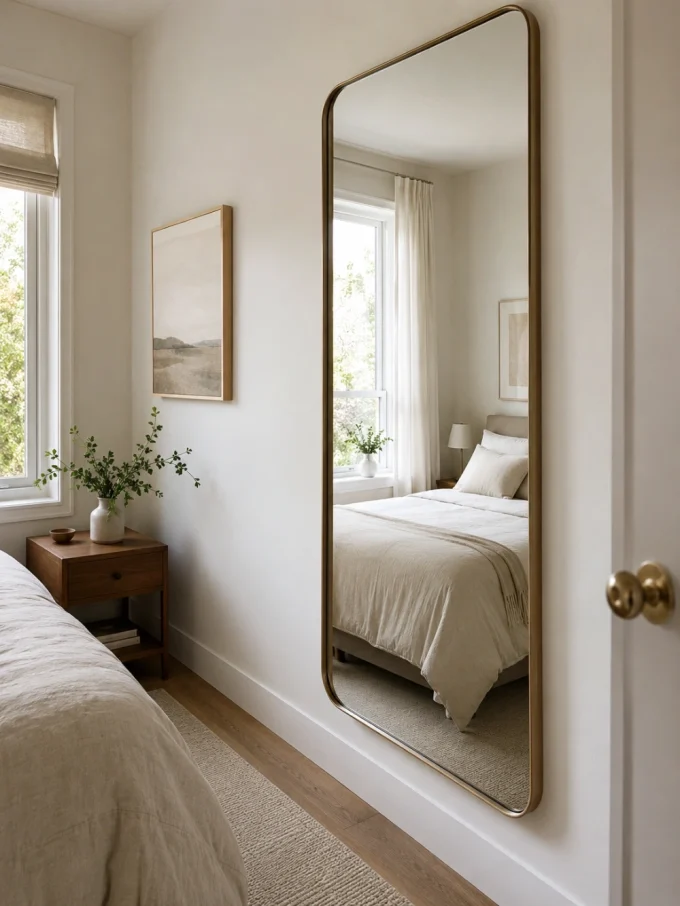
Mirrors are among the most repeated tiny-bedroom recommendations, but the advice often stops too early.
A mirror does not know whether it is reflecting daylight or laundry.
Put one opposite a bright window, open doorway, artwork, or relatively quiet part of the room and the repeated view can create useful depth.
Aim it toward an open clothes rail, overloaded shelf, or messy desk and you have simply duplicated the busiest part of the bedroom.
That is why reflection should determine placement.
A wall-mounted full-length mirror also avoids consuming floor space with a leaning frame, while mirrored wardrobe doors can combine dressing and storage functions.
For more detailed mirror placement and styling, see DecorAlcove’s contemporary bedroom mirror decor ideas.
Choose what you want to see twice.
Then hang the mirror.
15. Choose color according to light and mood, not a “tiny rooms must be white” rule
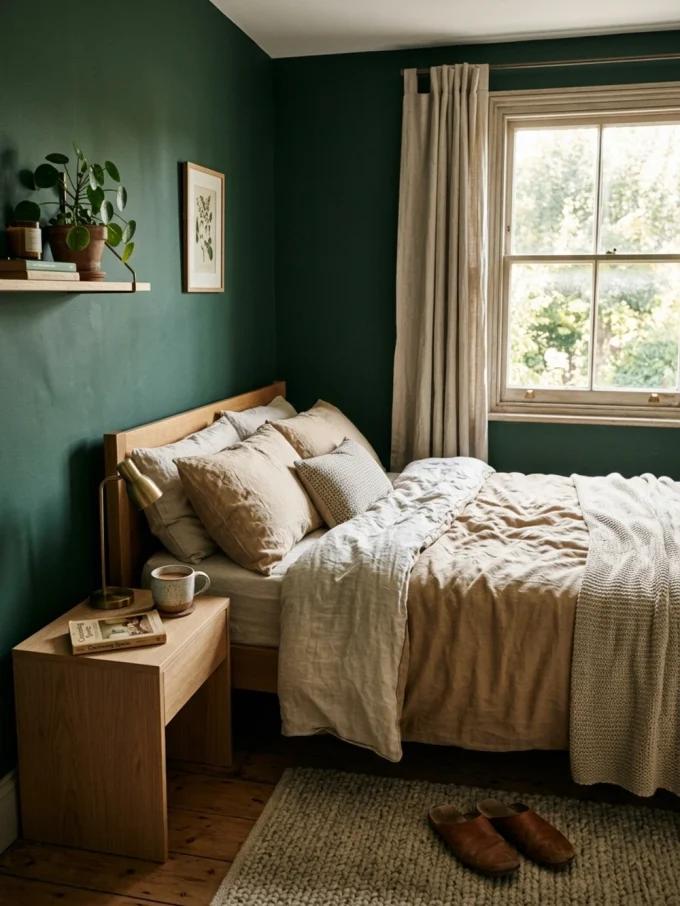
White can work beautifully in a tiny bedroom.
It is not compulsory.
Current designer guidance actively challenges the old rule that small rooms should always stay pale. Recent Architectural Digest coverage includes compact bedrooms deliberately wrapped in deep colors, with designers using darker palettes to make the small scale feel cocooning rather than apologetic.
The better question is what you want the bedroom to feel like.
If the room receives good daylight and you want an airy effect, pale warm neutrals, muted blues, soft greens, and low-contrast finishes can keep visual interruptions subdued.
If daylight is weak and the room already feels enclosed, endlessly fighting that fact with cold white paint may produce a flat grayish room. A richer color can make the enclosure feel intentional.
If blue suits the room, DecorAlcove’s cool blue paint ideas can help you explore that direction without assuming every blue behaves the same way.
Test paint in the actual room.
Morning, afternoon, and lamplight can make one color look like three different colors.
16. Put some of the personality above the furniture line
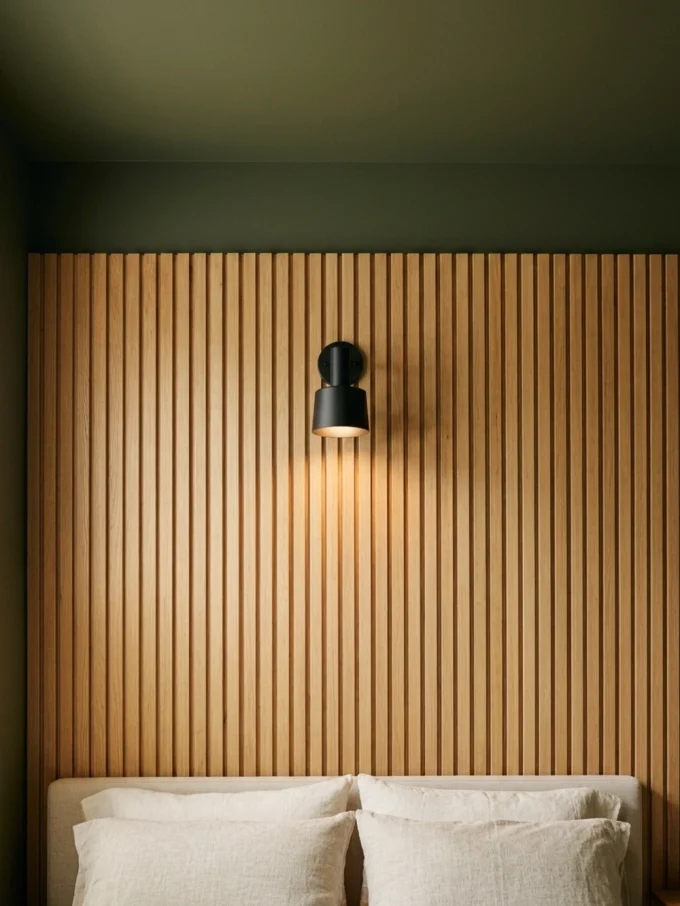
A tiny bedroom has very little floor. Its upper surfaces are far less crowded.
Use them selectively.
A painted ceiling, restrained wallpaper, a textured headboard wall, or architectural detail above the bed can give the room character without adding another object to walk around.
Recent designer projects demonstrate that compact bedrooms can handle strong ceiling and wall treatments rather than defaulting to visual emptiness.
There is a useful limit.
If the ceiling is low and already broken up by beams, vents, a fan, and several fixtures, another elaborate treatment may create more noise than interest.
Likewise, a deeply textured finish directly beside a bed may be less pleasant to clean than a smooth painted wall.
If you want to explore surface treatment rather than furniture, DecorAlcove’s wall texture design ideas and modern ceiling ideas are logical places to continue.
The room can have character without acquiring another piece of furniture.
17. Use fewer decorative objects, but let them have more presence
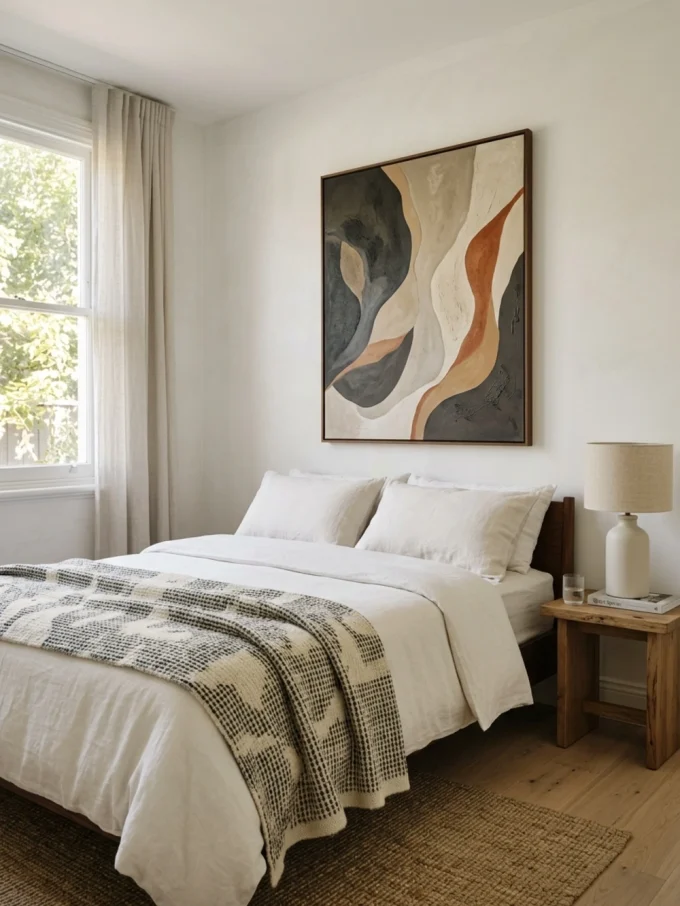
Small-space minimalism sometimes gets interpreted as “buy everything small.”
That tends to create a room full of tiny objects.
Six little frames, three miniature plants, several baskets, a cluster of candles, a tray of accessories, and a handful of cushions may each be small individually. Together they produce a surprising amount of visual information.
Try fewer, more decisive elements.
One artwork large enough to hold the wall.
One lamp with a clear purpose.
One patterned blanket rather than five decorative cushions.
One tactile material—linen, wool, timber, woven cane, matte ceramic—that gives the room depth without another color competing for attention.
Current small-space designer guidance also challenges the assumption that every item must become miniature; scale should be edited, not uniformly shrunk.
Before adding another accessory, it is worth reading through DecorAlcove’s home decor mistakes to avoid. Tiny rooms expose unnecessary objects faster than generous ones do.
18. Leave one part of the bedroom deliberately under-filled
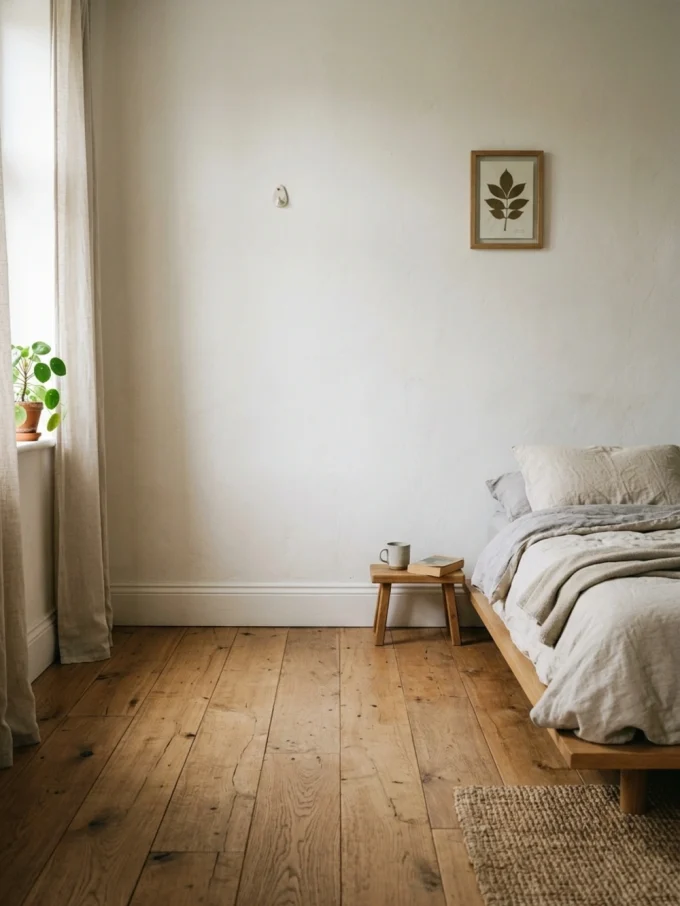
This may be the hardest idea because empty space can look like an opportunity.
A vacant wall asks for shelving.
A clear dresser asks for decor.
A corner asks for a chair.
The foot of the bed asks for a bench.
Sometimes the correct answer is no.
Visual quiet is doing useful work.
A mostly empty wall makes the wardrobe wall feel less dominant. An uncluttered dresser top gives everyday objects somewhere temporary to land without immediately creating chaos. A clear patch of floor makes cleaning easier and prevents every route through the room from becoming a slalom.
You do not need to maximize every inch.
You need to make every used inch justify itself.
That is the difference between a tiny bedroom that is impressively packed and one that is actually comfortable to occupy.
What I Would Change First in a Tiny Bedroom
Do not buy organizers yet.
Start with the physical problems.
First, open every door and drawer. Notice what collides.
Then reconsider the bed position. It controls more floor area than anything else.
Remove one unnecessary floor-standing piece. A redundant chair or second nightstand can release more useful space than several organizers create.
Fix clothing storage next. If everyday belongings have no home, styling cannot keep the bedroom calm.
Move lighting off valuable surfaces where that genuinely helps.
Only after the room works should you decide whether it needs paint, mirrors, wall texture, artwork, or a better ceiling treatment.
A tiny bedroom does not need to masquerade as a large one.
It needs to stop wasting the little space it has.
FAQS
How can I make a tiny bedroom look bigger?
Keep the room simple and avoid filling every corner with furniture. Light colors, mirrors, clear floor space, and curtains hung higher than the window can all make the room feel more open. Choosing a few well-sized pieces usually works better than squeezing in lots of small furniture.
How do you maximize space in a tiny bedroom?
Use the space you normally ignore. Under-bed drawers, wall shelves, over-the-door storage, and tall wardrobes can give you much more room without taking up extra floor space. Furniture that serves more than one purpose, such as a storage bed or bedside table with drawers, is especially useful.
Where should I place the bed in a small bedroom?
In most tiny bedrooms, placing the bed against the longest solid wall gives you the easiest layout. If the room is extremely narrow, pushing one side of the bed against a wall can free up valuable walking space. Just make sure doors, drawers, and wardrobes can still open comfortably.
How should I lay out a small bedroom?
Start with the bed, since it is usually the biggest item in the room. Then arrange everything else around it while keeping a clear path from the door. Try to keep bulky furniture together rather than scattering it around the room, as this can make the space feel less cluttered.
What color makes a small bedroom look bigger?
Soft whites, warm neutrals, pale gray, beige, and muted pastel shades can help a small bedroom feel brighter and more spacious. That does not mean you have to avoid dark colors completely. A darker accent wall or rich bedding can add depth without making the whole room feel closed in.
What furniture is best for a small bedroom?
Look for slim, practical furniture that earns its place in the room. Storage beds, floating nightstands, narrow dressers, wall-mounted lamps, and tall shelving units are all good options. The goal is not necessarily to buy smaller furniture, but to choose pieces that give you useful storage without making the bedroom difficult to move around in.