

The right living room rug can make a sofa arrangement feel connected, soften hard flooring, and give the entire room a finished look. But choosing one is not only about finding a pattern you like.
A rug that looks beautiful in a photo can feel completely wrong once it is placed under an undersized sofa, competes with patterned furniture, or becomes difficult to maintain. The best modern living room rug ideas balance style, scale, placement, texture, and everyday use.
Whether your room is compact, open-plan, neutral, colorful, minimalist, or built around a large sectional, these ideas will help you choose a rug that works with the room rather than simply sitting on the floor.
1. Anchor a Neutral Room With a Textured Cream Rug
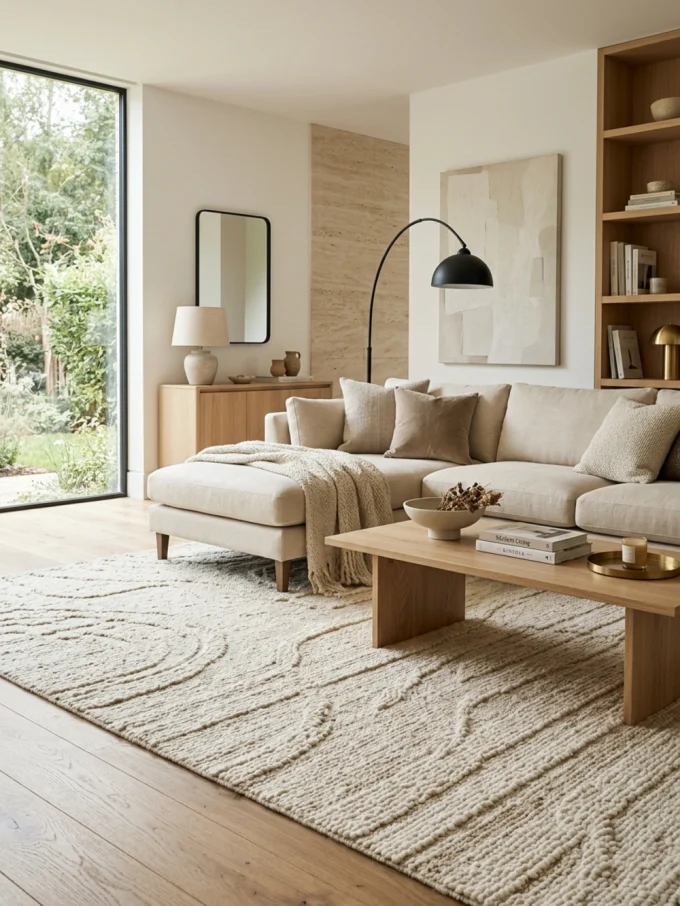
A cream rug can give a modern living room a softer, warmer foundation without introducing another strong color.
The trick is choosing texture instead of relying on pattern. Look for a subtle high-low design, raised lines, looped construction, or gentle tonal variation that becomes visible as light moves across the surface.
This works especially well with:
- Cream or beige sofas
- Light oak furniture
- White walls
- Natural stone
- Black accents
- Warm metal finishes
A textured cream rug is also easier to live with stylistically because it does not force every future accessory to coordinate with a particular color.
If your living room already has several statement pieces, this is one of the safest ways to add softness without creating another focal point.
2. Use an Oversized Rug to Connect the Seating Area
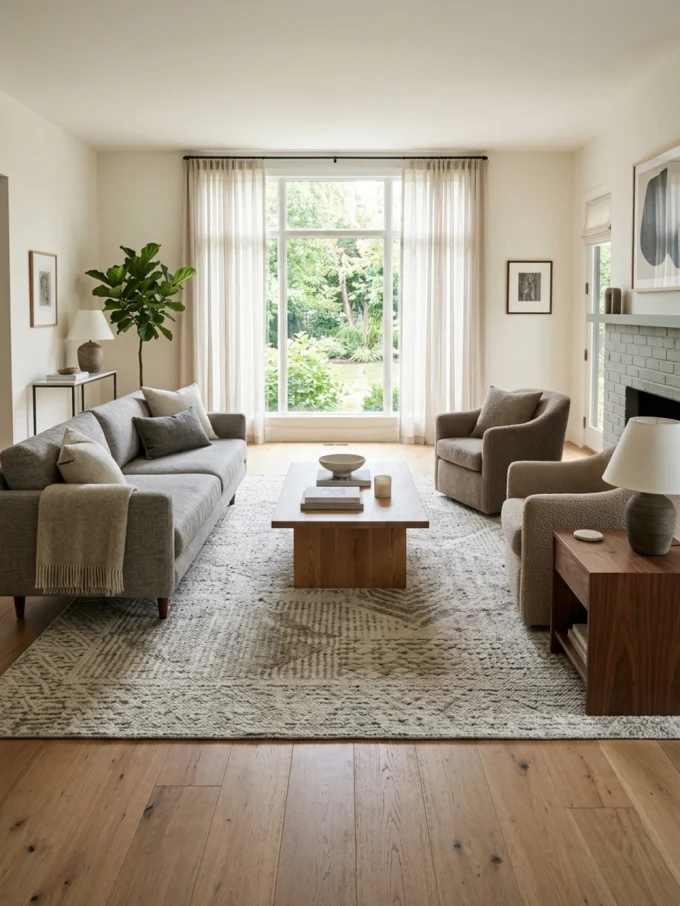
If your sofa and chairs feel like separate objects scattered around the room, the rug may be too small.
A properly sized rug visually groups the main seating pieces around the coffee table. For many average living rooms, 8 × 10 feet is a useful starting point, while 9 × 12 feet often works better for larger seating arrangements or open-plan spaces. Larger 10 × 14-foot rugs can define a substantial living zone when the room has enough floor area.
The exact size should come from your furniture layout rather than the room dimensions alone.
Before buying, mark the proposed rug dimensions on the floor with painter’s tape. This lets you check whether the rug reaches the seating, interrupts a walkway, or leaves awkward gaps.
When deciding between two sizes that both fit comfortably, the larger option is often more forgiving because an undersized rug is difficult to make look intentional.
3. Choose a Soft Geometric Rug for Clean-Lined Furniture
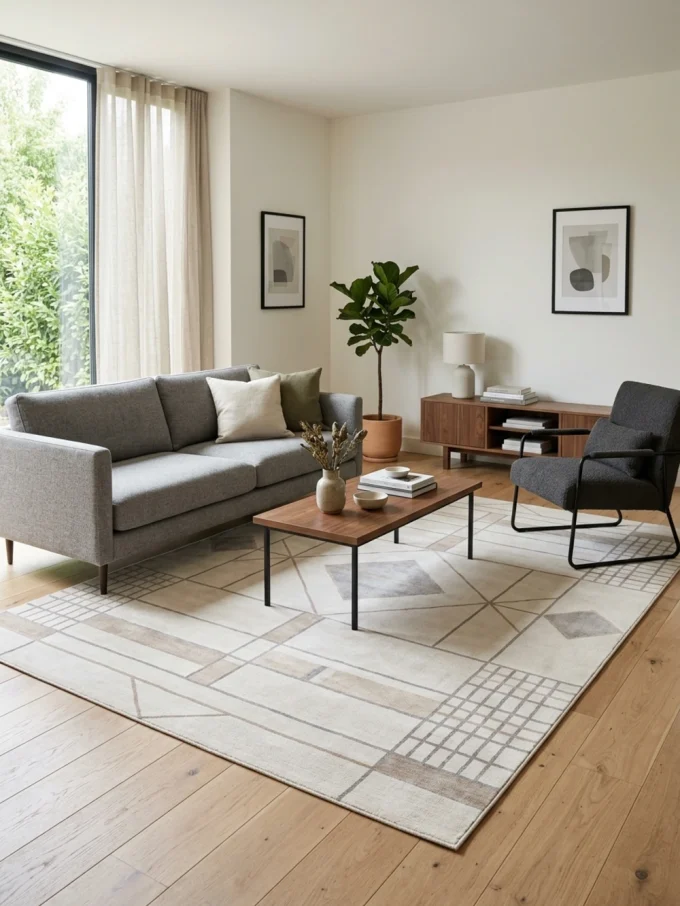
Geometric rugs are a natural match for contemporary furniture because their structured patterns reinforce the straight lines already present in many modern rooms.
You do not need an intense black-and-white grid. Softer designs can be just as effective:
- Thin intersecting lines
- Muted diamonds
- Offset rectangles
- Broken grids
- Tonal arches
- Irregular geometric blocks
Use a stronger geometric rug when the surrounding room is relatively simple.
If your sofa, curtains, artwork, and cushions already contain patterns, choose a lower-contrast geometric design so the floor does not become another competing focal point.
A useful rule is to repeat the visual language, not the exact pattern. A rectangular rug pattern can quietly echo the shape of a coffee table or media console without making the room look overly coordinated.
4. Warm Up the Room With a Greige Rug
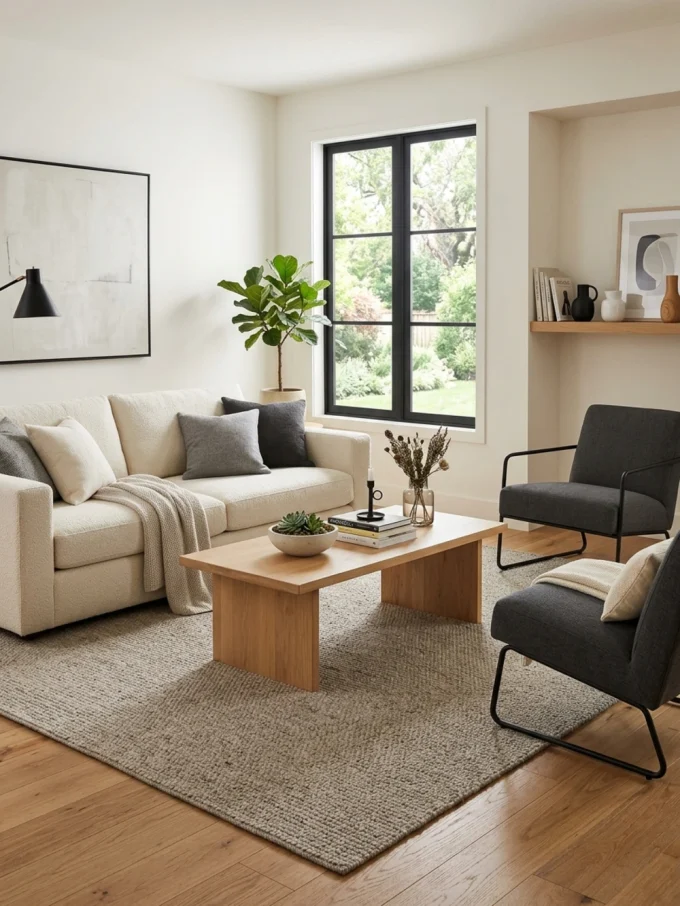
Warm greige sits between beige and gray, making it particularly useful when you want a modern neutral that does not feel too cold.
It works well with:
- Light and medium wood
- Cream upholstery
- Charcoal accents
- White walls
- Black metal
- Natural stone
Greige can also bridge different undertones when a room contains both warm and cool finishes.
Before choosing one, place the sample beside your actual sofa and flooring. A rug that appears neutral in a store can look noticeably warmer or cooler under your home’s lighting.
This is an especially good choice when you want flexibility. Unlike a strongly colored rug, greige can remain useful if you later change your cushions, artwork, or accent chair.
5. Give Contemporary Furniture Character With a Faded Vintage Rug
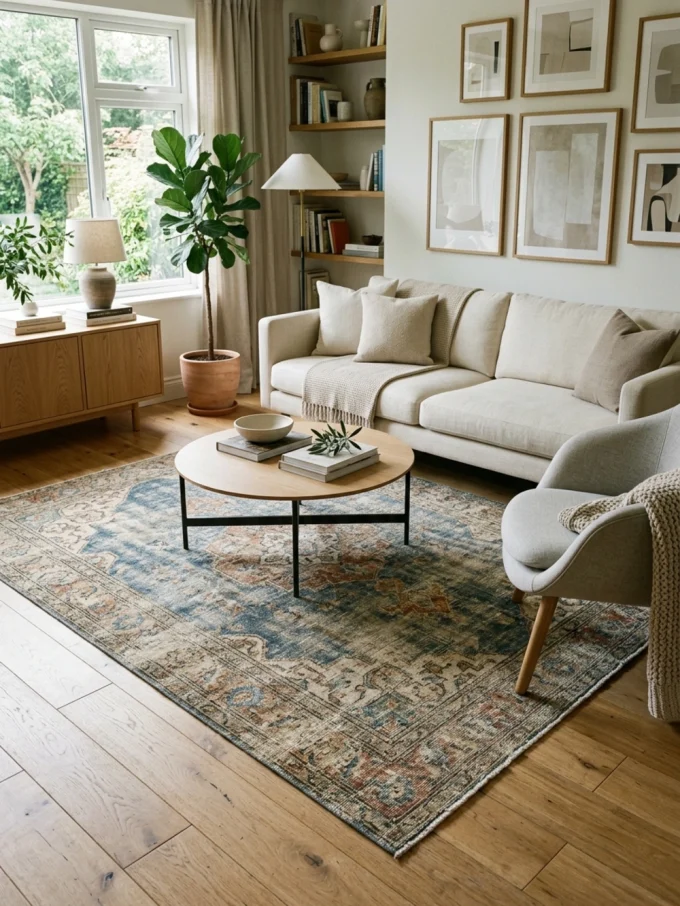
A modern living room does not need every piece to look new.
A faded vintage-inspired rug can introduce visual history and softness beneath clean-lined furniture. Look for designs with worn-looking motifs and muted color rather than highly saturated traditional patterns.
Good combinations include:
- Faded blue + cream
- Muted rust + beige
- Dusty olive + oatmeal
- Charcoal + warm ivory
- Faded terracotta + natural brown
The slightly imperfect appearance helps a contemporary room feel collected rather than showroom-perfect.
Current rug coverage continues to highlight vintage and antique-inspired designs with patina and lived-in variation as an important direction.
If your furniture is very modern, this contrast can be more effective than buying a rug that attempts to match every piece.
6. Make a Small Living Room Feel More Unified With a Properly Sized Rug
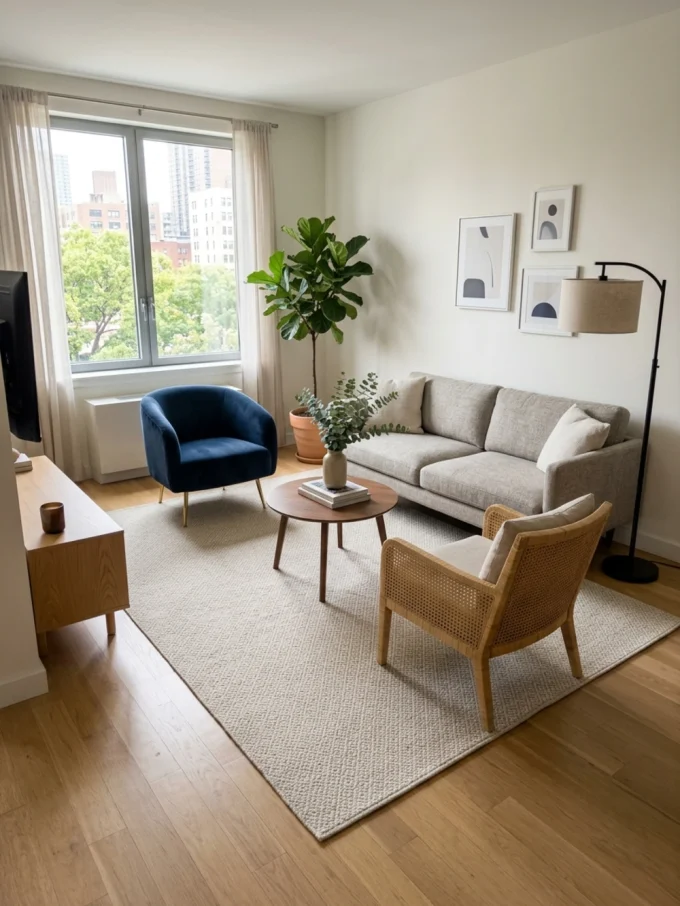
Small rooms often tempt homeowners into buying small rugs.
That can actually make the seating area feel more fragmented.
Instead, choose the largest rug that comfortably fits the furniture and circulation paths. A 6 × 9-foot rug can work well in a compact seating arrangement, while a 5 × 8-foot rug may suit a particularly tight room when a larger size would interfere with movement.
Keep the pattern relatively controlled.
A small room usually benefits from:
- Tonal patterns
- Fine geometric designs
- Subtle stripes
- Light-to-medium colors
- Low visual contrast
Avoid filling every surface with pattern. The rug should help define the room, not make the floor feel crowded.
For more small-space strategies, see our studio apartment decor ideas.
7. Let an Abstract Rug Become the Room’s Artwork
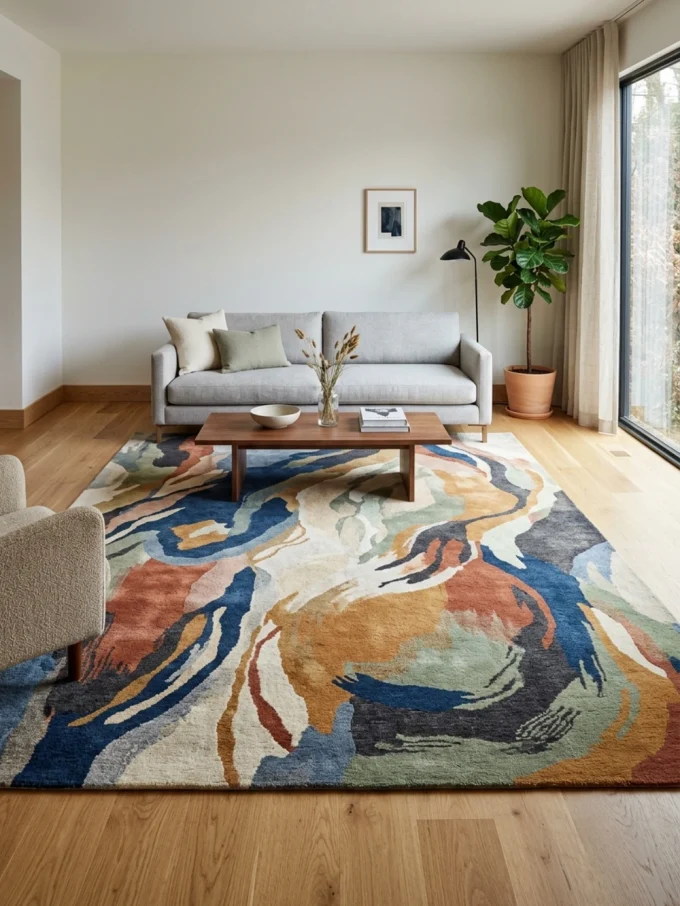
An abstract rug can carry the artistic energy of the room while keeping the walls relatively quiet.
Look for:
- Loose brushstroke patterns
- Organic shapes
- Blurred color fields
- Fluid lines
- Asymmetrical forms
This works best when the furniture is relatively restrained.
For example, pair an expressive abstract rug with a simple sofa, uncomplicated coffee table, plain curtains, and limited wall decor.
Let the rug be complicated enough to attract attention without repeating its entire palette throughout the room. Pulling one or two secondary colors into cushions or artwork is usually enough.
8. Use a Flatweave Rug for a Busy Household
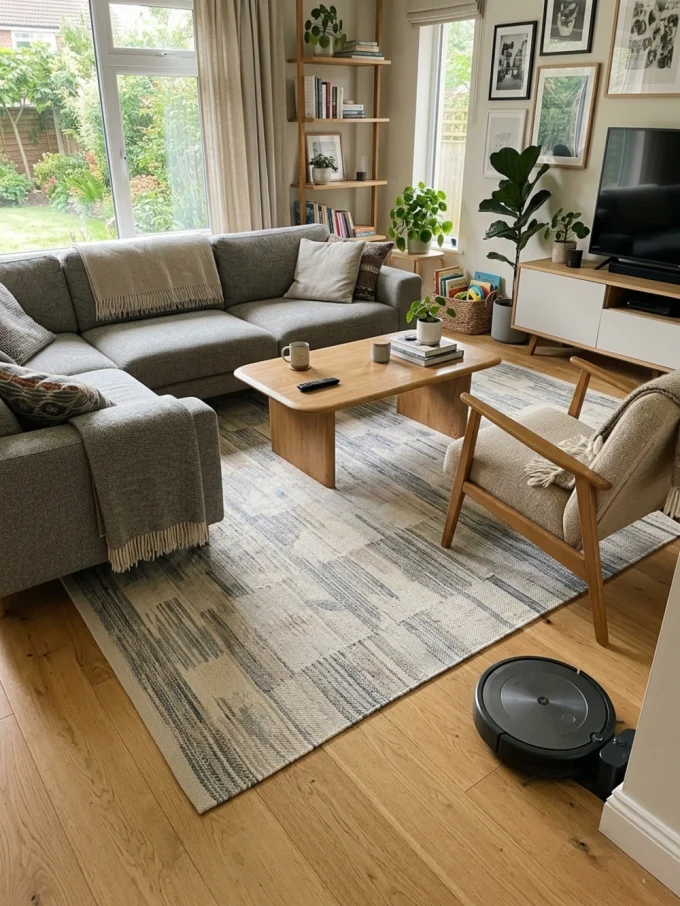
A beautiful rug still needs to work with the way your living room is used.
Flatweave rugs have a low profile, making them useful when you regularly move chairs, use a robot vacuum, or want to avoid a thick transition between the rug and flooring.
They can be especially practical in:
- High-traffic living rooms
- Family rooms
- Apartments
- Homes with frequent furniture movement
- Rooms with doors close to the rug
The trade-off is comfort. A flatweave will generally feel less plush than a thick wool or high-pile rug.
Choose it when easy movement and a cleaner profile matter more than maximum softness.
9. Layer a Neutral Base Rug With a Smaller Statement Rug
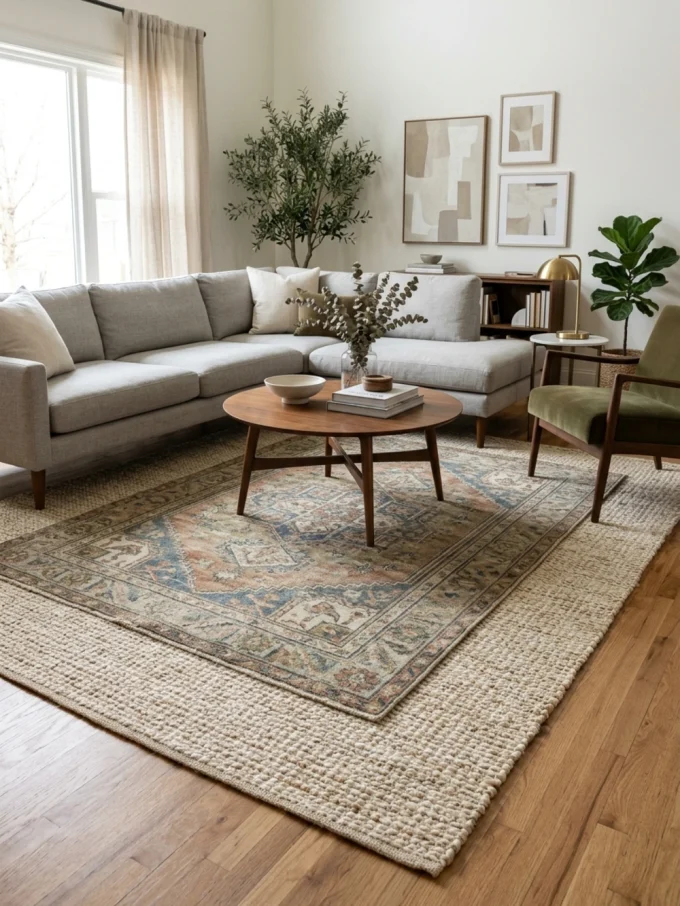
Layering can create depth without requiring one enormous patterned rug to dominate the room.
Start with a larger neutral foundation and place a smaller statement rug over it.
Try combinations such as:
- Large natural-fiber rug + faded vintage rug
- Cream textured rug + geometric accent rug
- Neutral flatweave + colorful patterned rug
- Large wool rug + smaller antique-inspired rug
The two layers should have enough difference in pattern, texture, or tone to remain visually distinct.
Layering is also useful when you love a smaller rug but need a larger foundation to properly anchor the seating area.
Do not force the technique into a room that is already crowded. In a small living room, two rugs can create more visual noise than depth.
10. Create Graphic Contrast With a Black-and-Cream Rug
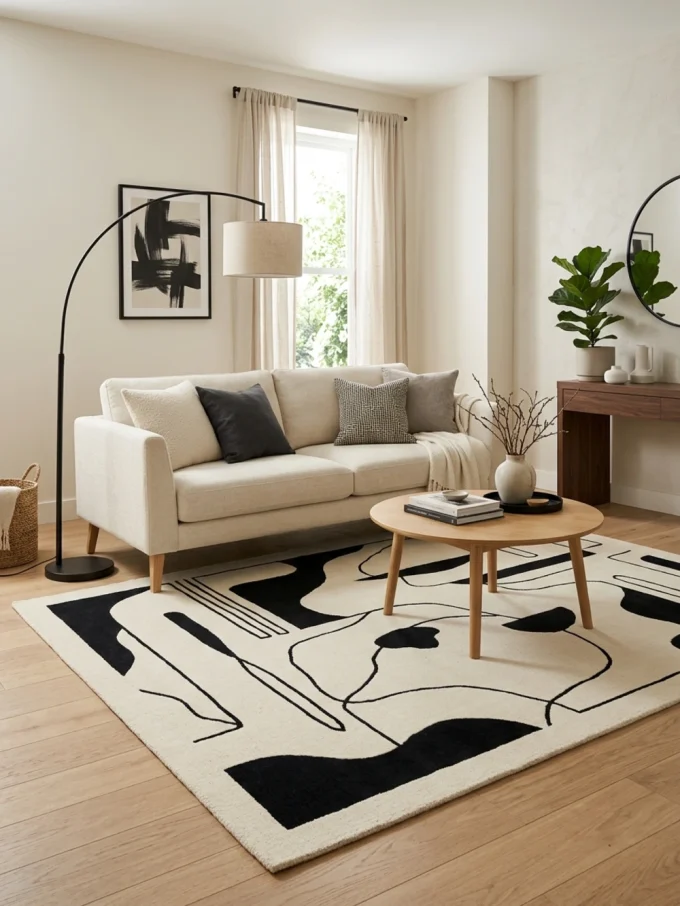
Black and cream create a strong modern foundation without requiring bright colors.
A black-and-cream rug works particularly well with:
- White or cream sofas
- Black lighting
- Dark wood
- Light oak
- Minimalist furniture
- Neutral walls
The pattern determines how dramatic the result feels.
A blurred abstract pattern is softer than a sharp checkerboard. A thin linear design can feel architectural without becoming overpowering.
If your living room is compact, consider a design where cream occupies more of the surface and black acts as an accent.
For more ideas on balancing this palette, explore our small black and white living room ideas.
11. Add Organic Texture With Jute, Sisal, or Wool
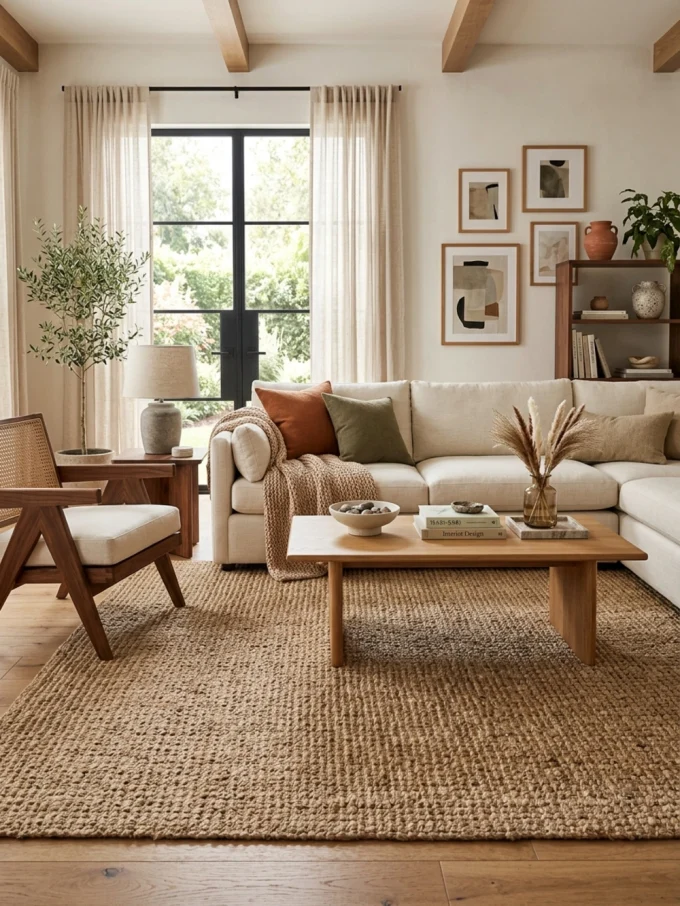
Natural-fiber rugs can soften the polished appearance of a modern room.
Jute and sisal introduce strong visible texture, while wool generally offers a softer and more refined underfoot experience.
They work especially well with:
- Oak furniture
- Linen sofas
- Cream upholstery
- Walnut
- Stone
- Muted green
- Terracotta
If you like the appearance of natural fibers but want a softer surface, consider a wool-natural-fiber blend.
Remember that natural fibers are not automatically the easiest option for every household. Check the manufacturer’s care instructions and consider where spills are most likely to happen.
12. Bring Controlled Color With a Muted Blue Rug
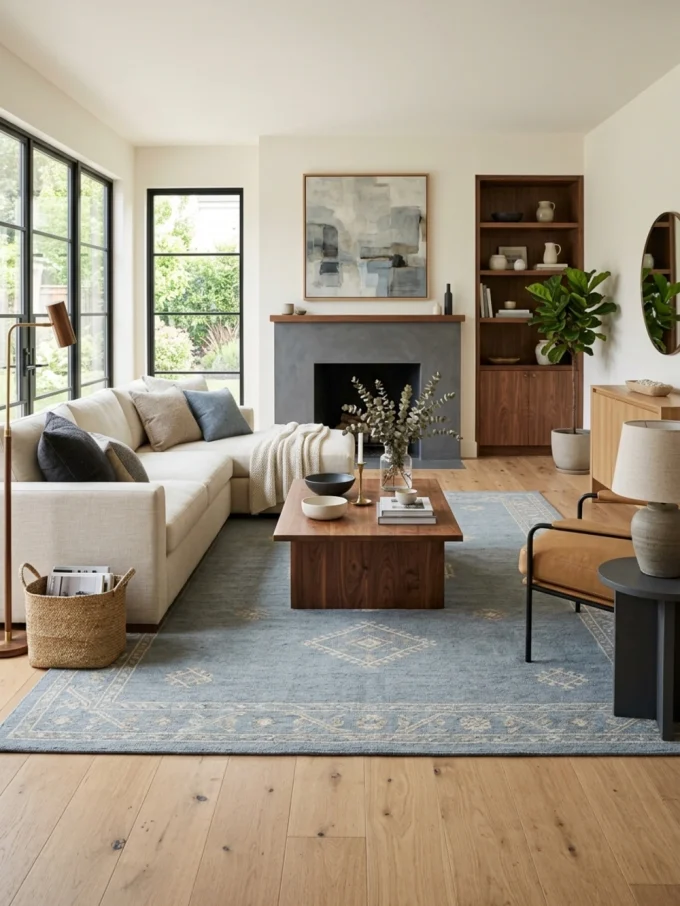
A muted blue rug can cool down a living room dominated by warm wood, tan upholstery, or brass.
Instead of bright royal blue, consider:
- Dusty blue
- Blue-gray
- Faded denim
- Desaturated navy
- Soft slate blue
These shades introduce color without turning the rug into the room’s only theme.
Pair muted blue with cream, walnut, camel, charcoal, or natural oak for a balanced palette.
If you are unsure about committing to a large colored surface, choose a patterned rug where blue appears alongside cream or beige rather than covering the entire rug.
13. Define an Open-Plan Living Room With an Oversized Rug
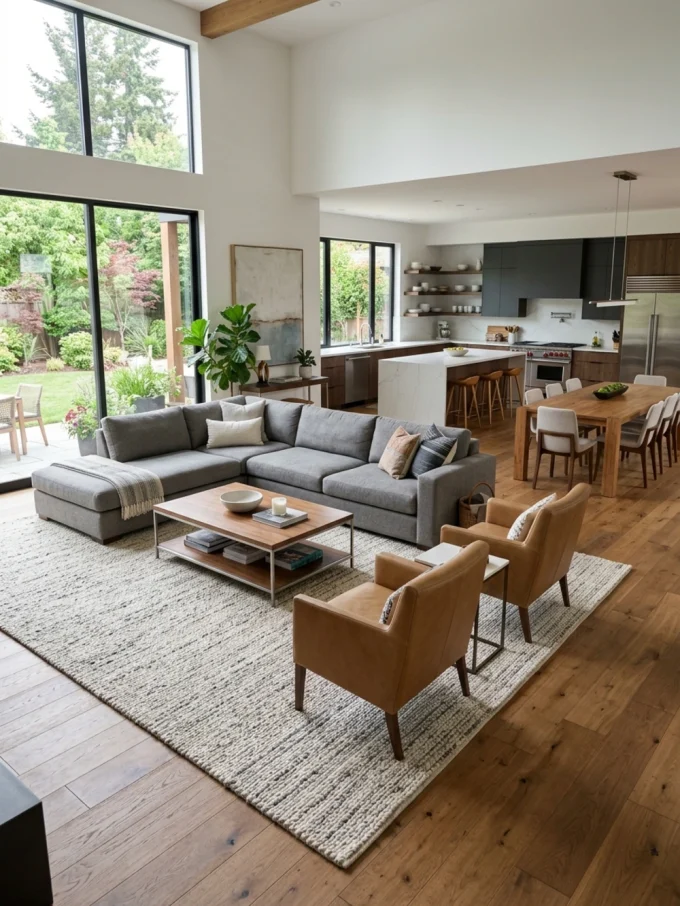
Open-plan rooms need visual boundaries even when there are no walls.
A large rug can establish the living area as a distinct zone between the kitchen, dining space, and other functions.
For this layout, a larger rug that accommodates all or most of the seating is usually more effective than a small rug floating beneath the coffee table. Large rugs are specifically useful for visually separating an open living area from surrounding spaces.
Keep enough flooring visible around the perimeter so the rug still reads as an intentional area rather than wall-to-wall carpeting.
For more inspiration around this type of room, see our cozy modern living room ideas.
14. Choose a Rug Specifically for a Sectional Sofa
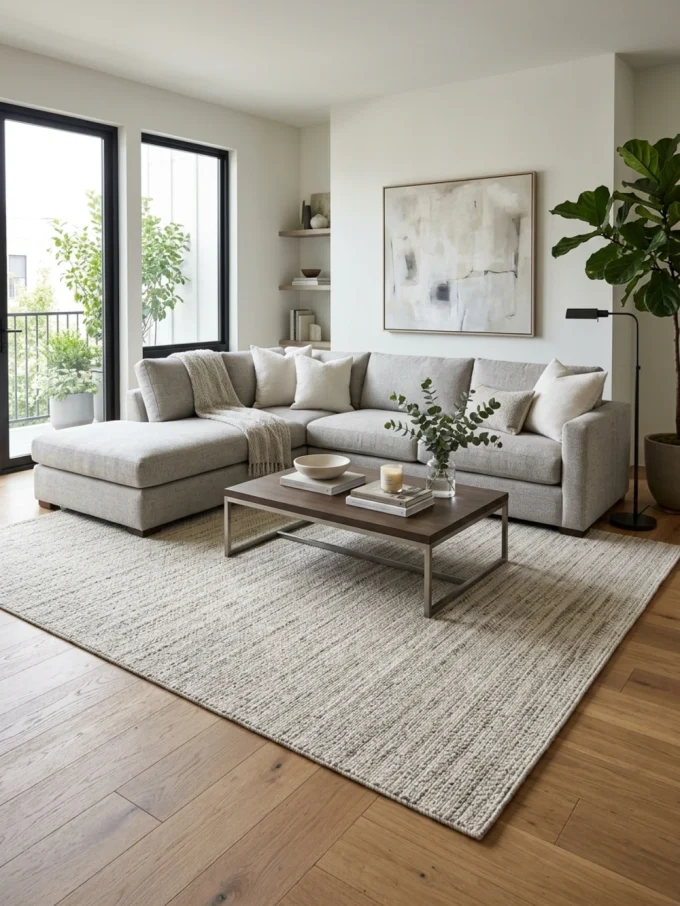
Sectionals need more careful rug placement because the seating occupies more floor area.
For a typical L-shaped sectional, position the rug so the front legs of both sections sit on it. Do not anchor only the long side while leaving the chaise or return floating outside the rug.
For larger rooms, an all-legs-on arrangement can create an even more unified seating zone.
As a starting point, 9 × 12 feet often suits a standard sectional, while 10 × 14 feet or larger may be more appropriate for a large sectional or open-plan room. The exact dimensions still depend on the sectional and room.
The important part is not memorizing one size. It is making sure the rug connects every important part of the sectional.
15. Try a Round or Organic-Shaped Rug
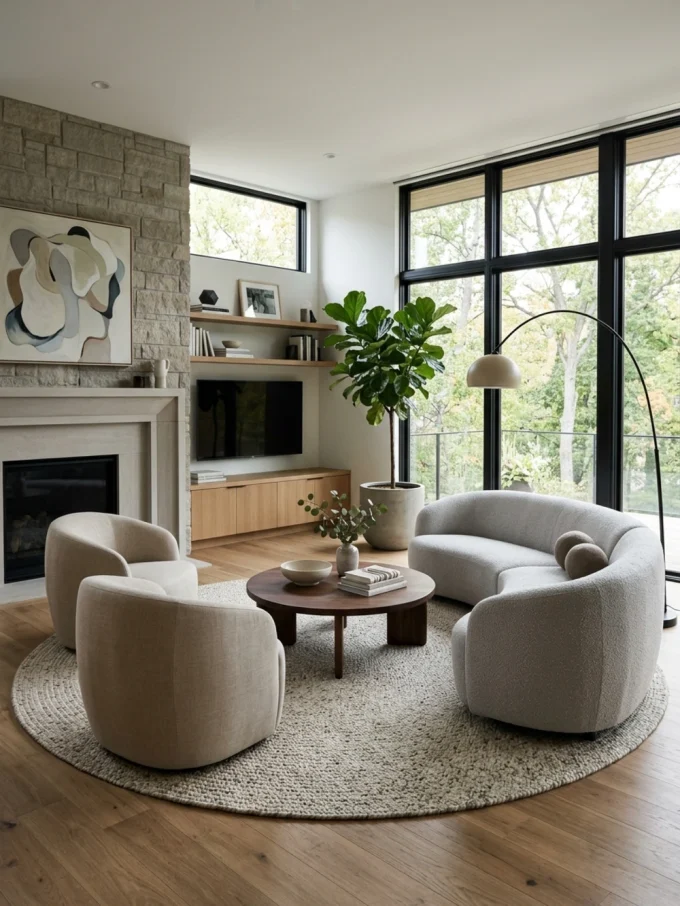
Rectangular rugs are the easiest choice, but they are not the only option.
A round rug can soften a room dominated by straight lines and works particularly well with:
- Round coffee tables
- Curved sofas
- Small conversation areas
- Circular lighting
- Compact seating arrangements
An irregular or organic-shaped rug can have a similar effect while feeling more contemporary.
The shape should support the furniture arrangement rather than sit randomly underneath one object.
If the seating arrangement is long and rectangular, a round rug may feel disconnected. If the room has several curves, however, it can reinforce that softer design language.
16. Use a Sculpted Rug for Tone-on-Tone Texture
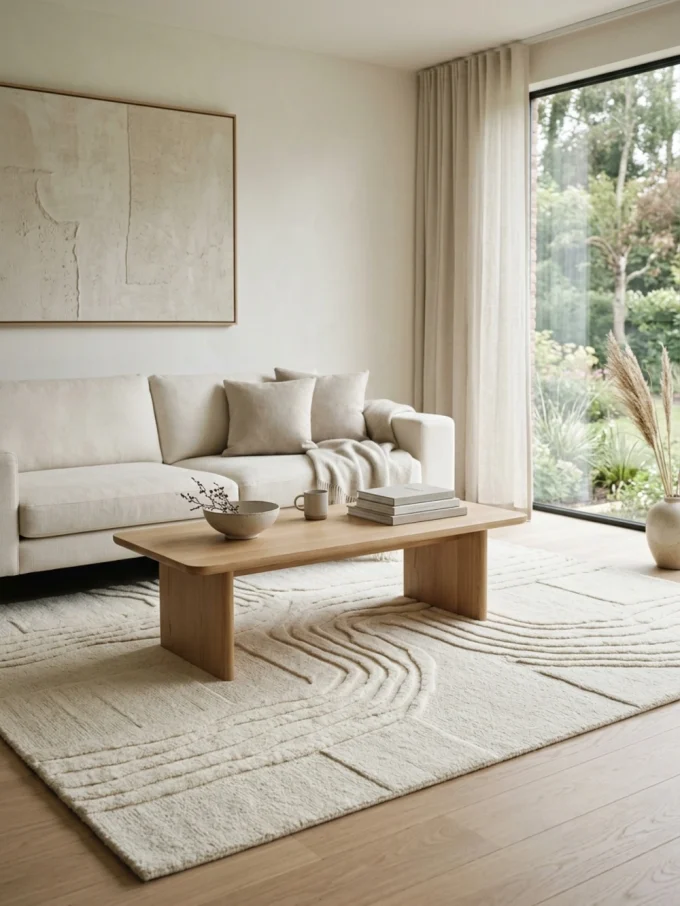
A sculpted rug creates pattern through changes in pile height rather than strong color contrast.
Imagine a warm ivory rug with raised organic lines or subtle geometric sections. From across the room it appears mostly solid; closer up, the texture becomes visible.
This is ideal when you want visual interest without adding another obvious color.
It works particularly well in minimalist rooms where the furniture and walls already have simple palettes.
The trade-off is maintenance. Deep or highly textured surfaces can require more attention than a straightforward low-pile rug, especially in homes with pets.
17. Match the Rug to Your Flooring Undertone
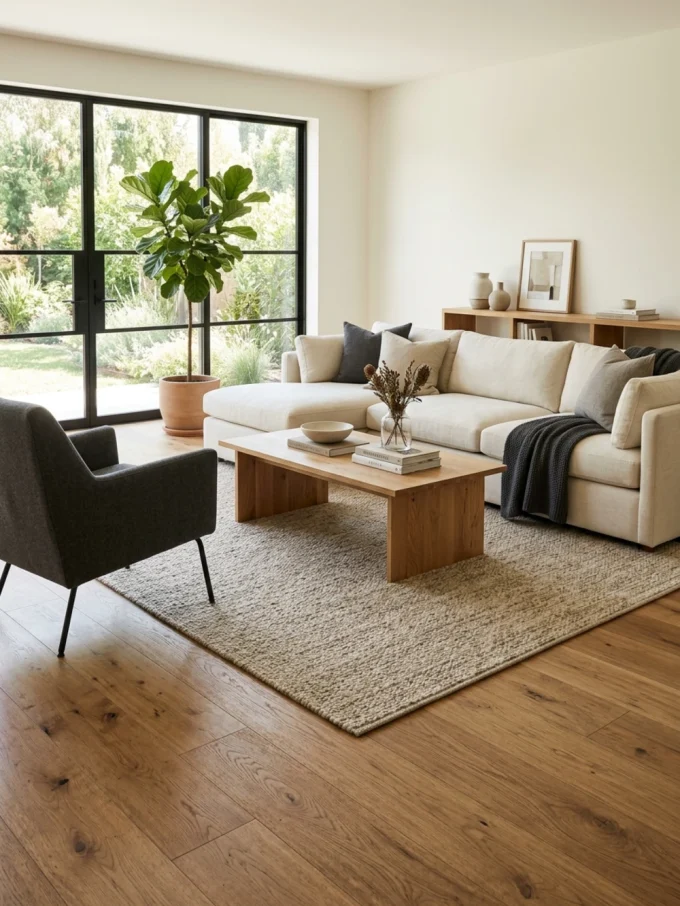
Do not choose a living room rug in isolation from the floor.
The same beige rug can look completely different over:
- Light oak
- Dark walnut
- Gray wood
- Concrete
- Stone
- Existing carpet
With dark flooring, a lighter rug can create useful separation.
With pale flooring, a medium-toned rug can give the seating area more definition.
With warm wood, warm neutrals often create a seamless look, while muted charcoal, blue, or olive can introduce controlled contrast.
The goal is not to make the rug disappear. It should have enough tonal difference from the floor to clearly define the seating area.
18. Choose a Practical Rug for Pets, Children, and Daily Traffic
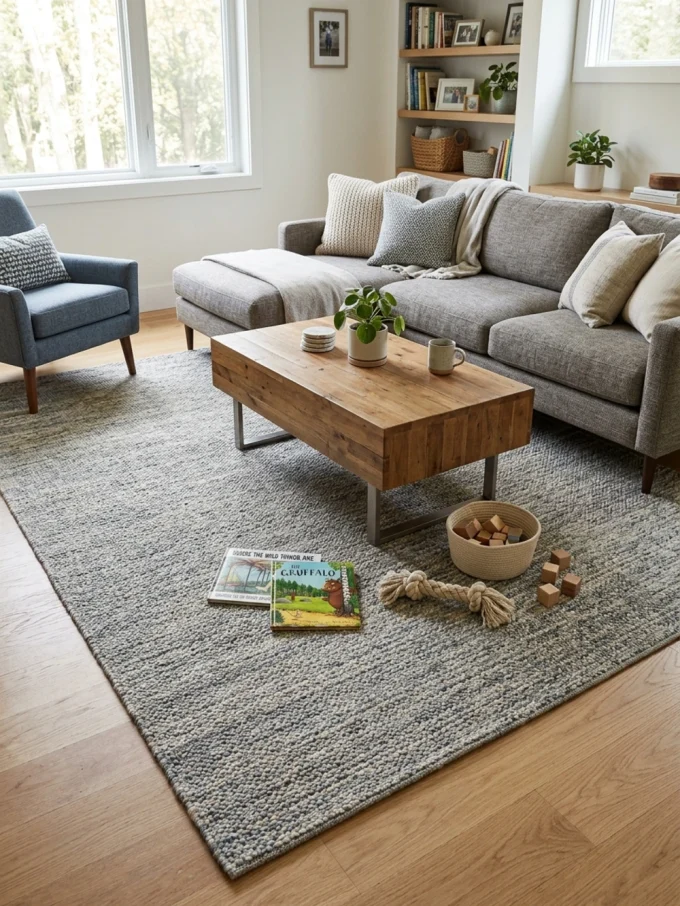
Your ideal rug should match the household, not just the photograph.
For pets and children, consider:
- Low or moderate pile
- Easy-clean construction
- Durable fibers
- Patterns that disguise small marks
- A color that does not show every piece of dirt
Washable rugs can also be useful in high-spill homes, but check the actual care requirements before buying. A rug being labeled “washable” does not automatically mean every large size will be convenient to clean at home.
Deep shag can feel luxurious, but it may be less practical when hair, crumbs, and dirt are regular concerns.
If your home receives heavy traffic, durability and maintenance should be part of the design decision from the beginning.
19. Make One Statement Rug the Starting Point for the Room
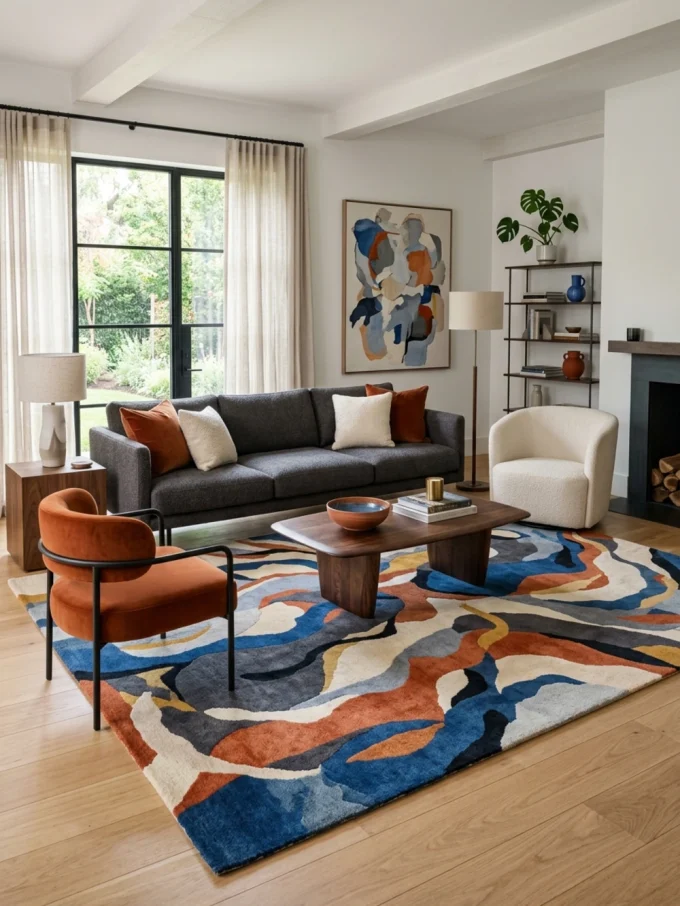
Instead of treating the rug as the final accessory, make it the design starting point.
This works especially well with a distinctive:
- Abstract rug
- Vintage-inspired rug
- Geometric rug
- Multicolor rug
- Sculptural rug
Choose the sofa and larger furniture around the rug’s overall character rather than trying to match every color exactly.
You only need to repeat one or two secondary colors elsewhere.
This approach is particularly useful when you want a room with personality. The rug establishes the palette, visual scale, and mood before the smaller accessories are added.
There is no universal answer to whether the sofa or rug should come first. Designers currently take both approaches, but they agree that the major pieces should be compared together before committing so scale and color work as a system.
How to Choose the Right Rug Size for Your Living Room
Rug size should be based primarily on the furniture grouping, not simply the empty room.
Here is a useful starting point:
| Seating arrangement | Starting rug size | Best placement |
|---|---|---|
| Small loveseat | 5 × 8 or 6 × 9 ft | Front legs on |
| Standard 3-seat sofa | 6 × 9 or 8 × 10 ft | Front legs on |
| Sofa + two chairs | 8 × 10 or 9 × 12 ft | Front legs on |
| Standard L-shaped sectional | 9 × 12 ft | Front legs of both sections on |
| Large sectional | 10 × 14 ft or larger | Front or all legs on |
| Open-plan seating | 9 × 12 or 10 × 14 ft+ | All legs on when possible |
These are starting points, not rigid rules. Current sizing guides similarly place 8 × 10 feet among the common choices for average living rooms and 9 × 12 feet among the stronger options for larger rooms and open layouts.
The Front-Legs-On Layout
Place the front legs of the main seating pieces on the rug while the back legs remain on the floor.
This is one of the most versatile arrangements because it anchors the furniture without requiring an extremely large rug.
Use it when:
- The room is medium-sized
- You have a sofa and chairs
- A larger rug would crowd the walkways
- You want a balanced result without covering most of the floor
The All-Legs-On Layout
Put all four legs of the seating pieces on the rug.
This works particularly well in larger rooms and open-plan spaces because the rug creates a clearly defined seating zone.
It requires more rug area, so measure carefully before purchasing.
The Coffee-Table-Only Layout
This is the smallest arrangement and should generally be reserved for genuinely tight spaces.
The coffee table sits on the rug while the seating remains outside it.
It can work in a small apartment, but it is also the easiest arrangement to make look undersized. If the rug does not visually connect to the seating, the furniture may appear to float around it.
How to Place a Rug Under a Sectional
A sectional changes the calculation because both sections need to feel connected.
For an L-shaped sectional, position the rug so the front legs of both sections rest on it. The chaise or return should not look visually separated from the rest of the seating.
For a large open-plan room, you can move toward an all-legs-on arrangement if the rug is large enough.
The coffee table should also sit comfortably within the rug rather than hovering at the edge.
If the rug stops halfway underneath the sectional, it can make the entire seating arrangement look disconnected.
How to Choose a Rug Based on Your Flooring
Light wood floors
Medium warm neutrals, muted colors, and soft patterns can create enough contrast without making the room feel heavy.
Dark wood floors
Cream, oatmeal, beige, dusty blue, and other lighter rugs can prevent the seating area from visually disappearing into the floor.
Gray flooring
Look at undertones carefully. Warm greige, cream, muted blue, and soft taupe can prevent a cool gray floor from feeling overly stark.
Concrete or stone
Natural textures, warm neutrals, wool, jute, and earthy colors can soften the harder architectural feel.
Wall-to-wall carpet
An area rug can still work, especially when you want to visually define a seating zone. Use a suitable grip solution and avoid creating an unstable or bulky transition.
How to Choose a Modern Living Room Rug Material
Wool
Wool is a strong option when softness, durability, and a more premium feel matter.
It is particularly suitable for rooms where the rug will be used heavily and remain in place for years.
Synthetic Fibers
Synthetic options can be useful when affordability, stain resistance, and easier maintenance are priorities.
Check the specific fiber and manufacturer’s care instructions rather than treating all synthetic rugs as identical.
Jute and Sisal
These are useful when texture and an organic appearance matter more than plush softness.
They can look excellent with modern wood furniture but may require more careful handling around spills.
Flatweave
Choose a flatweave when you want a lower profile, easier furniture movement, and less bulk.
High Pile
High-pile rugs are best when comfort is a priority and you are prepared for more maintenance.
They can be less convenient with pets, robot vacuums, and heavy everyday traffic.
Do You Need a Rug Pad?
In many living rooms, a rug pad is more than an optional extra.
A suitable pad can help:
- Keep the rug from shifting
- Reduce bunching
- Add cushioning
- Protect the floor
- Make the rug feel more substantial
Choose a pad designed for your flooring type. The wrong backing can create problems on some surfaces, so check compatibility before installation.
A pad is particularly worthwhile when the rug sits in a high-traffic walkway or underneath furniture that moves frequently.
How to Choose a Modern Rug for Pets and Kids
Start with maintenance rather than appearance.
A practical family-room rug should tolerate the type of mess your household actually produces.
For pets
Low or moderate pile can be easier to vacuum than deep shag. A subtle pattern can also disguise small marks between cleanings.
For children
Consider washable or easy-clean options, durable fibers, and colors that do not show every small spill.
For heavy traffic
Prioritize construction and care requirements over an extremely delicate finish.
A rug that looks perfect but requires constant professional cleaning may not be the best choice for a room used every day.
How to Choose the Right Rug Shape
Rectangular
Best for most sofas, sectionals, and conventional seating arrangements.
Round
Useful for curved furniture, circular coffee tables, and compact conversation areas.
Square
Can work in nearly square seating zones where a rectangular rug would feel unnecessarily directional.
Organic or irregular
Useful when you want to soften a room dominated by straight lines and create a more artistic contemporary feel.
The shape should reinforce the furniture arrangement. A beautiful rug with the wrong geometry can still make the room feel awkward.
Common Modern Living Room Rug Mistakes to Avoid
Buying a Rug That Is Too Small
If the rug sits only beneath the coffee table while all the seating floats outside it, the room can feel disconnected.
Choosing the Pattern Before Measuring
A rug should fit the room before it fits your Pinterest board.
Measure first, then choose the design.
Ignoring Sectional Geometry
A sectional requires the rug to connect both sections. Anchoring only one side can make the chaise or return look detached.
Matching Every Color Exactly
Your rug does not need to match the sofa, cushions, curtains, and artwork.
Use related colors instead of exact repetition.
Forgetting the Flooring Undertone
A beige rug beside warm oak can look very different from the same beige rug beside cool gray flooring.
Always compare samples in your actual room.
Choosing a High-Pile Rug Without Considering Maintenance
A plush rug can be wonderful, but it may not suit pets, children, robot vacuums, or heavy traffic.
Skipping the Rug Pad
A rug that constantly moves, curls, or bunches can become both annoying and unsafe.
Letting the Rug Stop at an Awkward Point
The rug should visually connect the main seating area rather than stopping just short of the sofa or sectional.
For broader decorating guidance, our home decor mistakes to avoid covers other decisions that can affect how cohesive the finished room feels.
Frequently Asked Questions
What is the best rug size for a modern living room?
For many average living rooms, 8 × 10 feet is a useful starting point. Larger seating arrangements and open-plan rooms may need 9 × 12 feet or 10 × 14 feet. The furniture layout should determine the final size.
Should a living room rug go under the sofa?
Usually, the rug should reach at least the front legs of the sofa. In a larger room, putting all furniture legs on the rug can create an even more unified seating area.
What size rug works best under a sectional?
A 9 × 12-foot rug is a useful starting point for many standard sectionals, while large sectionals may require 10 × 14 feet or larger. The key is making sure the front legs of both sections rest on the rug.
Is a round rug good for a living room?
Yes, particularly when the room includes curved furniture, a round coffee table, or a compact conversation area. A round rug is less naturally suited to a long rectangular seating arrangement.
Are neutral rugs good for modern living rooms?
Yes. Neutral rugs work particularly well when they add texture, tonal variation, or subtle pattern instead of appearing completely flat.
What is the easiest living room rug to maintain?
Low-pile, flatweave, and performance-oriented rugs can be practical for busy households, but maintenance depends on the specific fiber and construction. Always follow the manufacturer’s care instructions.
Should the rug be darker or lighter than the floor?
There is no universal rule. A lighter rug can create separation from dark flooring, while a medium or darker rug can add definition to pale floors. The important factor is sufficient contrast and compatible undertones.
Can you put an area rug over carpet?
Yes. It can help define a seating area within a carpeted room, especially in open layouts. Use an appropriate non-slip solution and make sure the rug does not create an unstable or excessive edge.
Final Thoughts
The best modern living room rug ideas are not simply the ones that look fashionable.
They are the ones that solve a specific problem in the room.
A large rug can connect scattered furniture. A textured neutral rug can soften a minimalist space. A vintage-inspired design can add character to contemporary furniture. A muted blue rug can balance warm wood, while a sculpted tone-on-tone rug can create interest without introducing another color.
Before buying, measure the seating area, test the rug dimensions with painter’s tape, consider how the furniture will sit on it, and check the material against your household’s actual needs.
Then choose the style.
When size, placement, material, and design all work together, the rug stops looking like an accessory placed on the floor and starts doing what a great living room rug should do: making the entire room feel more intentional.