
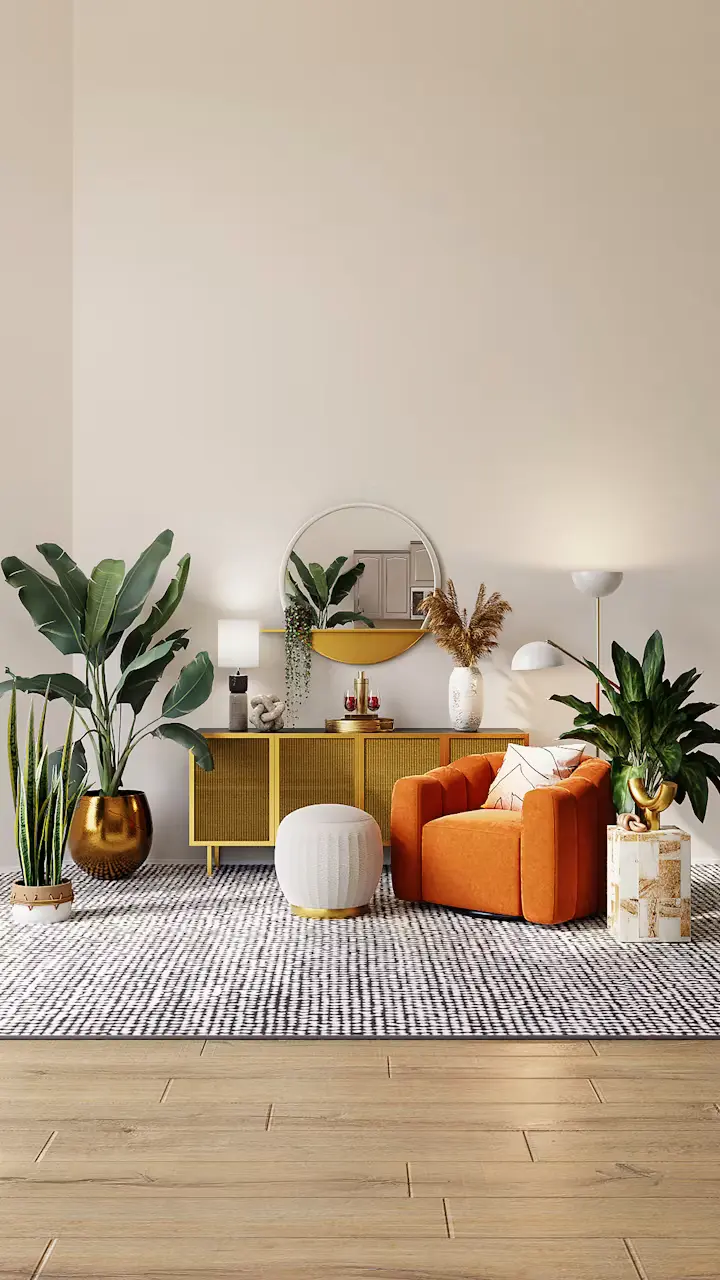
Cozy modern living room ideas work best when comfort is built into the room rather than scattered across it in the form of extra cushions, throws, candles, and decorative objects. A contemporary room can have clean furniture and relatively little clutter while still feeling warm if the seating is properly grouped, the lighting works after sunset, hard materials are balanced with softer ones, and the things used every day have somewhere sensible to live.
The opposite is also true.
A room can contain a cream sofa, wool rug, timber coffee table, and several lamps and still feel uncomfortable if the furniture is pushed against distant walls or the television dominates every sight line.
So start with the room.
Decor comes later.
Cozy Modern Living Room Ideas That Work in Real Homes
1. Arrange the Room for People Before Arranging It for the Walls
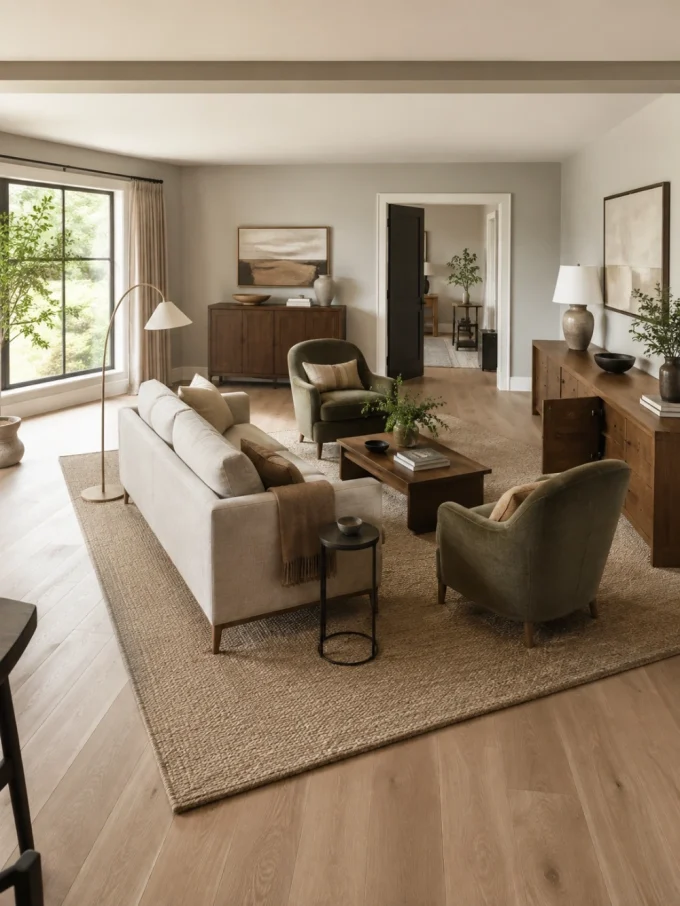
Furniture does not have to touch the perimeter.
In fact, pushing every piece against a wall can leave a large empty area in the middle while the people using the room sit surprisingly far apart.
Start with the main activity.
If conversation matters, pull seating close enough that people naturally feel part of the same group. A sofa may face two chairs rather than a television. An armchair can turn slightly inward instead of sitting square to the architecture.
In a large room, moving furniture away from the walls can create a much stronger central zone.
In a small room, the principle still applies, but clearance becomes more important. Do not float a sofa simply because larger rooms do it successfully.
Walk through the layout.
Open the doors.
Pull out any drawers.
The best arrangement is the one that still works when people start moving through it.
2. Stop Assuming a Cozy Room Needs Small Furniture
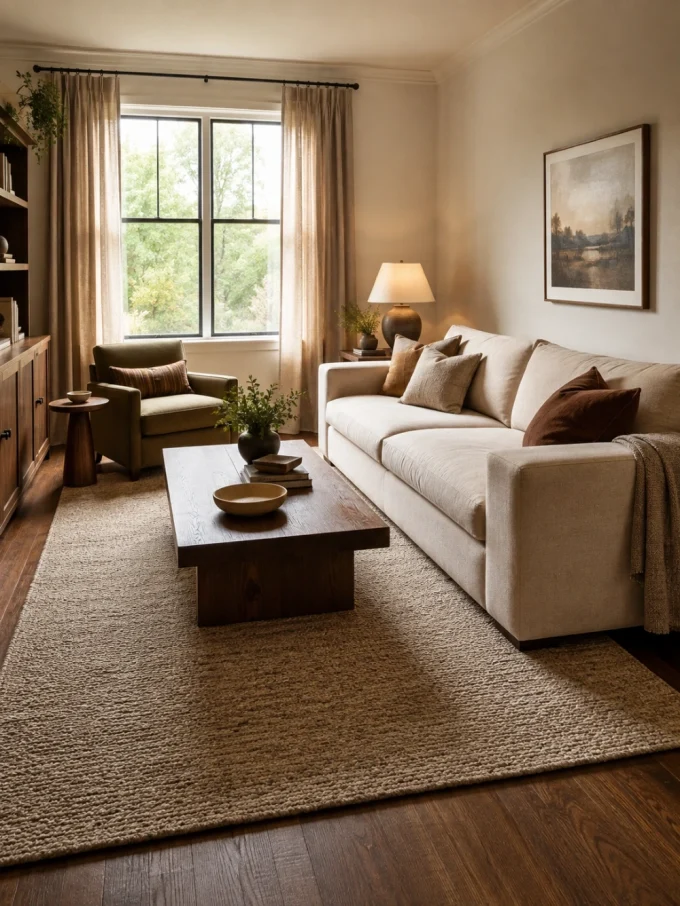
Small furniture does not automatically make a room feel larger.
Sometimes it makes the room feel fragmented.
A compact sofa, tiny rug, miniature coffee table, two narrow chairs, and several little side tables may technically fit, but the eye has to process each as a separate object.
One properly scaled sofa can create more calm than several smaller pieces.
The same applies to a coffee table.
If everyone has to lean forward awkwardly because the table was chosen mainly for its visual lightness, the room may look spacious while functioning badly.
Modern interiors often benefit from fewer pieces with enough presence to anchor the space.
Scale furniture to the room, but also scale it to the people and activities it serves.
3. Let the Rug Hold the Seating Together
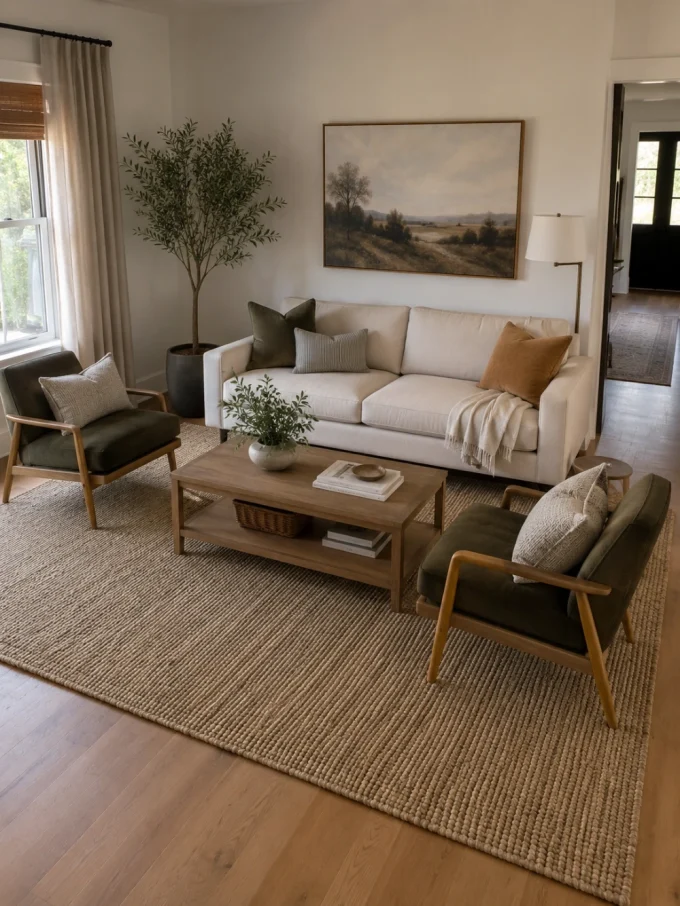
A rug is not just something soft to put under the coffee table.
Its more important job is often spatial.
When the sofa, chairs, and table visibly relate to the same rug, the seating area reads as one composition.
When the rug floats alone in the middle, the furniture can appear disconnected even if every individual piece is attractive.
Look at the whole grouping rather than treating rug size as an isolated purchase.
In a modest living room, this does not mean forcing the largest rug available beneath everything. Door swings, furniture legs, floor vents, and cleaning still matter.
The useful question is:
Does the rug connect the furniture, or is it simply decorating the floor between it?
Texture can then add physical warmth.
A flatter wool or woven rug may make more sense in a home with pets or frequent cleaning than an extremely deep pile chosen mainly for its photograph.
4. Let Wood Create Warmth Before Adding More Decor
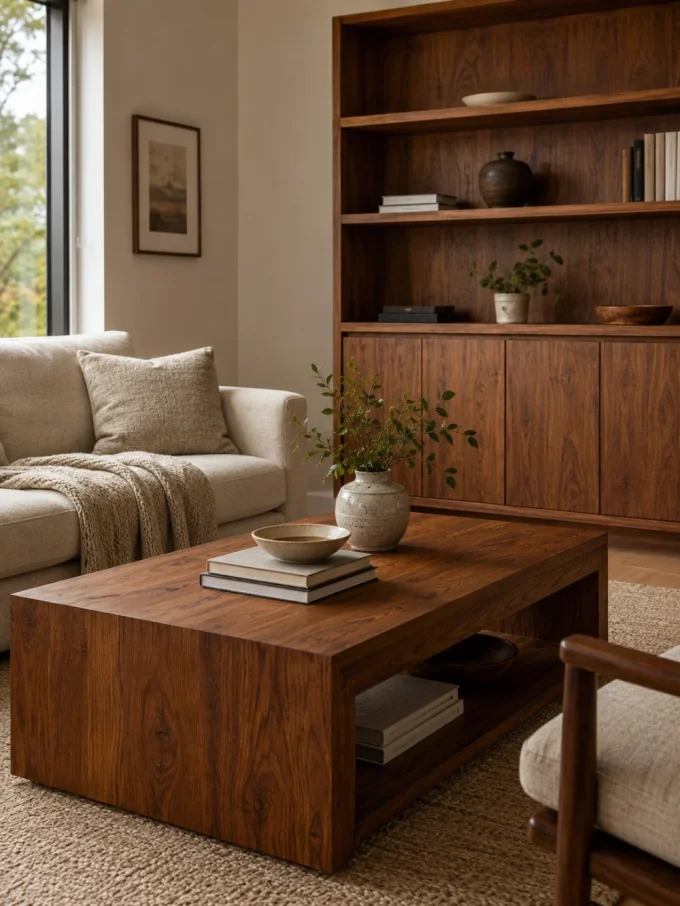
Natural timber does something particularly useful in a modern room.
It adds color and visible texture at the same time.
An oak coffee table, walnut cabinet, timber shelving, or exposed wood chair frame can soften painted walls, glass, metal, and upholstered furniture without needing another decorative pattern.
You do not have to match every wood perfectly.
Slight variation can make a room feel more natural.
The problem begins when several unrelated undertones appear together: yellow oak, orange flooring, red timber, cool gray wood, and very dark walnut competing within one small view.
Choose a dominant wood direction.
Then let secondary pieces relate rather than duplicate.
Warmth comes more easily from one substantial wood surface than six tiny wooden accessories placed around the room.
5. Build a Neutral Palette With Differences You Can Actually See
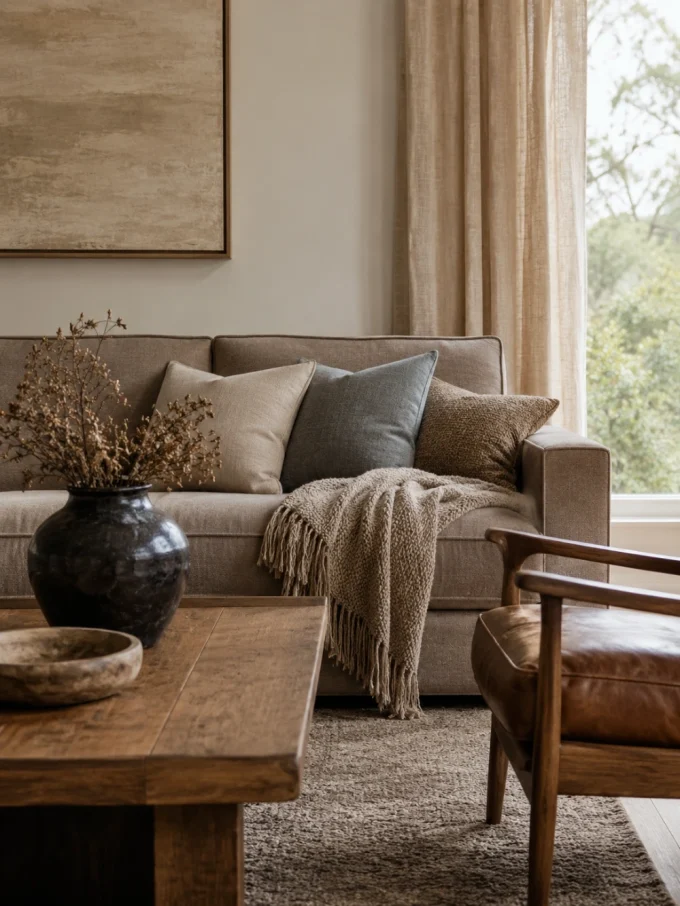
Cream sofa.
Cream walls.
Beige rug.
Beige curtains.
Beige cushions.
A room can contain five colors and still look like one flat surface.
A successful warm-neutral room needs variation in temperature, depth, and material.
Try a warm-white wall with a mushroom sofa, deeper taupe rug, medium wood, and one dark object.
Or keep the furniture pale and let the curtains move slightly warmer.
Texture helps too.
A smooth cotton cushion behaves differently from wool, linen, leather, glazed ceramic, or timber even when their colors are close.
If you are using a cooler accent such as blue, it does not automatically destroy the warmth. A muted dusty or gray-blue can provide useful relief against warmer wood and cream. DecoralCove’s cool blue paint ideas can help if you want to explore cooler tones without turning the entire room cold.
A palette needs relationships, not just a color family.
6. Add One Deeper Color So the Room Has Somewhere to Land
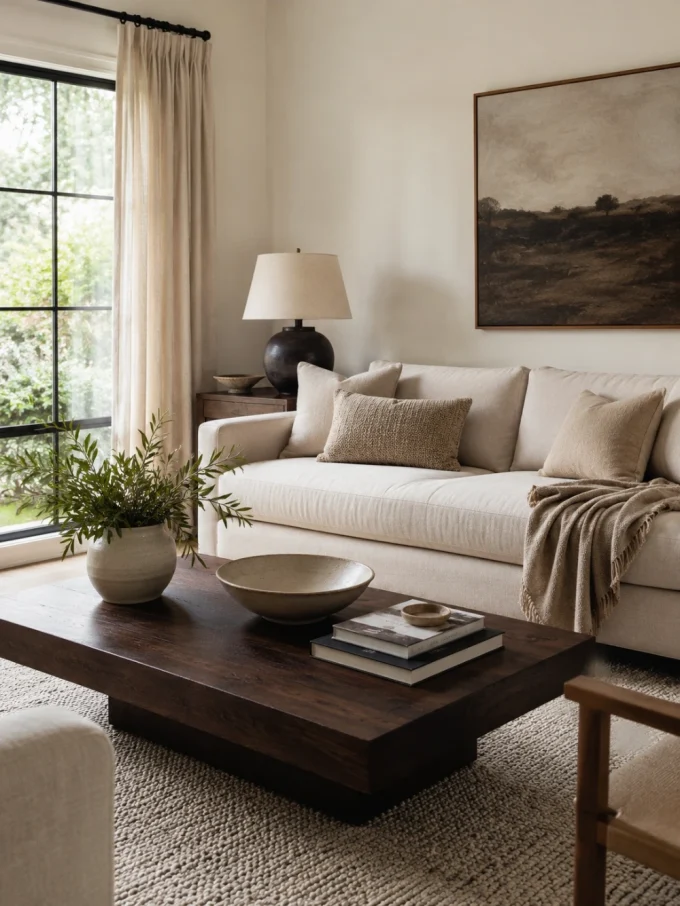
Pale modern rooms can begin to float visually.
The wall, rug, sofa, curtains, and coffee table may all be attractive, yet nothing gives the composition enough weight.
Introduce one deeper note.
That could be:
- walnut;
- chocolate brown;
- charcoal;
- muted olive;
- burgundy;
- dark blue;
- soft black.
A dark coffee table beneath a pale sofa can be enough.
So can a charcoal lamp, deeper chair, or one substantial artwork.
The objective is not to distribute black accents around the room according to a formula.
Use contrast where it improves hierarchy.
For a stronger example of controlled contrast, DecoralCove’s small black and white living room ideas shows how light and dark elements can work together without making the whole room feel severe.
7. Design the Lighting for 8 p.m., Not Just Noon
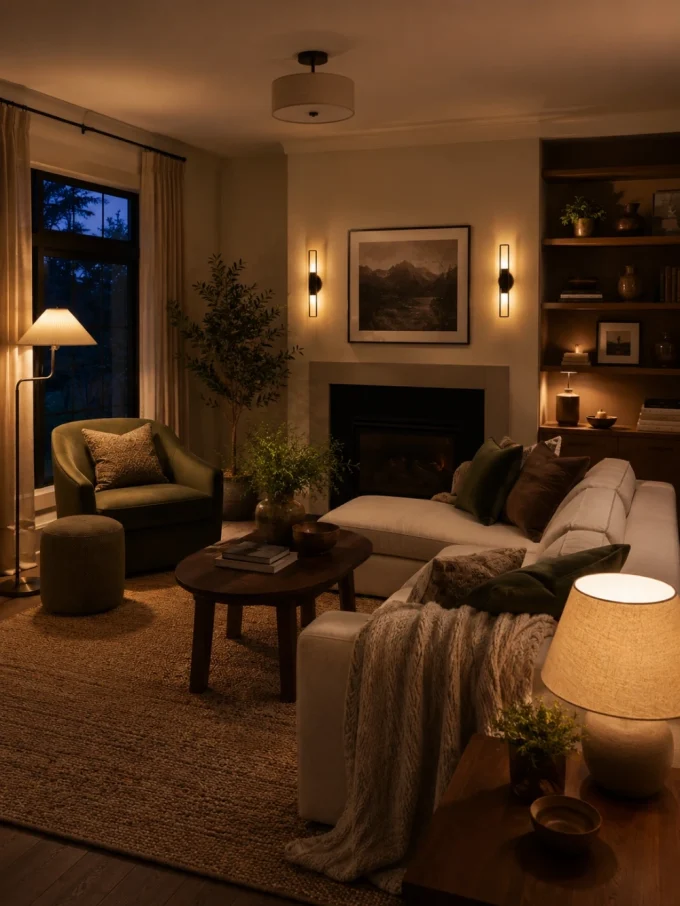
A room can look beautifully warm in afternoon sunlight and surprisingly clinical once the ceiling light comes on.
That is why cozy modern interiors need more than one source of light.
Think in terms of activities.
Where does someone read?
Where does a conversation happen?
Which wall becomes very dark after sunset?
Does the coffee table need direct light at all, or would a lamp behind the sofa be more useful?
A floor lamp can bring light down to human height. A table lamp can warm one corner. Wall lights can illuminate a surface while keeping the floor clear.
If the architecture suits them, DecoralCove’s wall sconce light fixture ideas and indoor wall-mounted light fixture ideas offer more ways to move lighting away from a single ceiling source.
Avoid turning every light into a statement fixture.
The room should glow in layers.
It should not look like a lighting showroom.
8. Give Wall Texture One Clear Job
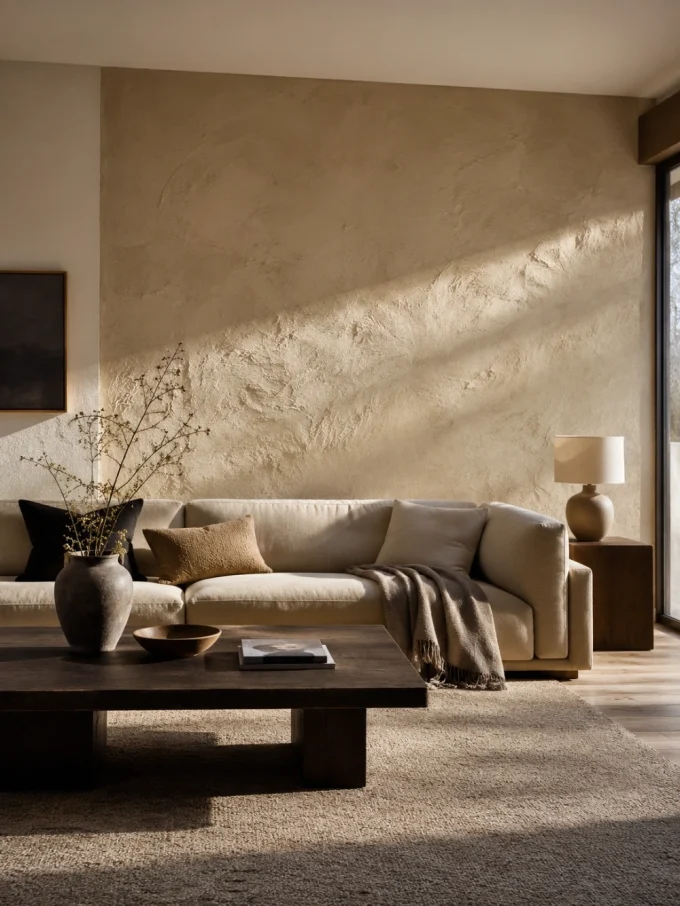
Textured plaster, limewash-like surfaces, wood paneling, fluted details, stone, and dimensional treatments can all make a modern room feel warmer.
They can also overwhelm each other.
Ask what one textured surface needs to achieve.
Behind the sofa, it may provide enough depth that several framed pieces are unnecessary.
Near a fireplace, plaster can help the architectural form feel less flat.
A subtly textured wall receiving sideways daylight may change throughout the day without adding another color.
For more options, see DecoralCove’s wall texture design ideas.
Then stop.
If the feature wall is textured, the fireplace is stone, the media wall is slatted, the ceiling is paneled, and every soft furnishing has a strong weave, the room may contain plenty of warmth but very little visual rest.
Texture works because it contrasts with quieter surfaces.
9. Make the Fireplace Part of the Architecture
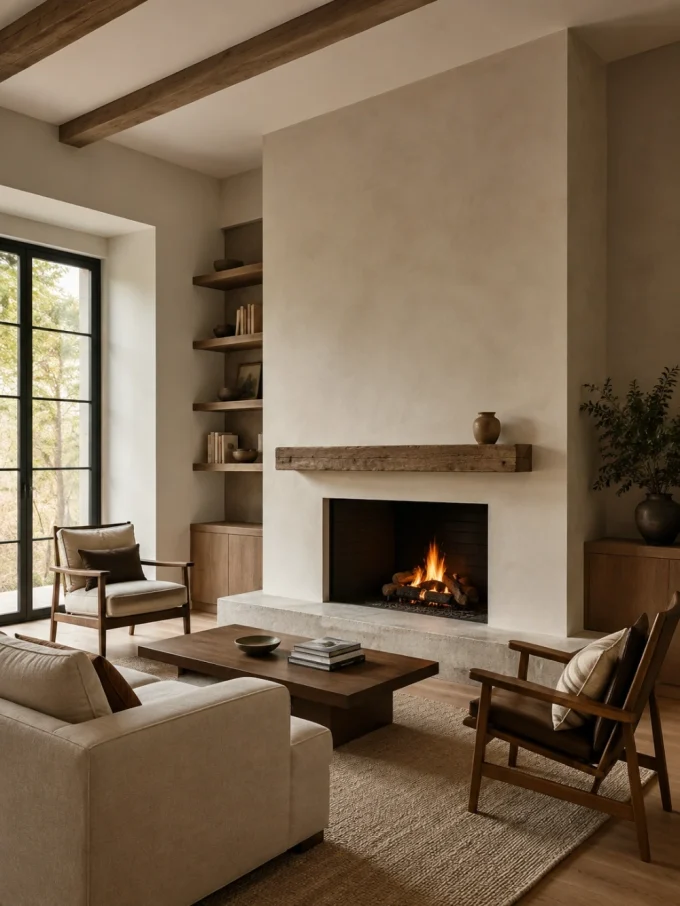
A fireplace can give a living room warmth even before it is lit.
The surround, hearth, proportion, and material create a visual center that furniture can respond to.
But decorating the mantel is not the first decision.
Look at the entire fireplace wall.
Does the surround feel too small for the wall?
Would plaster carried higher make the fireplace feel architectural?
Is a dramatic stone already doing enough without extra shelving?
Would one simple timber mantel create the warmth the wall is missing?
And if the room contains both a fireplace and television, decide which one is actually meant to dominate.
DecoralCove’s modern fireplace ideas goes deeper into stone, plaster, mantels, fireplace proportions, TV conflicts, and built-ins.
A cozy room does not need the biggest fireplace treatment.
It needs one that belongs to its architecture.
10. Make the Television Belong Without Designing the Whole Room Around It
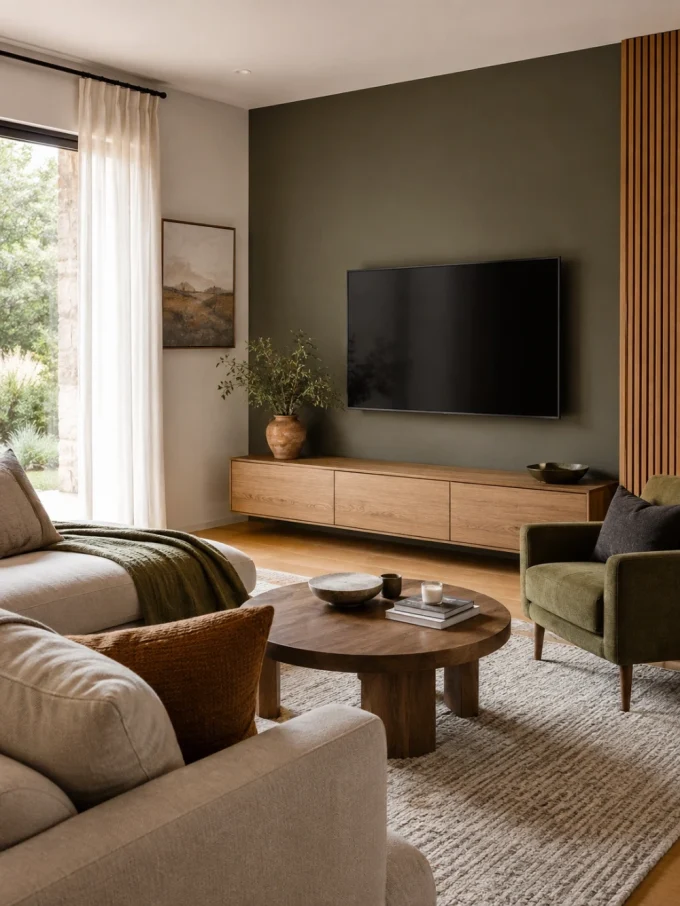
A television is a functional object.
Treating it as something shameful usually creates complicated solutions.
Treating it as the only important object creates a different problem.
Give the screen something to relate to.
That might be:
- a low console;
- a darker wall;
- timber panel;
- shallow cabinetry;
- controlled artwork;
- a simple media wall.
Hide cables and make sure devices have usable storage.
Then look at what the room feels like when the screen is off.
If the television remains a huge isolated black rectangle, the wall may need more visual support.
If the screen is surrounded by stone, slats, LED strips, niches, shelves, artwork, and ornaments, the wall may need less.
Our beautiful TV wall ideas article explores that balance in more detail.
The television can belong to the room without becoming the room.
11. Interrupt All the Rectangles With One Softer Shape
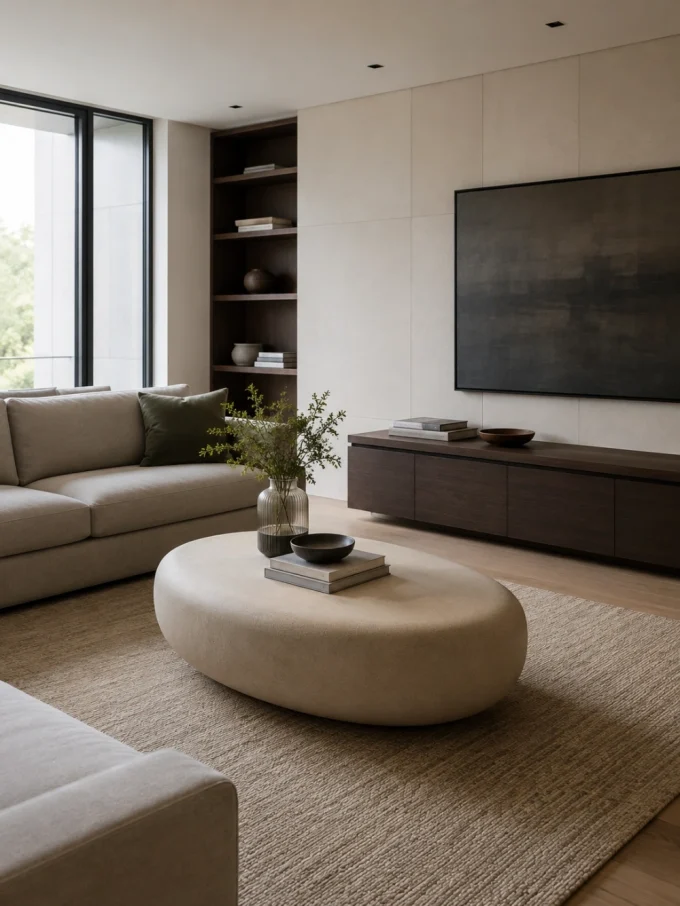
Modern living rooms accumulate straight edges quickly.
Sofa.
Rug.
TV.
Window.
Console.
Coffee table.
Artwork.
Another rectangular piece may technically coordinate while making the room feel increasingly rigid.
Introduce one rounded or irregular form.
A circular side table, oval coffee table, curved chair, softly arched lamp, or rounded ottoman may be enough to alter the rhythm.
Do not respond by making everything curved.
When the sofa, table, chairs, mirror, lamps, and shelving all use exaggerated rounded forms, the contrast disappears and the room starts following a theme.
One softer shape is useful because the rest of the architecture is straighter.
Let the difference remain visible.
12. Use Curtains to Soften the Architecture, Not Just Cover the Window
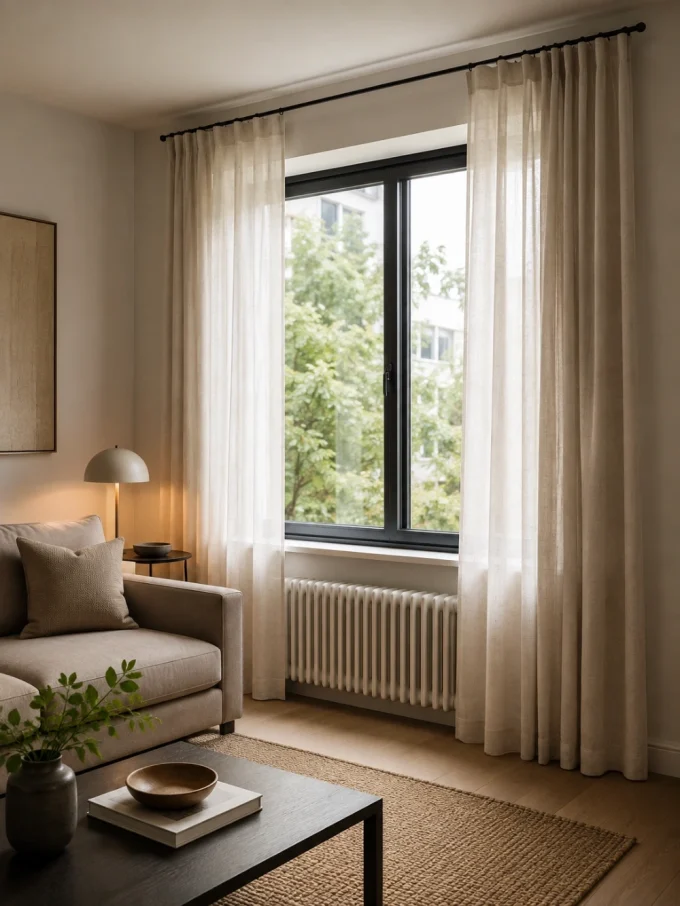
Curtains occupy more visual area than many decorative objects combined.
That makes their material and placement important.
A softer fabric can introduce movement beside rigid window frames and straight furniture.
Taking the treatment higher can visually connect more of the wall to the window, while allowing the fabric to fall close to the floor creates a cleaner vertical line.
But do not blindly copy floor-to-ceiling curtains from a tall inspiration room.
Check:
- radiator positions;
- furniture beside the window;
- door clearance;
- how much fabric stacks to either side;
- whether blackout or privacy control is actually needed.
In a compact room, enormous folds of heavy fabric can consume more visual and physical space than expected.
Softness should not become bulk.
13. Hide the Mess That Minimalist Photographs Conveniently Remove
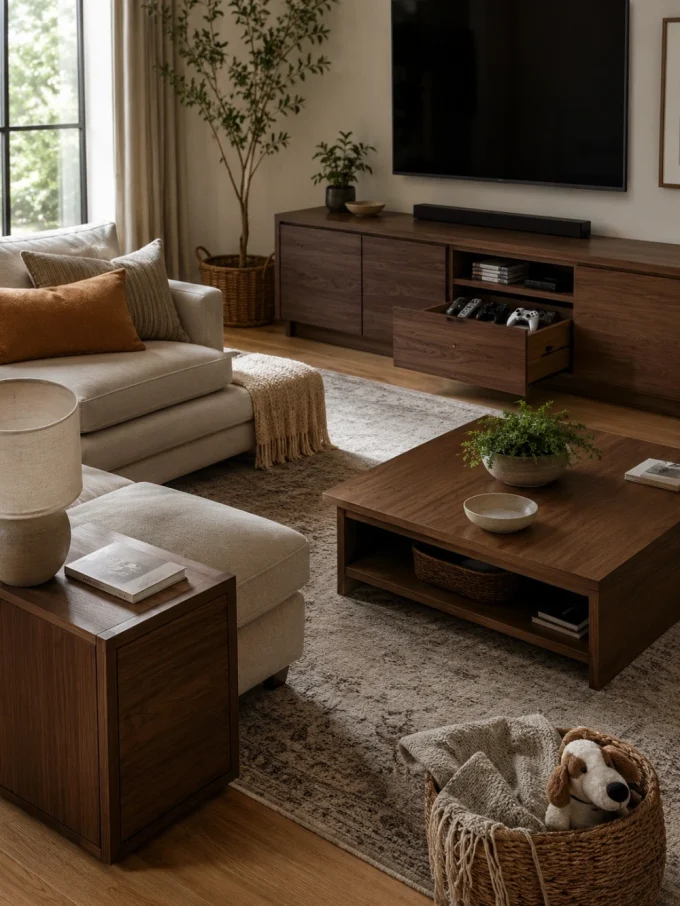
Living rooms collect things.
Remotes.
Charging cables.
Toys.
Board games.
Blankets.
Mail.
Controllers.
Books.
Pet accessories.
A room may be beautifully styled and still become visually chaotic within a day if none of these things has a home.
Before adding decorative shelving, solve storage.
A low media cabinet may hide electronics and games.
A closed side table can hold chargers.
A basket can collect blankets if it genuinely gets used.
Built-ins can be excellent when the household actually has enough belongings to justify them.
The objective is not hiding every sign of life.
It is preventing everyday items from permanently covering the surfaces that are supposed to create visual calm.
Storage is often what makes a modern room stay modern after the photographer leaves.
14. Choose Fewer Objects, but Let Them Have Enough Presence
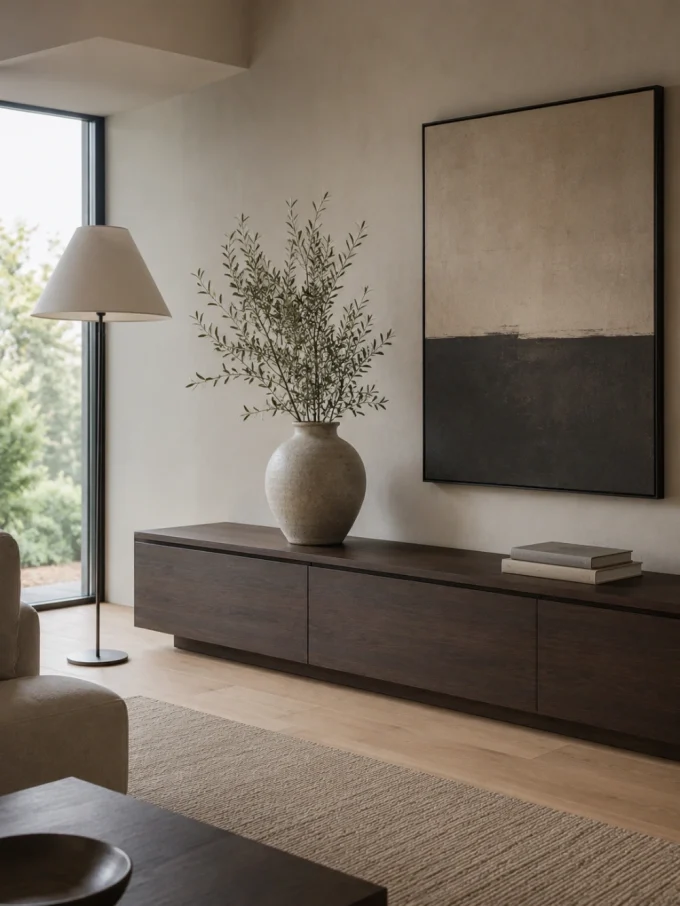
A room does not necessarily need more decoration because a console has empty space.
One large ceramic vessel may do more than five tiny accessories.
A substantial framed piece may settle a wall better than a collection of undersized prints.
One floor lamp can create a clear vertical element where several small table objects only create clutter.
Scale applies to decoration too.
This does not mean every object must be expensive or dramatic.
A simple bowl can look intentional when it has enough open surface around it.
A stack of books can feel useful when it relates to someone who actually reads them.
The room begins to feel less generic when objects have specific reasons to remain.
If you regularly reach the point where every surface seems to need “one more thing,” DecoralCove’s home decor mistakes to avoid is a useful next read.
15. Connect an Open Living Room to the Kitchen Without Matching Everything
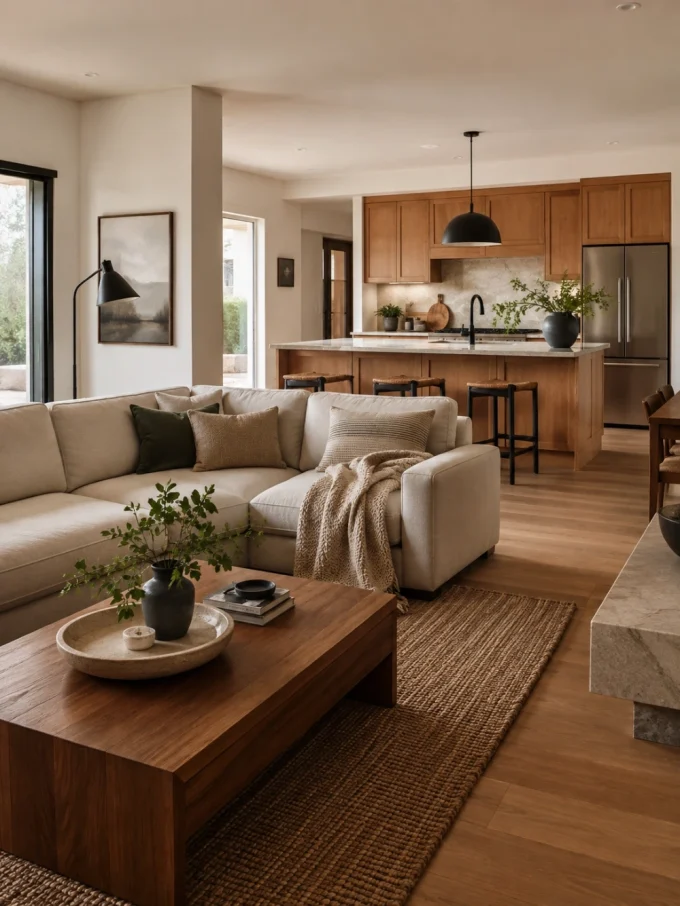
Open-plan rooms create a specific problem.
The living room has to feel connected to the kitchen without looking as though the same material palette was copied mechanically across both zones.
Look for one or two relationships.
The living room coffee table might repeat the warmth of the kitchen cabinetry.
A dark pendant in the kitchen may relate to a black living room lamp.
A stone surface can reappear in a smaller form.
The flooring may provide the strongest continuous element, allowing furniture and textiles to vary more freely.
Then use the arrangement to distinguish the functions.
The sofa, rug, and lighting can define the living area without constructing a wall.
If the spaces are being designed together, DecoralCove’s open kitchen design ideas can help you think about the relationship before finishing either side in isolation.
Connection is not the same as matching.
16. In a Small or Rental Living Room, Spend Space Before You Spend Money
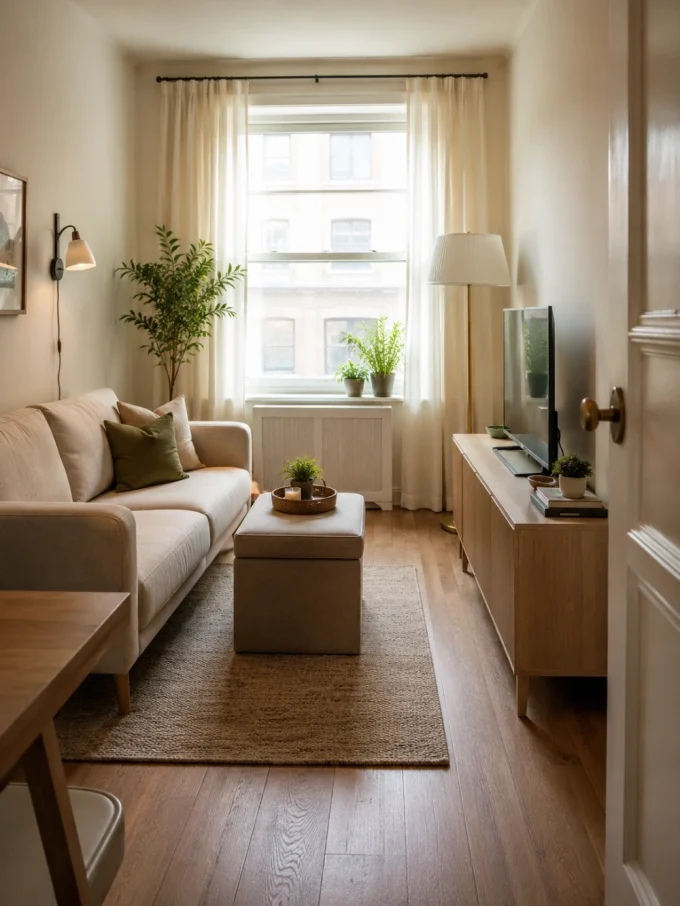
Small living rooms expose weak furniture decisions quickly.
A deep media unit, oversized sectional, bulky armchairs, and several accent tables can consume the usable floor before the decorating even begins.
Measure depth as carefully as width.
A sofa may fit across the wall and still project so far into the room that circulation becomes awkward.
A slimmer floor lamp may do the work of a side table and lamp.
Wall-mounted lighting may free another surface.
Closed storage can prevent several baskets from accumulating around the room.
For renters, permanent feature walls and built-ins may not make sense anyway. DecoralCove’s rental apartment decorating ideas offers more reversible approaches.
Do not treat temporary as inferior.
A well-scaled sofa, rug, lamp, curtains, and movable storage can establish most of the atmosphere without construction.
17. Remove Something Before Buying the Final Cozy Accessory
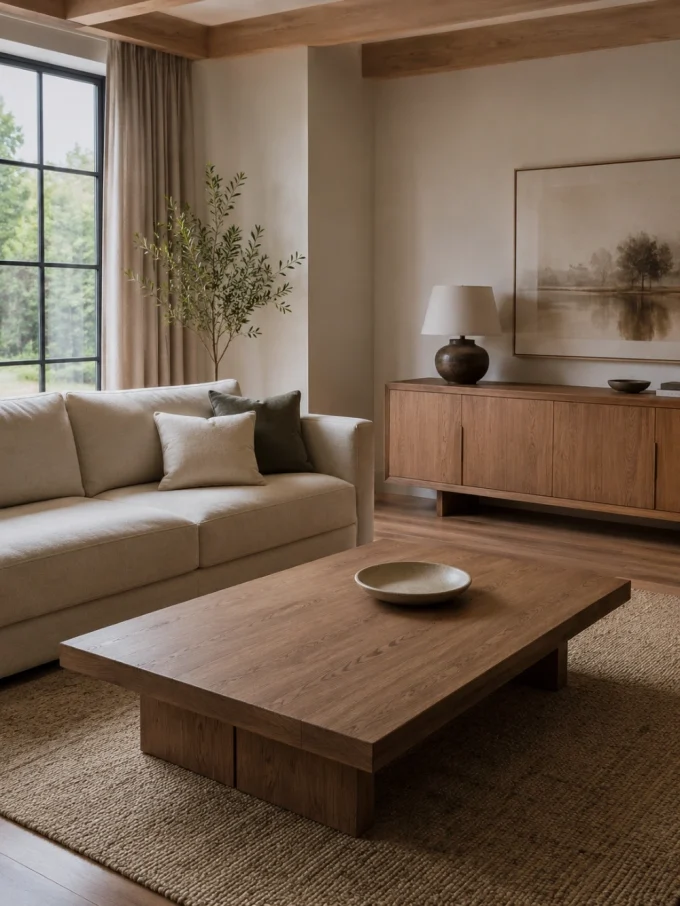
The room is nearly finished.
This is where a lot of living rooms become worse.
The sofa has cushions, but another set looks inviting.
The coffee table already has books and a bowl, but perhaps it needs a candle.
The console has a lamp and artwork, but one side looks empty.
Leave it empty for a few days.
Then look again.
Ask:
- Are several textures doing the same job?
- Does every horizontal surface contain objects?
- Are there too many small tables?
- Is the room warm because of its materials or because blankets cover everything?
- Does the furniture grouping work without the styling?
- Can you see some uninterrupted wall, floor, or tabletop?
A cozy room needs visual relief just as much as softness.
Comfort does not come from filling every gap.
Sometimes the most modern decision is restraint.
And sometimes the coziest thing you can add is simply enough room to put down a cup.
What Actually Makes a Modern Living Room Feel Cozy?
A cozy modern living room is usually built from a handful of relationships rather than a shopping list.
Furniture is close enough to support the way people actually use the room.
The rug makes the seating feel connected.
Wood and tactile materials soften harder architectural surfaces.
Lighting works after daylight disappears.
Storage absorbs the things everyday life introduces.
Dark or deeper elements give pale rooms visual weight.
The television and fireplace have clear roles rather than competing constantly.
Empty space remains visible around the objects that matter.
That is the useful balance.
Modern design gives the room clarity.
Cozy design makes that clarity comfortable to live with.
8. FAQs
How do you make a modern living room feel cozy?
Begin with furniture arrangement, lighting, and material contrast before adding decorative accessories. Bring seating into a useful grouping, add lower-level light sources, introduce natural wood or tactile textiles, and make sure everyday clutter has storage. A room usually feels warmer when its larger decisions work together.
Can a cozy modern living room use dark colors?
Yes. Charcoal, chocolate brown, deep olive, muted navy, and soft black can add useful visual weight. Dark colors are often most effective when their proportion suits the room rather than covering every surface automatically.
What colors work best in a cozy modern living room?
Warm white, mushroom, oatmeal, taupe, muted earth tones, brown, olive, and deeper neutrals all work well, but there is no required palette. Cooler accents such as dusty blue can also work when balanced by warm timber, textiles, or lighting.
How do you make a neutral modern living room less boring?
Increase differences in texture, depth, and material before adding more colors. Wood grain, woven textiles, stone, matte ceramics, darker accents, and varied lighting can make a restrained palette feel layered without becoming busy.
Does modern living room furniture have to match?
No. Furniture usually feels more natural when pieces relate through scale, color, material, or line without coming from one identical set. Perfectly matching furniture can sometimes make a modern living room feel more like a showroom.
How can I make a small modern living room cozy without clutter?
Use fewer pieces with clear jobs. Prioritize a properly scaled sofa, one useful rug, controlled storage, and layered lighting. Avoid filling every gap with small tables, baskets, or decorative furniture simply because the room is compact.