

Beautiful TV wall ideas are not really about disguising the fact that a television exists. The more useful goal is to make the screen belong to the room: properly positioned, visually grounded, coordinated with the seating and room arrangement, and surrounded by enough material or storage to feel deliberate without turning the whole wall into an entertainment showroom.
That distinction matters because a TV is already visually powerful.
When it is off, it becomes a large dark rectangle. When it is on, it naturally commands attention. Adding stone, timber slats, shelves, LED strips, cabinetry, artwork, and decorative objects around it does not necessarily reduce that dominance. Sometimes it simply creates a busier focal point.
Recent media-wall coverage shows plenty of built-ins, textured backgrounds, concealed storage, timber treatments, and methods for hiding or visually absorbing televisions.
The better question is not:
What can I add around my TV?
It is:
What does this wall actually need to make the television, room, and everyday equipment work together?
1. Decide Where the TV Belongs Before Designing the Wall Around It
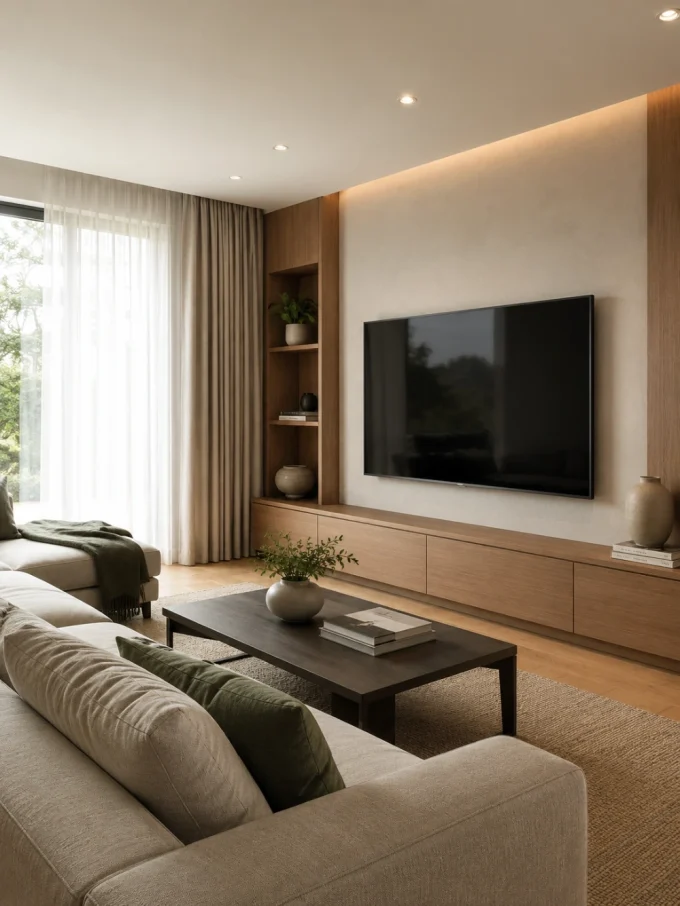
Start with the television.
Not the wood sample.
Not the stone slab.
Not the floating shelf.
Sit in the places where people actually watch the screen and look at the wall.
The position needs to make sense from the sofa before it makes sense from the room entrance.
Screen mounting also has technical requirements that depend on the television, mount, wall construction, and installation. Samsung’s mounting guidance, for example, recommends consulting the specific television manual and compatible mount instructions rather than assuming one installation works for every model. Sony similarly advises matching wall-mount hardware and attachment conditions to the actual television and wall.
Light matters too.
A striking TV wall opposite a large sunny window may create reflections that become much more noticeable once the screen is on. Sony’s current mounting guidance specifically identifies lighting conditions and screen glare as factors to consider when selecting TV placement.
Solve the viewing wall first.
Then make it attractive.
2. Use a Floating Console to Give the Screen Something to Relate To
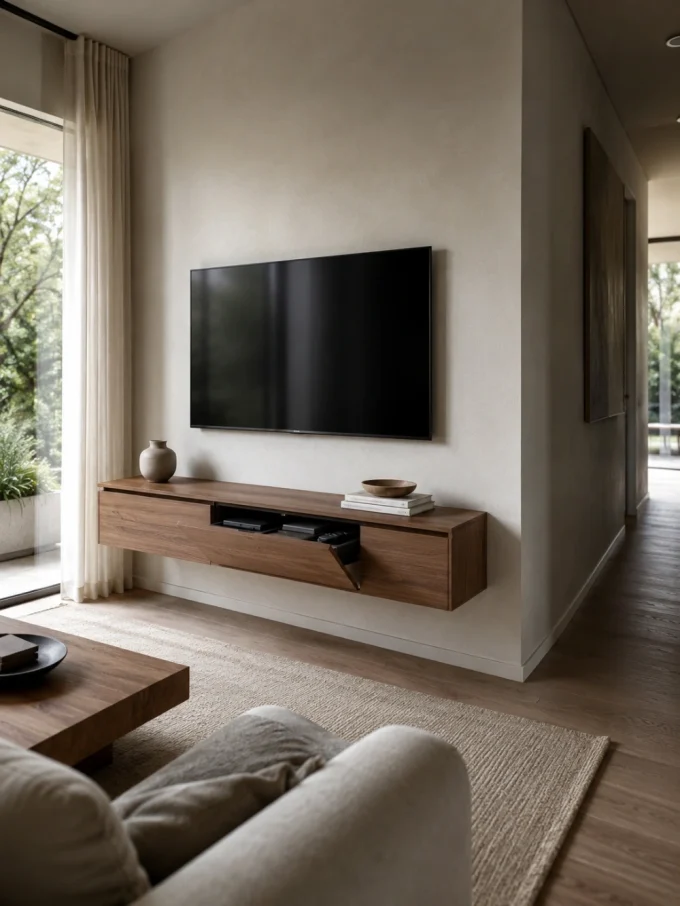
A television mounted alone on a large wall can look as though someone simply found the nearest available outlet.
A low console gives it a visual base.
The furniture and screen begin to read as one arrangement instead of two unrelated rectangles.
A floating console strengthens that effect without placing another heavy piece of furniture on the floor.
It can also conceal:
- remotes;
- gaming equipment;
- small electronics;
- spare cables;
- controllers;
- media accessories.
But do not choose the console by width alone.
Depth matters in a narrow living room.
A beautiful cabinet that projects too far into the walkway can create a daily circulation problem even if it fits perfectly across the wall.
Also check what actually needs to live inside it.
A shallow floating unit may look excellent and be completely useless if the devices you own do not fit.
Design the storage from the inside out.
3. Try a Darker Wall Before Building an Elaborate Media Wall
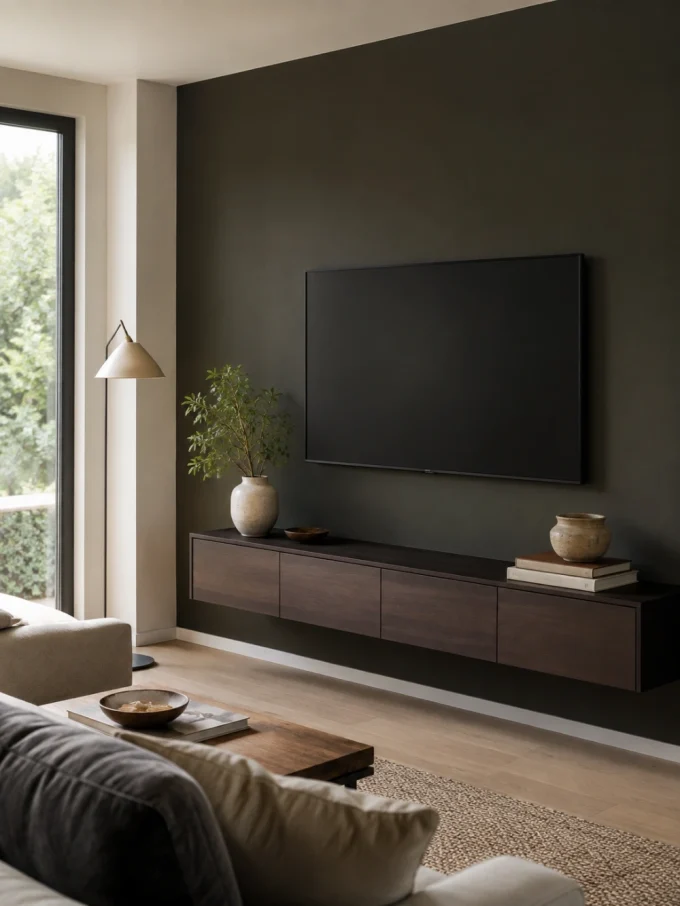
Sometimes paint can solve a problem that carpentry was about to make expensive.
A black television creates strong contrast against a very pale wall.
Move that same television onto charcoal, deep olive, brown, muted navy, or another darker background and the boundary of the screen can become less visually abrupt when it is off.
The wall does not have to be black.
The objective is simply to reduce the contrast enough that the television stops looking pasted onto the surface.
If you like stronger tonal relationships, DecoralCove’s small black and white living room ideas show how dark and light elements can coexist without making the entire room severe.
Test the color in the actual room.
A dramatic dark TV wall can provide useful depth in a bright living space but feel much heavier in a narrow room receiving limited daylight.
Paint is inexpensive compared with millwork.
Use that advantage.
4. Use Wood to Warm the Screen Without Turning the Wall Into a Slat Catalogue
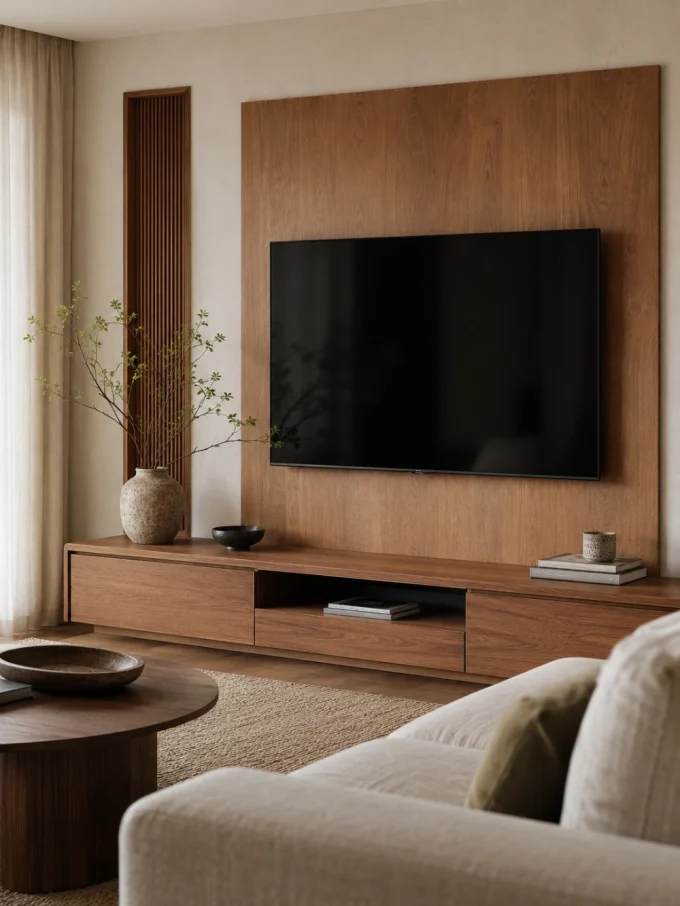
Wood is effective behind a television because its grain provides variation while its natural color softens the hard black surface of the screen.
That does not mean the whole wall needs vertical slats.
Current TV-wall inspiration contains plenty of slatted and fluted treatments.
The idea becomes more interesting when timber is used selectively.
You might use:
- one broad veneered panel behind the television;
- timber only below the screen;
- a vertical timber zone to one side;
- a wood console against a plain wall;
- shallow slats framing rather than filling the entire wall.
This gives the material room to be noticed.
It also prevents the television from being surrounded by dozens of high-contrast vertical lines.
Ask what the timber is doing.
If it adds warmth, establishes scale, or connects the screen to existing wood elsewhere in the room, it has a purpose.
If it is only there because TV walls currently have slats, reconsider it.
5. Let Plaster, Limewash-Like Texture, or Matte Paint Stay Quiet
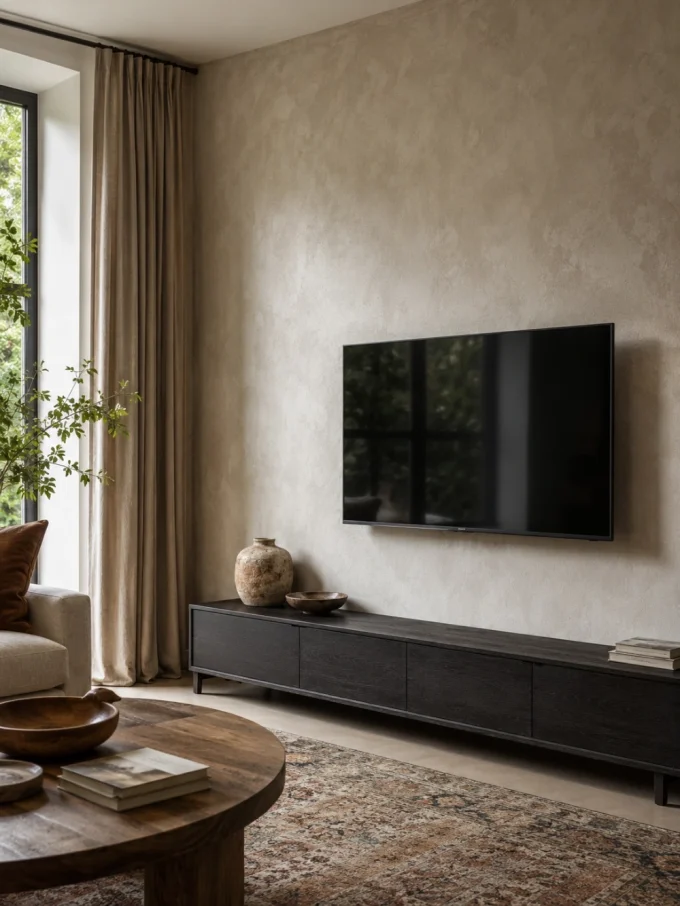
A TV wall does not have to be constructed from multiple materials to feel designed.
Subtle surface texture can provide enough variation by itself.
A plaster-like finish, softly mottled paint treatment, restrained wall texture, or very matte surface can catch light without competing aggressively with the television.
This can work particularly well in rooms already containing:
- patterned rugs;
- visible wood grain;
- statement lighting;
- colorful upholstery;
- substantial artwork.
If you are considering a more dimensional treatment, DecoralCove’s wall texture design ideas can help you decide how much surface detail the room actually needs.
Do not automatically combine texture with timber slats and stone.
One good background can be enough.
6. Use Stone When You Want the Wall Material to Be the Decoration
Stone surfaces can provide natural character and texture while allowing the rest of the entertainment area to remain simple and balanced.
Marble, limestone, travertine-like surfaces, or other stone can introduce:
- grain;
- veining;
- tonal movement;
- depth;
- material weight.
The important word is enough.
Strongly veined stone behind a large television already creates two powerful visual elements.
Add illuminated shelves, timber strips, gold trim, a fireplace, ornaments, and several open niches and the wall can become more complicated rather than more luxurious.
Current media-wall imagery frequently combines large stone or marble surfaces with screens and cabinetry.
That does not mean all those ingredients belong together in your room.
If the stone is beautiful, let people see it.
7. Recess the Television Only When the Recess Improves Something
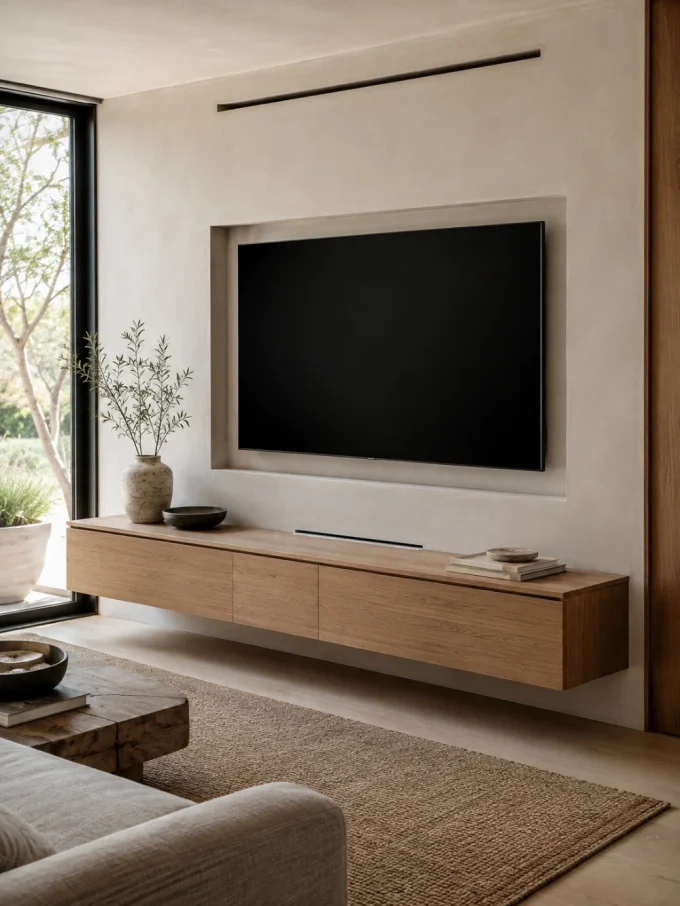
A shallow niche can make the television feel integrated into the architecture instead of attached afterward.
It can also provide a clean perimeter around the screen.
But a recessed TV is not automatically a better TV wall.
The construction has to accommodate the actual screen, mount, cabling, connections, ventilation requirements, and future access.
Television manufacturers publish model-specific mounting requirements for a reason.
Think ahead as well.
A niche built precisely around one television may become awkward if a later replacement has different dimensions.
Leave the design enough tolerance to survive something more consequential than this year’s screen.
Architecture should have a longer lifespan than electronics.
8. Build Storage Around the TV According to What You Actually Own
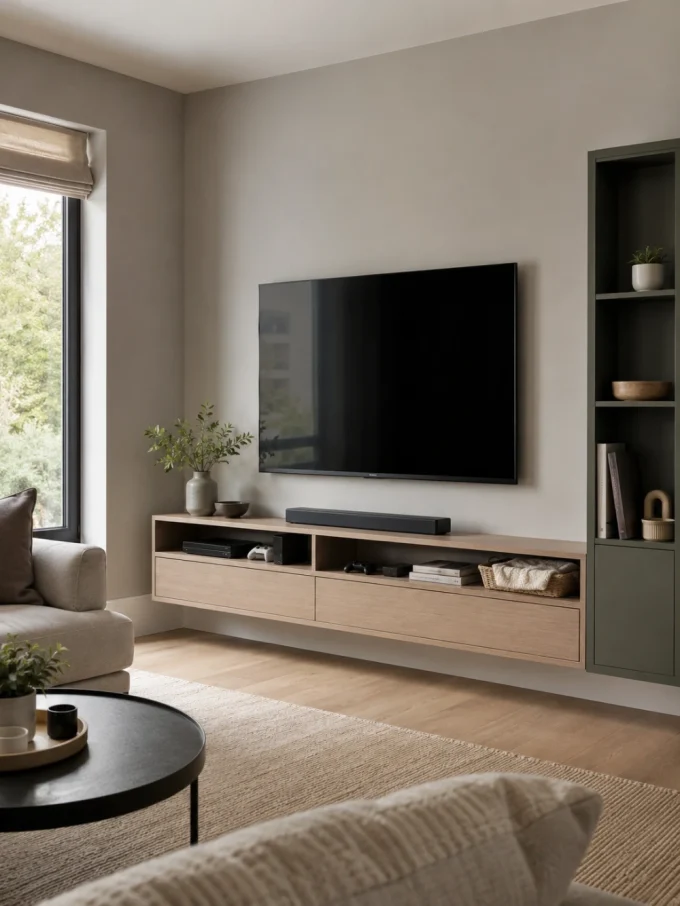
Built-in media walls can be extremely useful.
They can also be remarkably effective at creating storage nobody needed.
Before designing shelves on both sides, make an inventory.
Where will you put:
- game consoles?
- controllers?
- board games?
- books?
- speakers?
- router equipment?
- children’s toys?
- blankets?
- DVDs, if you still use them?
- charging cables?
- objects you actually want to display?
If the answer is “almost none of those,” full-height cabinetry may be solving an imaginary problem.
Current media-wall coverage emphasizes hidden storage because it can keep electronics and everyday objects from spreading across the room.
That advantage is real when storage pressure is real.
Otherwise, a low cabinet may be enough.
Do not spend an entire wall solving clutter you do not have.
9. Let Asymmetrical Cabinetry Respond to the Room
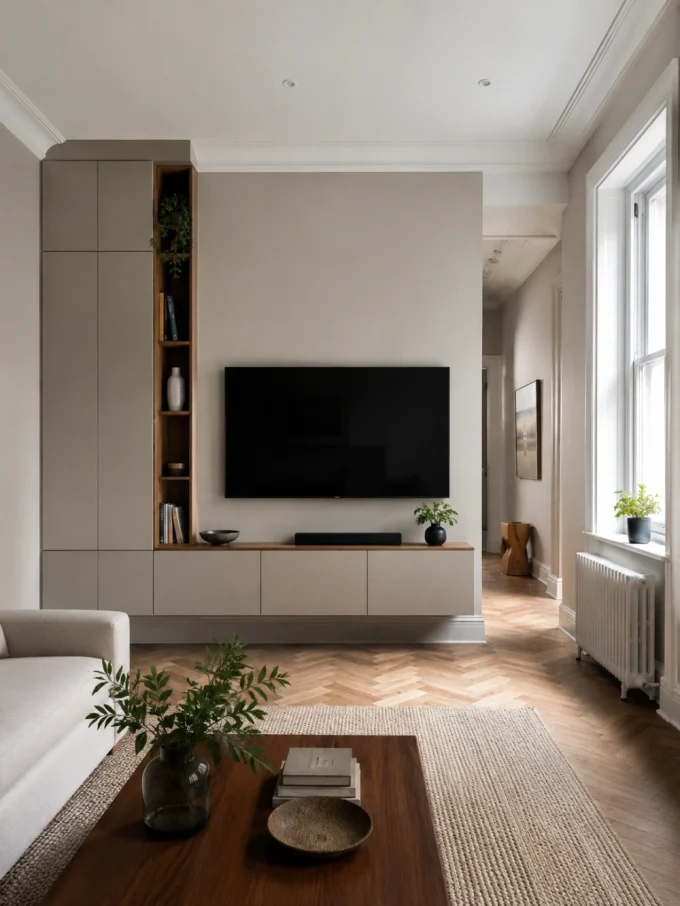
The television does not need a bookshelf standing at attention on each side.
Real rooms have:
- doors;
- windows;
- radiators;
- adjoining walls;
- fireplaces;
- circulation routes.
Sometimes symmetry is simply not the best use of those conditions.
Try a low cabinet extending on one side of the television while the other side remains open.
Or place tall storage on the side that has enough wall depth and allow the opposite side to breathe.
You can still create order through:
- aligned cabinet heights;
- repeated materials;
- one consistent paint color;
- a shared horizontal line.
Symmetry is one way to create balance.
It is not the only way.
10. Hide the Television When the Room Has Something More Important to Say
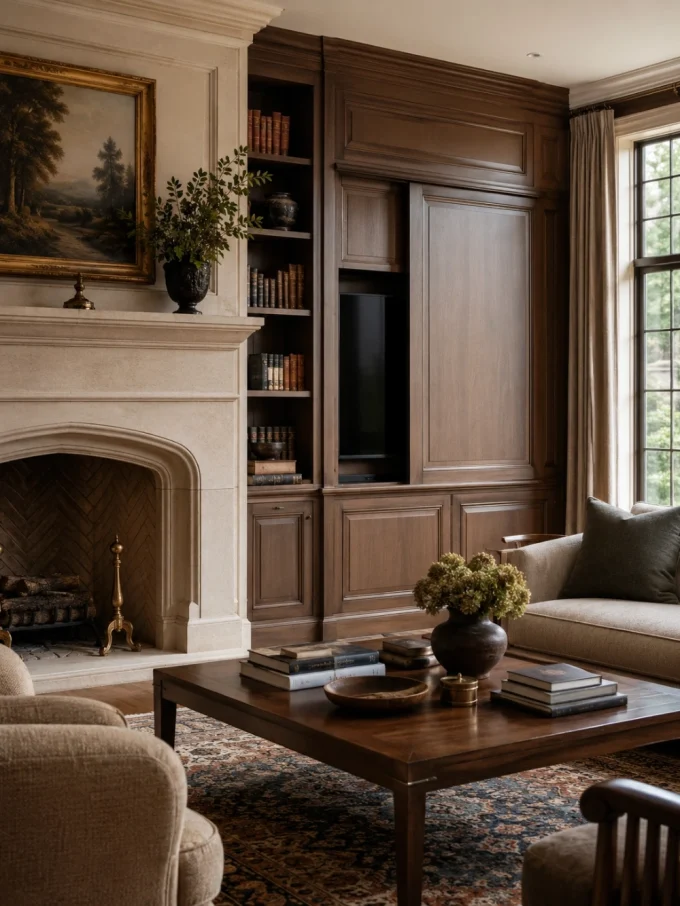
Not every living room needs the television visible all day.
In a formal room, historic interior, library-like living space, or room containing exceptional architecture, hiding the screen can preserve another focal point.
House & Garden’s 2026 TV-wall coverage includes solutions that conceal televisions behind cabinetry, folding treatments, and other architectural devices rather than making the screen permanently dominant.
Possible approaches include:
- sliding panels;
- cabinet doors;
- folding screens;
- artwork panels;
- custom millwork.
These solutions can be excellent.
They can also become inconvenient if you watch television several times a day and have to perform a small architectural ceremony every time you turn it on.
Concealment should make the room easier to enjoy.
Not the television harder to use.
11. Integrate the Television Into an Art Wall Carefully
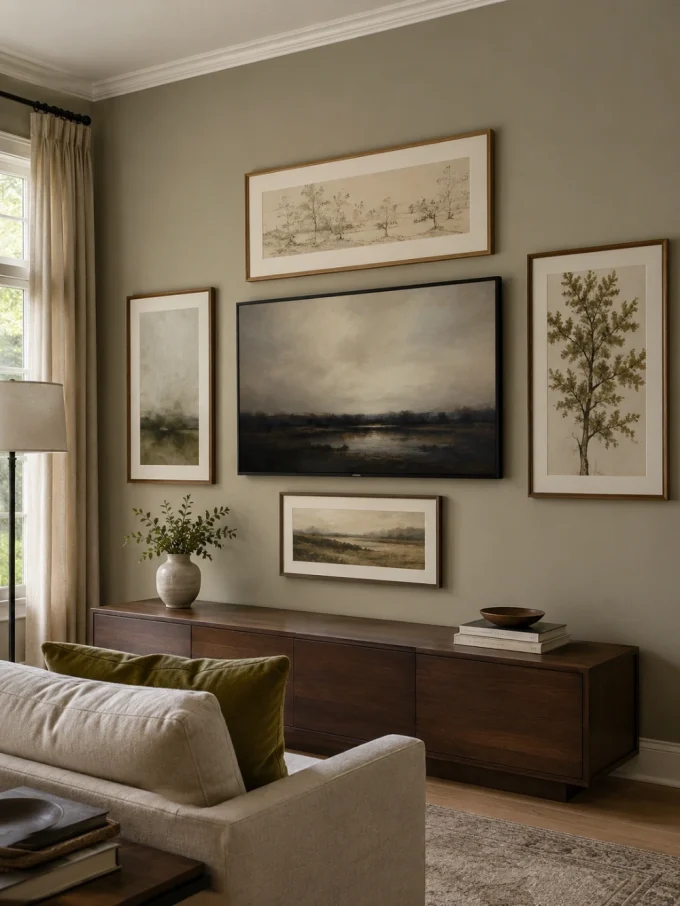
A television surrounded by frames can feel less isolated because it becomes one rectangle among several.
But gallery walls are easy to overdo around a screen.
The television is already significantly larger and darker than most artwork.
Trying to defeat that difference with fifteen tiny frames often creates more visual noise.
Use fewer, more substantial pieces.
Consider:
- similar frame depths;
- restrained spacing;
- artwork with enough scale to stand beside the screen;
- a wall color that reduces the TV’s contrast.
Art-display televisions are another option for design-conscious rooms, and the category continues to expand in 2026.
But technology should not become a substitute for composition.
Even a screen displaying beautiful artwork needs to relate properly to the wall around it.
12. Plan the Cables Before the Wall Becomes Beautiful
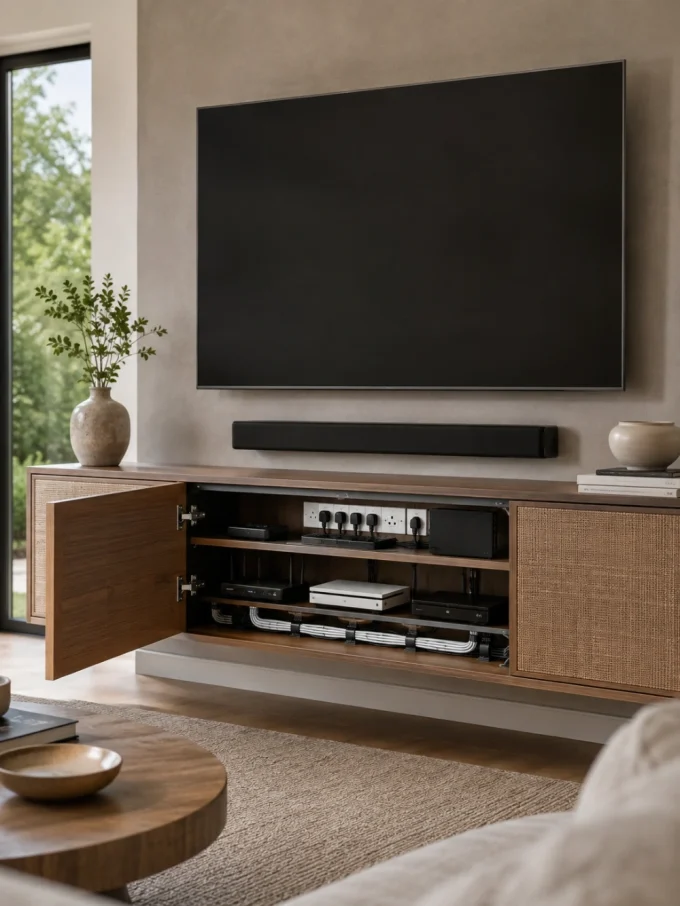
Few things expose an unfinished TV wall faster than one black cable hanging from the bottom of the screen.
Cable management is not the glamorous part of the project.
It may be the part you notice every day if it is ignored.
Before finishing the wall, identify:
- power;
- streaming devices;
- game systems;
- soundbar connections;
- network equipment;
- speakers;
- future access.
Samsung’s current TV-design guidance specifically treats cable organization as part of the television’s physical integration into a room.
Do not permanently bury components that will eventually need to be unplugged, reset, replaced, or serviced.
And do not improvise electrical work inside a finished wall merely to hide a cord.
Use solutions appropriate to the wall construction and installation, and use qualified help where electrical work or structural mounting is involved.
Beautiful should remain serviceable.
13. Add Light Around the TV Without Shining It Into the Screen
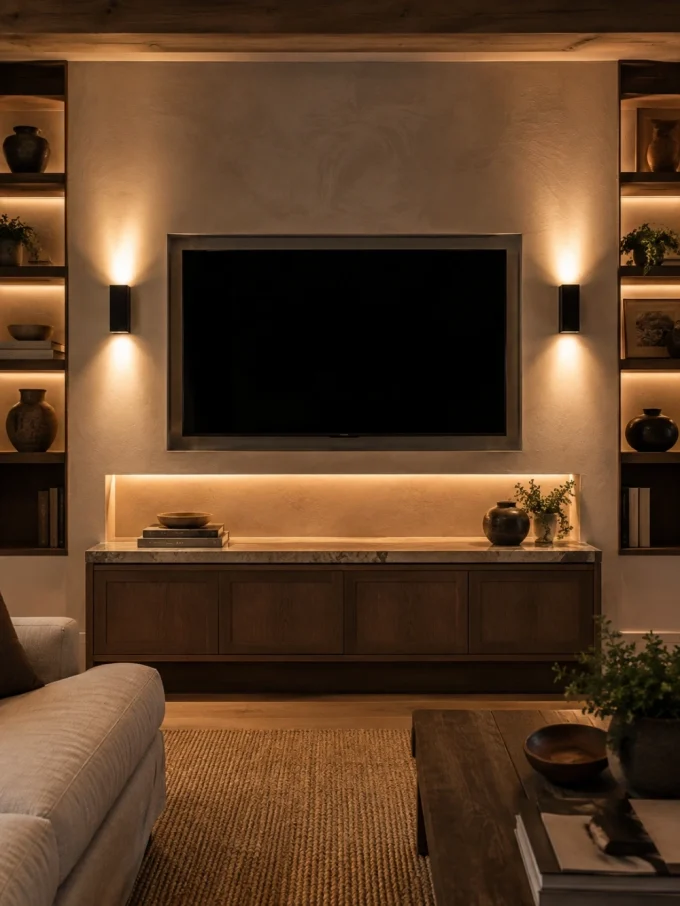
Lighting can make a media wall feel much more architectural after dark.
It can also create distracting reflections.
Instead of placing bright decorative fixtures where the screen catches them, think about surfaces that can receive the light.
A wall sconce might illuminate textured plaster beside the television.
A concealed light source can wash a shelf or cabinet.
Soft background illumination can make the wall feel less like a black void after sunset.
For fixture ideas, DecoralCove’s wall sconce light fixture ideas and indoor wall-mounted light fixture ideas provide different approaches to integrating light directly into the architecture.
The mistake is using lighting because media walls are “supposed” to glow.
If the LEDs are the first thing you notice from across the room, reduce them.
Light should reveal the wall.
Not outline every component like a display cabinet.
14. Give the Fireplace and TV Separate Jobs Where the Layout Allows It
Putting a TV above a fireplace creates one extremely concentrated focal wall.
Sometimes that is the only practical solution.
Sometimes it is simply the first solution people consider.
Before stacking them, test whether the television could occupy an adjacent wall.
That may allow:
- a more comfortable screen position;
- more freedom with fireplace materials;
- simpler wiring;
- less competition between two large rectangles;
- a furniture arrangement that supports both watching and conversation.
The broader movement toward conversation-first living rooms makes this worth reconsidering rather than automatically centering every living space on one screen.
If both elements genuinely need the same wall, solve the fireplace’s technical requirements before styling anything.
Our modern fireplace ideas article goes deeper into fireplace-and-TV competition, fireplace proportions, materials, and the technical questions that should come before decorating.
Do not assume a universal TV-above-fireplace measurement.
The actual fireplace and television requirements matter.
15. Keep a Small TV Wall Shallower Than Your Inspiration Photograph
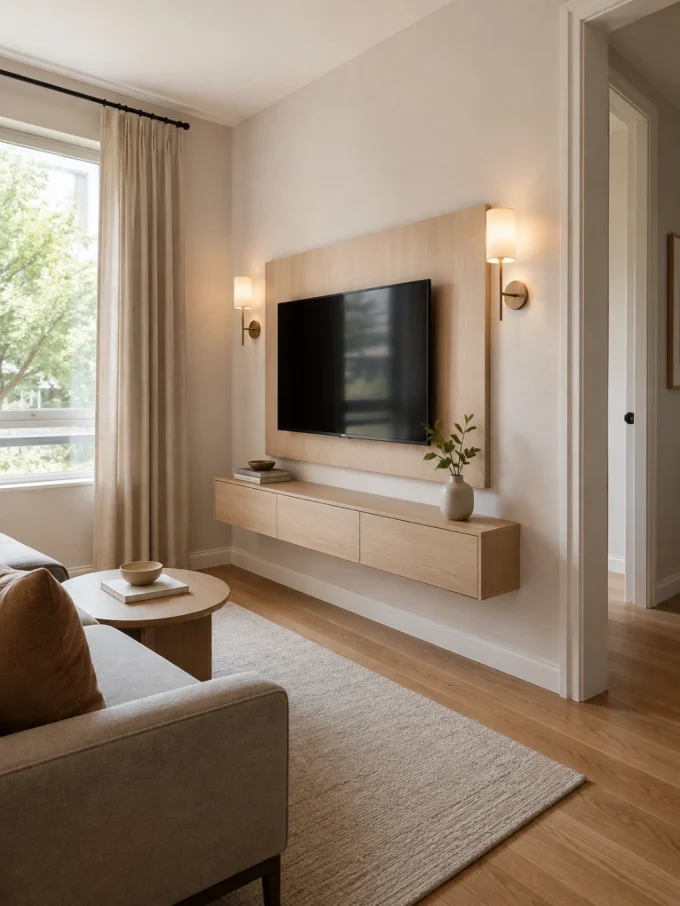
Media walls often look effortless in large rooms because the photograph has space around them.
The same design can feel heavy once compressed into a modest living room.
Deep cabinetry takes up real floor area.
Full-height dark units carry considerable visual weight.
Large projecting shelves narrow the circulation route whether or not they look elegant from the sofa.
In a smaller room, consider:
- a shallow floating cabinet;
- one painted wall;
- a thin timber panel;
- limited open shelving;
- wall-mounted lighting instead of floor lamps;
- fewer material changes.
The wall does not have to advertise how much design work went into it.
Sometimes its success is measured by how little floor area it steals.
16. Make a Rental TV Wall Look Finished Without Pretending It Is Built-In
Renters do not need a permanent media wall to improve the television area.
Start with movable elements.
A well-proportioned console can visually anchor a wall-mounted or stand-mounted screen.
A large piece of furniture below the TV can often create more order than several small accessories around it.
Depending on the rental agreement, paint, removable treatments, freestanding shelving, lamps, and artwork can provide additional structure without constructing custom cabinetry.
DecoralCove’s rental apartment decorating ideas covers more reversible ways to make an apartment feel intentional without pretending permanent renovation is available.
And consider whether wall mounting is necessary at all.
Current 2026 coverage has even highlighted refined rolling television stands as a flexible alternative for spaces where making the TV a permanent architectural focal point is undesirable.
A television can belong to a room without belonging permanently to one wall.
17. Stop Before the TV Wall Becomes a Material Sample Board
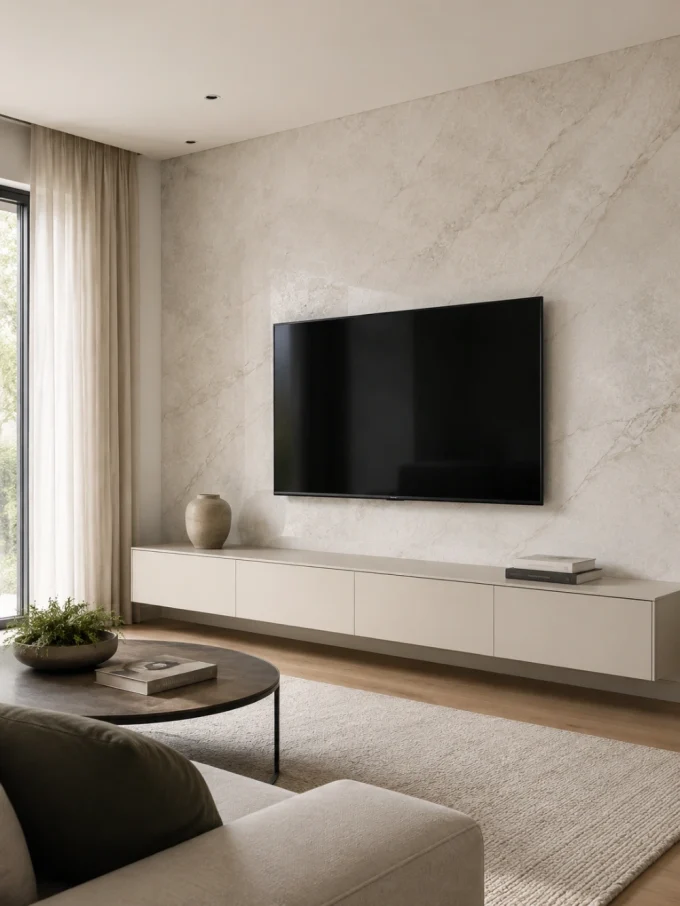
This may be the most important idea.
Look at the wall and count what is already happening.
Is there:
- a large TV;
- stone;
- timber;
- fluted panels;
- LED lighting;
- a floating cabinet;
- open shelves;
- two sconces;
- artwork;
- ornaments;
- a fireplace?
The problem may no longer be that the wall needs something.
It may need subtraction.
This is a common decorating issue beyond TV walls, which is why our guide to home decor mistakes to avoid emphasizes editing rather than assuming more design always creates a better room.
Choose a hierarchy.
Perhaps the stone is the feature and the cabinetry stays simple.
Perhaps the timber is the warmth and everything else remains painted.
Perhaps the television is intentionally prominent because the room is genuinely used for movies.
Perhaps the screen should almost disappear.
All of those can work.
What rarely works is asking every element to be the focal point.
What Actually Makes a TV Wall Look Beautiful?
An effective TV wall design is created through balance between the screen, surrounding elements, and the way the room is used daily.
It depends on relationships.
The screen has the right proportion to the wall.
It does not look stranded or squeezed.
The television has something to relate to.
That may be a console, cabinetry, wall color, stone plane, or architectural recess.
Equipment has somewhere to go.
The room does not rely on photography-day cable removal.
Material has a reason.
Wood adds warmth. Stone adds visual weight. Paint reduces contrast. Texture changes how light behaves.
Lighting supports the wall rather than fighting the screen.
Storage reflects real belongings.
The room can still function when the television is off.
That last point deserves attention.
A living room often spends more hours with a dark screen than an active one.
Design that wall for both conditions.
8. FAQs
What should I put on the wall behind my TV?
Start with the simplest solution that solves the actual visual problem. That could be paint, subtle texture, timber, stone, or cabinetry. A TV wall does not automatically need paneling, shelves, or multiple materials. The background should help the screen relate to the room rather than compete with it.
What color looks best behind a television?
There is no universal best color. Darker and mid-tone colors can reduce the contrast between a black screen and the wall, while lighter walls may suit rooms where maintaining brightness is more important. Consider daylight, room size, surrounding furniture, and how dominant you want the television to appear.
Are wood slats good behind a TV?
They can be.Timber elements introduce natural warmth and help soften the technical appearance of a television setup, but they are not necessary for every television wall. A broad timber panel or simple wood console may provide enough natural material without covering the entire wall in repetitive lines.
Should shelves go around a wall-mounted TV?
Only when they have a genuine purpose. Shelves can hold books, media equipment, or selected objects and help integrate the screen into cabinetry. Too many small shelves and accessories can make the television wall feel busier rather than more finished.
Should a TV be centered on the wall?
Not automatically. The television should relate to the seating position and usable architecture. A room with doors, windows, fireplace openings, or asymmetrical cabinetry may look and function better without strict geometric centering.
Can a TV go above a fireplace?
Sometimes, but the decision should begin with the actual fireplace and television installation requirements rather than appearance. Heat, required clearances, mount compatibility, wiring, viewing position, and the fireplace manufacturer’s instructions can all affect whether the arrangement is appropriate.
How can I make a TV less noticeable when it is off?
Reducing contrast can help. A darker wall, surrounding artwork, cabinetry, or a material with enough visual presence can make the black screen less isolated. Some televisions can also display artwork when not being watched, while custom cabinetry or sliding panels can conceal the screen entirely.