

A fireplace can be made from beautiful stone, fitted with an expensive insert, and centered perfectly on the wall—and still feel disconnected from the room.
Usually, the problem is not the fireplace itself.
It is what happens around it.
The ceiling ends awkwardly above the surround. The television fights the fire for attention. The mantel is too thin for the scale of the wall. Built-ins occupy every remaining inch. Or a very long linear fire has been placed inside a room whose other proportions are compact and vertical.
That is why the most useful modern fireplace ideas start with architecture rather than decoration.
Recent fireplace coverage shows both clean-lined contemporary treatments and a move toward warmer, more material-rich rooms: plaster, stone, dark timber, sculptural forms, and fireplaces that act as genuine architectural anchors rather than isolated appliances.
The goal is not to make the fireplace look modern by adding every current finish.
It is to make the entire wall make sense.
1. Choose the Fireplace Type Before Designing the Wall
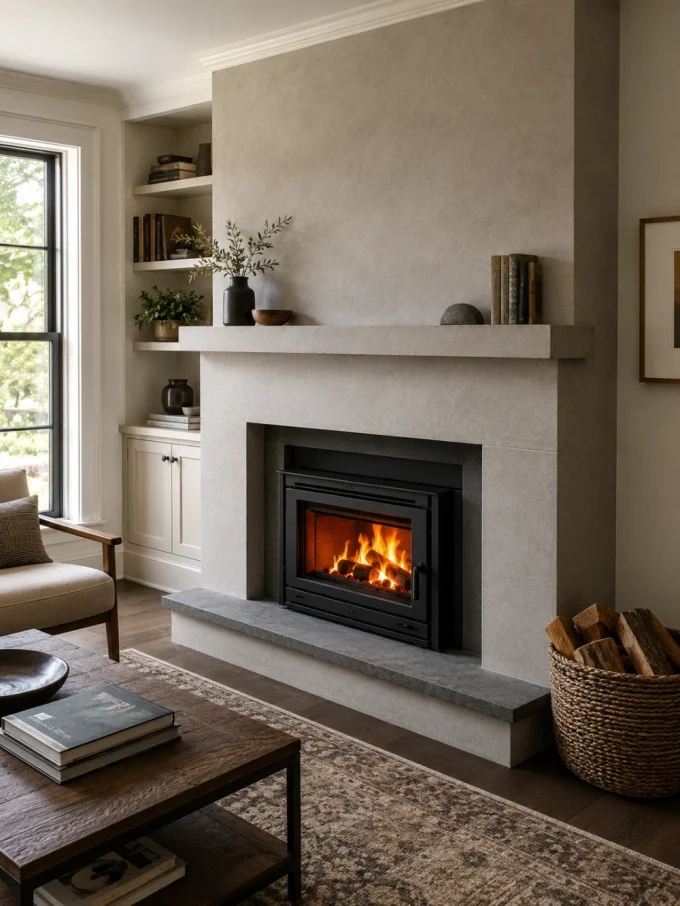
Do not begin with marble samples.
Begin with what the fireplace needs to do.
Is it primarily visual? Is meaningful heat important? Is there an existing chimney or firebox? Are you renovating an old masonry fireplace or starting with an empty wall? What fuel types and installations are appropriate and permitted where you live?
Those questions affect considerably more than the flame.
They can influence the depth of the structure, ventilation requirements, access for servicing, surrounding materials, hearth design, and what can safely be installed above or beside the unit.
A sleek inspiration photograph is therefore not a construction drawing.
Design the wall around the actual appliance or fireplace system being used, rather than choosing a visual concept first and trying to force the technical requirements inside it later.
For wood-burning appliances in particular, EPA guidance distinguishes traditional masonry fireplaces, prefabricated fireplaces, and fireplace inserts; it also notes that fireplaces and inserts should not be treated as interchangeable systems.
Once the functional decision is clear, the design becomes much easier.
2. Take a Quiet Plaster Surround All the Way Up
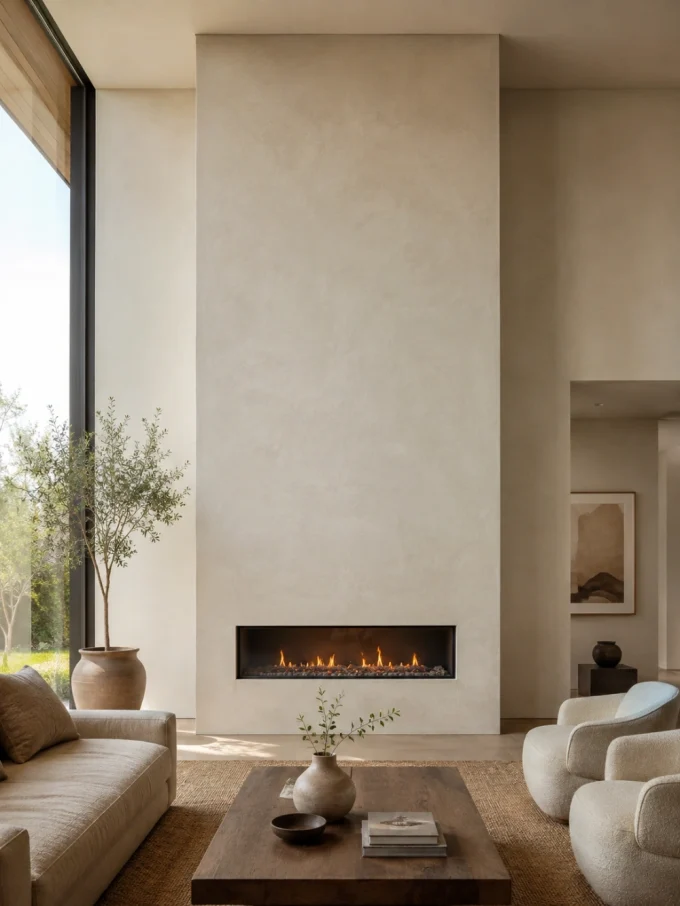
One of the cleanest ways to modernize a fireplace is not to add more detail but to make the existing volume feel intentional.
Instead of stopping a surround a short distance above the firebox, consider allowing the fireplace mass to continue toward the ceiling.
A restrained plaster-like finish works particularly well because the form remains visible without adding multiple grout lines, trim pieces, shelves, and material transitions.
The effect becomes stronger in a tall room.
The eye reads the fireplace as part of the architecture rather than a decorative rectangle placed against a wall.
Current design coverage continues to feature plaster and other quiet full-wall treatments precisely because they can add texture while keeping the composition relatively simple.
There is a limit.
If the room already has heavy ceiling beams, complicated moldings, several wall openings, and substantial built-ins, another large vertical feature may make the architecture compete with itself.
Look upward before deciding how high the fireplace should go.
If the ceiling is already doing a lot of visual work, DecoralCove’s modern ceiling ideas may help you decide which surface should take priority.
3. Use Large Pieces of Stone When You Want the Material to Be the Detail
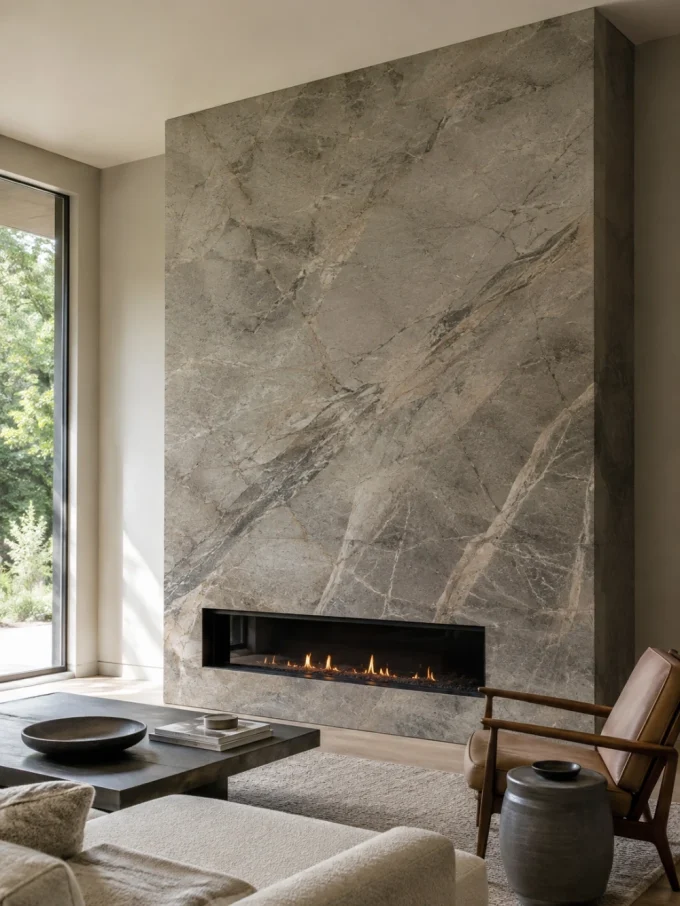
Stone can look traditional or distinctly modern.
The difference often lies in how much interruption surrounds it.
Large slabs or broad pieces with fewer joints allow grain, veining, color movement, and natural variation to become the decoration.
That is very different from covering the same wall with a small repeating tile.
Marble can create drama. Limestone can read quieter. Some heavily patterned stones can become almost artwork in their own right.
But the stronger the stone, the less the rest of the wall usually needs.
A dramatic slab plus a thick timber mantel plus shelves plus sconces plus artwork can quickly become five focal points occupying the same six feet of wall.
Decide whether the stone is background or subject.
If it is the subject, give it space.
4. Keep Rough Stone Modern by Simplifying Everything Around It
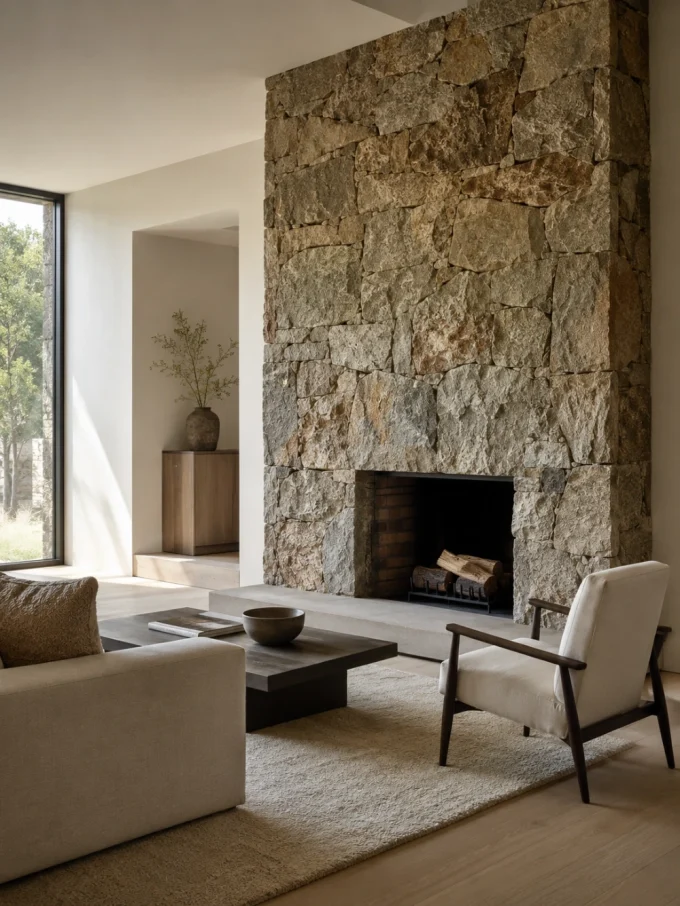
Modern does not require a perfectly smooth surface.
A rougher stone fireplace can work beautifully in a contemporary room when the architecture around it stays controlled.
The key is contrast.
Irregular stone already provides:
- color variation;
- shadows;
- depth;
- uneven edges;
- substantial visual weight.
It does not necessarily need ornate mantel brackets or crowded accessories as well.
Pairing that stone with clean furniture lines, a limited palette, simple lighting, and quieter adjacent walls can make the texture feel deliberate instead of rustic by default.
Recent editorial examples continue to show modern rooms using substantial natural stone and other highly tactile materials rather than relying exclusively on flat white minimalism.
This is worth remembering if you already own a stone fireplace.
The surface itself may not be the problem.
What surrounds it may be making it look dated.
5. Use a Linear Fireplace Only When the Wall Can Carry the Width
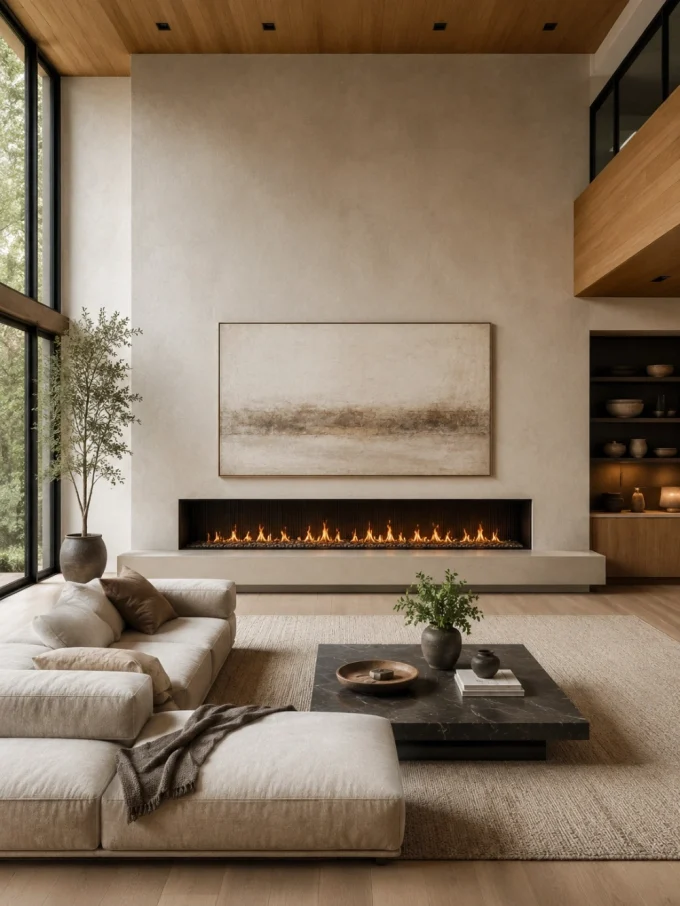
A long horizontal flame can create a strong modern line.
It can also look oddly stretched when inserted into the wrong room.
Before choosing one, look at the width of the wall, the ceiling height, nearby windows, built-ins, and the furniture arrangement.
A broad fireplace feels natural when another horizontal element reinforces it: a long sofa, low cabinetry, floating hearth, large artwork, or generous wall width.
In a narrow room with tall windows and relatively compact furniture, an exaggerated horizontal opening may fight everything around it.
Linear fireplaces remain prominent in contemporary fireplace design, but that popularity is not a reason to use the widest model available.
Scale still decides whether the result looks architectural or merely fashionable.
6. Consider Whether You Need a Mantel at All
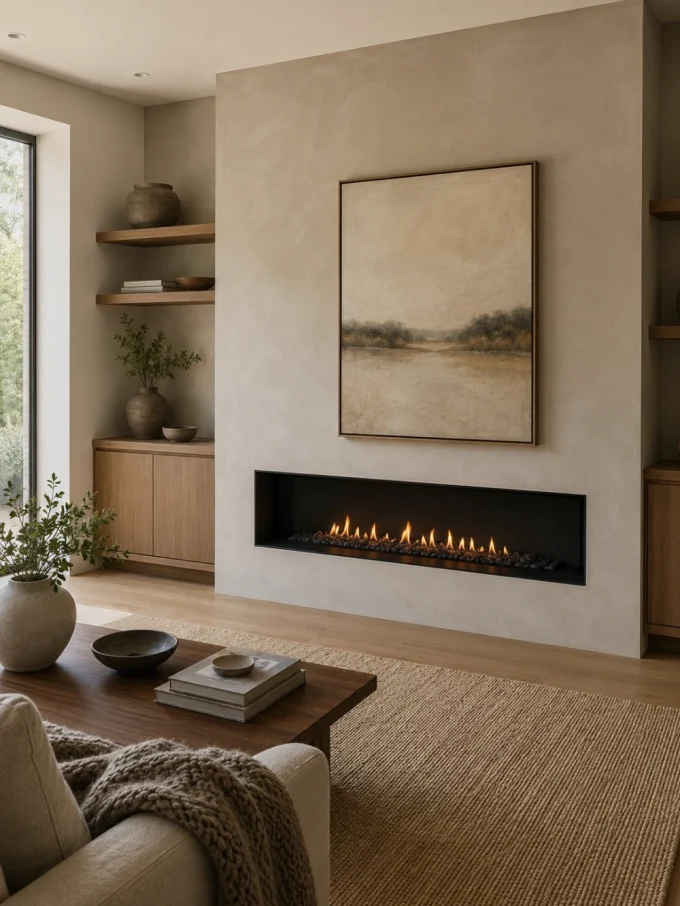
A mantel is useful.
It is not compulsory.
Removing it can make a fireplace wall noticeably quieter, particularly when stone, plaster, tile, or the flame itself already provides enough visual interest.
A mantel-free wall also avoids creating an automatic shelf that gradually fills with small objects.
That can be especially effective around a contemporary linear fireplace or a strong slab-stone surround.
But do not remove a mantel merely because minimalist fireplaces are fashionable.
A room with substantial traditional moldings, an older hearth, or prominent timber elsewhere may benefit from the horizontal transition a mantel provides.
Ask what the shelf is doing compositionally.
If removing it leaves the fireplace looking taller, cleaner, and more coherent, that is useful.
If removing it makes a historic fireplace appear abruptly stripped of its architecture, restraint has gone too far.
7. Add a Simple Wood Mantel When the Wall Needs Warmth
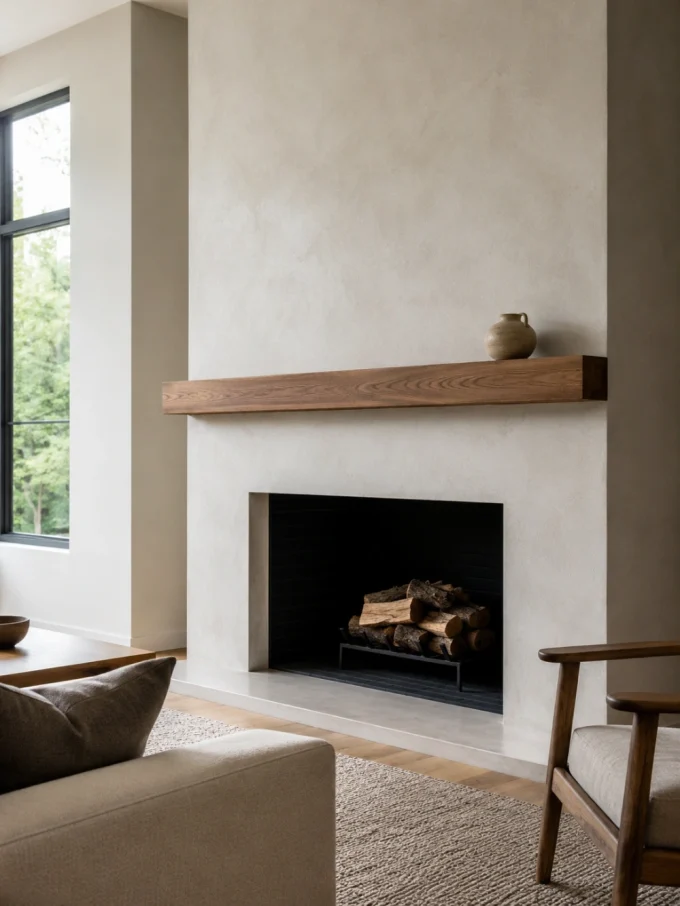
The opposite approach works too.
A narrow timber mantel can introduce warmth against plaster, pale stone, dark tile, or another hard surround.
The grain also provides visual variation without requiring decorative objects.
Avoid making the mantel unnecessarily intricate.
A clean timber beam or floating shelf often provides enough horizontal definition to break up a tall fireplace wall.
Then check its depth and scale against the firebox.
A mantel that looks substantial in a product photograph can appear surprisingly thin once installed across a wide masonry wall.
One stronger timber line usually reads more deliberately than several smaller wood accents scattered around the fireplace.
8. Let a Dark Fireplace Ground a Pale Room
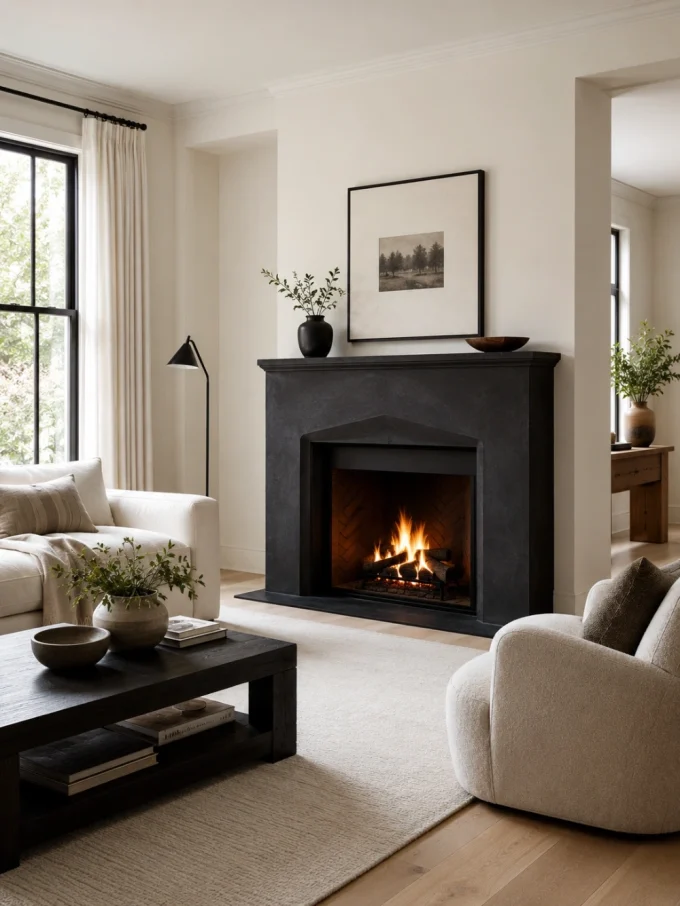
Black is not mandatory for a modern fireplace, but depth can be useful.
A dark charcoal surround, black stone, deep brown finish, or other near-black surface can create a clear center of gravity in a room dominated by pale walls and upholstery.
The fire becomes brighter by contrast.
So does everything immediately beside it.
This works particularly well when the dark material is repeated lightly elsewhere—in a window frame, lamp, coffee table, or small amount of hardware—rather than copied onto every object.
For a useful example of how strong light-and-dark relationships can stay controlled rather than harsh, see DecoralCove’s small black and white living room ideas.
The caution is obvious once you see the whole wall.
A large black fireplace reaching a low ceiling has much more visual weight than a narrow dark surround inside a bright room.
Proportion still matters more than the color trend.
9. Turn the Hearth Into a Low Architectural Bench
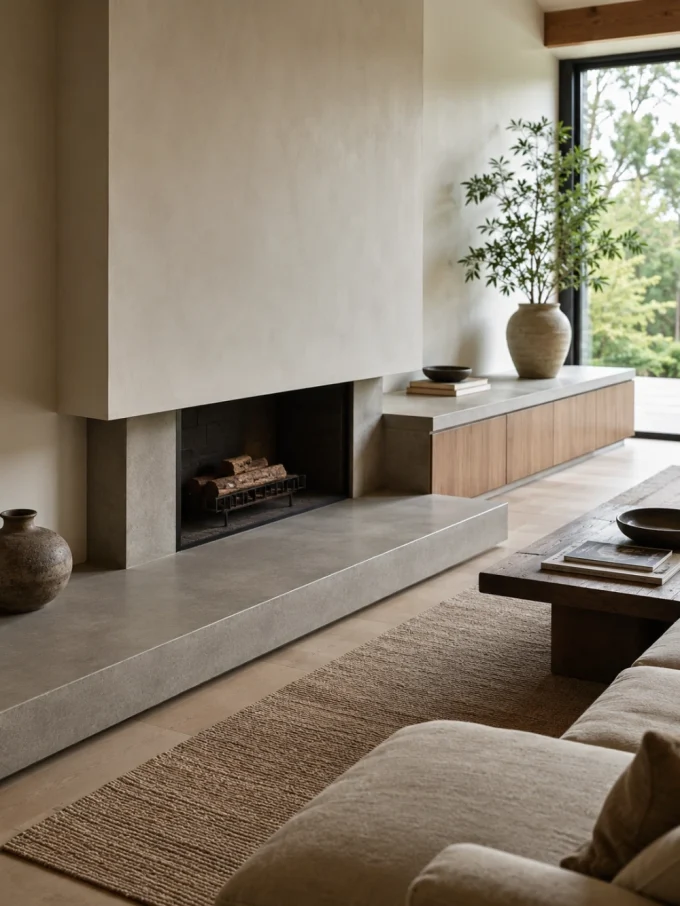
A hearth does not have to look like a small ledge attached to the bottom of a fireplace.
A broader, low hearth can become a horizontal architectural line.
In the right room, it may visually connect the fireplace with adjacent cabinetry or create an informal perch when the design and fireplace specifications permit it.
The strongest versions look intentional even when nothing sits on them.
Stone, concrete-like surfaces, or another restrained material can make the hearth feel like part of the building rather than added trim.
But do not automatically enlarge it.
A projecting hearth consumes floor area.
In a narrow living room, those extra inches may interfere with the furniture arrangement or route around the coffee table.
This is exactly the kind of idea that needs the real-house test.
A beautiful ledge is not an improvement if everyone has to walk around it.
10. Use a Curve to Soften an Extremely Rectilinear Room
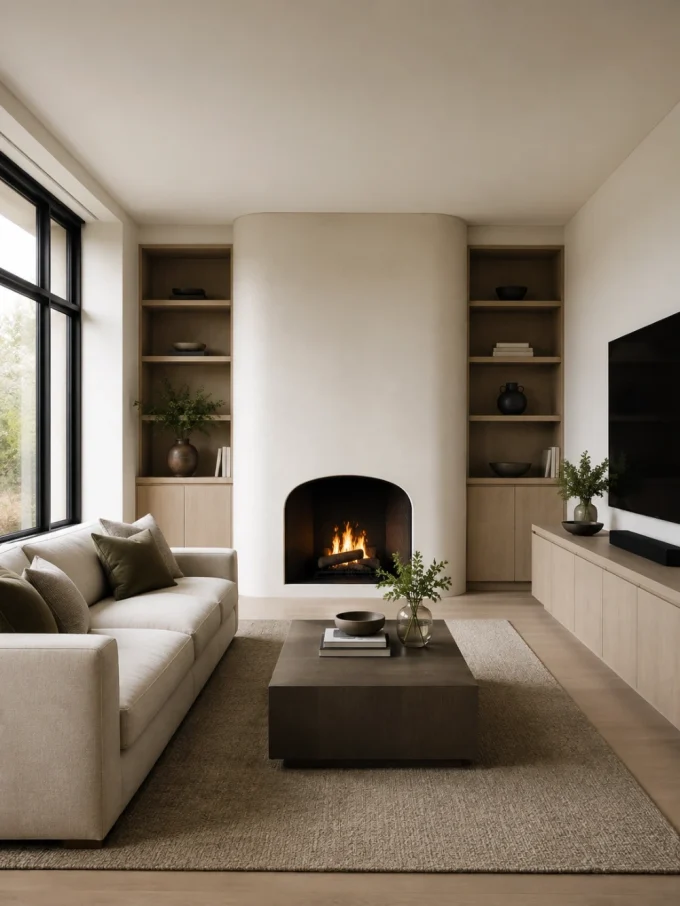
Modern interiors can accumulate rectangles surprisingly quickly.
Doors. Windows. Television. Sofa. Rug. Coffee table. Cabinetry. Fireplace opening.
Another rectangular surround may be technically neat while making the whole room feel rigid.
A restrained curve can interrupt that geometry.
Possible approaches include:
- a gently rounded fireplace volume;
- an arched opening;
- curved plaster corners;
- a rounded chimney breast;
- an arched recess above or beside the fire.
Sculptural curves are appearing in current fireplace and wider interior design coverage, alongside the broader move away from extremely cold, rigid minimalism.
One curve is usually enough.
Repeated arches, curved shelving, rounded furniture, circular lighting, and an arched fireplace in the same view can turn a useful contrast into a theme.
11. Make Asymmetrical Built-Ins Look Deliberate
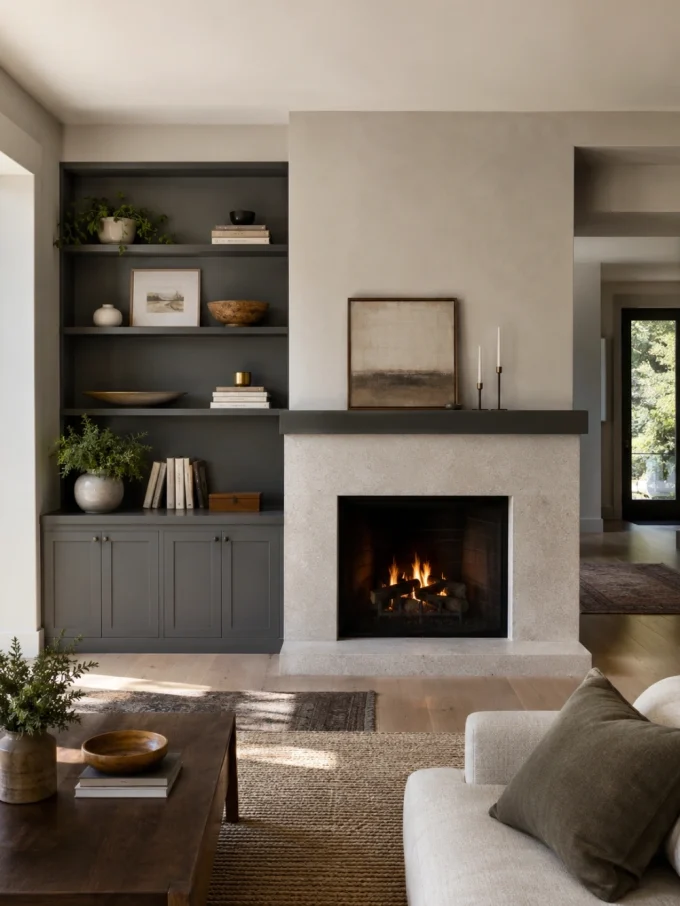
A fireplace does not have to sit between two identical bookcases.
Sometimes the architecture provides a better answer.
Perhaps cabinetry is needed on one side but the other side contains a doorway.
Maybe a low storage unit should extend from the fireplace while the opposite wall remains open.
That asymmetry can look more modern—and often more natural—than forcing the room into artificial balance.
The fireplace becomes the anchor, not necessarily the geometric center of an identical storage composition.
Keep some relationship between the pieces.
That might come from a shared material, aligned shelf height, repeated paint finish, or one horizontal line carried through the composition.
The goal is controlled imbalance.
Not accidental furniture placement.
12. Do Not Fill Both Sides Just Because the Recesses Exist
Fireplace alcoves tempt people into immediate construction.
Shelves on the left.
Shelves on the right.
Cabinets below.
Lights above.
Decor on every shelf.
Sometimes that is exactly what the room needs.
Sometimes it is simply a lot of carpentry surrounding an already substantial focal point.
Before adding built-ins, identify the storage problem.
Do you actually have books, media equipment, games, or objects that need somewhere to live?
If not, one open side may create useful breathing room.
This is especially important in modest living rooms, where heavy cabinetry can reduce both physical space and perceived openness.
It echoes a larger DecoralCove principle explored in our home decor mistakes to avoid: more design is not automatically better design.
13. Give the Television and Fireplace Separate Jobs Where Possible
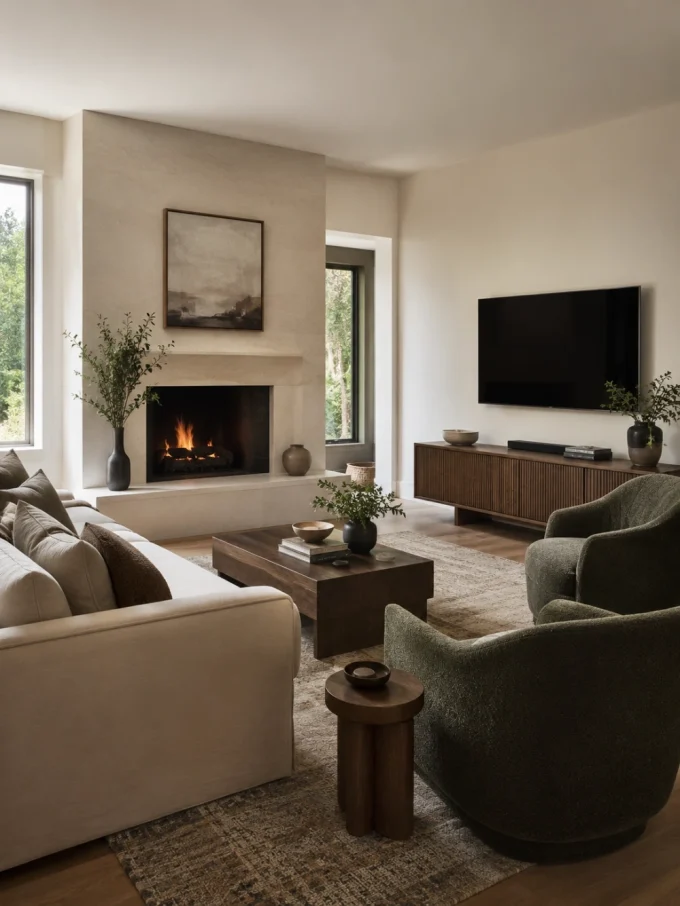
The fireplace-and-TV argument is not really about whether televisions are attractive.
It is about competition.
Both are visually dominant rectangles.
Stack them together and the fireplace wall has to manage:
- two focal points;
- viewing height;
- heat and appliance requirements;
- cables;
- screen reflections;
- the proportions of two large objects.
Where the room allows it, separating the television from the fireplace can release both elements.
The fireplace can anchor the conversation area while the television occupies an adjacent wall or secondary zone.
This approach also aligns with a broader 2026 shift toward living rooms designed less exclusively around an oversized screen and more around conversation and multiple uses.
There are rooms where separation is impossible.
But it is worth testing before accepting the stack as the default.
14. If the TV Must Go Above the Fireplace, Solve the Technical Problem Before Styling It
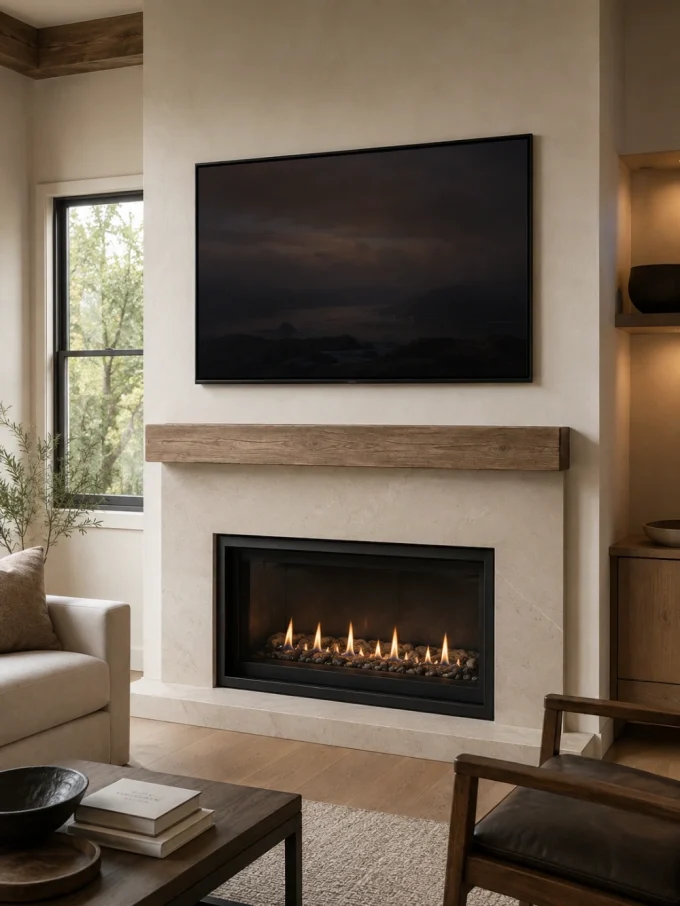
Sometimes one wall is the only practical location for both.
In that case, do not start by choosing frames or mantel decor.
Start with the actual fireplace manufacturer requirements and the television setup.
Heat management, required clearances, fireplace construction, mantel design, wiring, access, and safe installation vary by product and installation.
There is no responsible universal measurement that applies to every fireplace.
Once the technical conditions are known, address the visual issue.
Keep the surround relatively calm.
Avoid placing several smaller objects between the two large rectangles.
Consider whether the television can visually recede when not being watched rather than adding even more contrast around it.
The objective is not to pretend the screen does not exist.
It is to stop the entire wall from looking like equipment stacked vertically.
15. Make a Corner Fireplace Look Intentional Instead of Apologetic
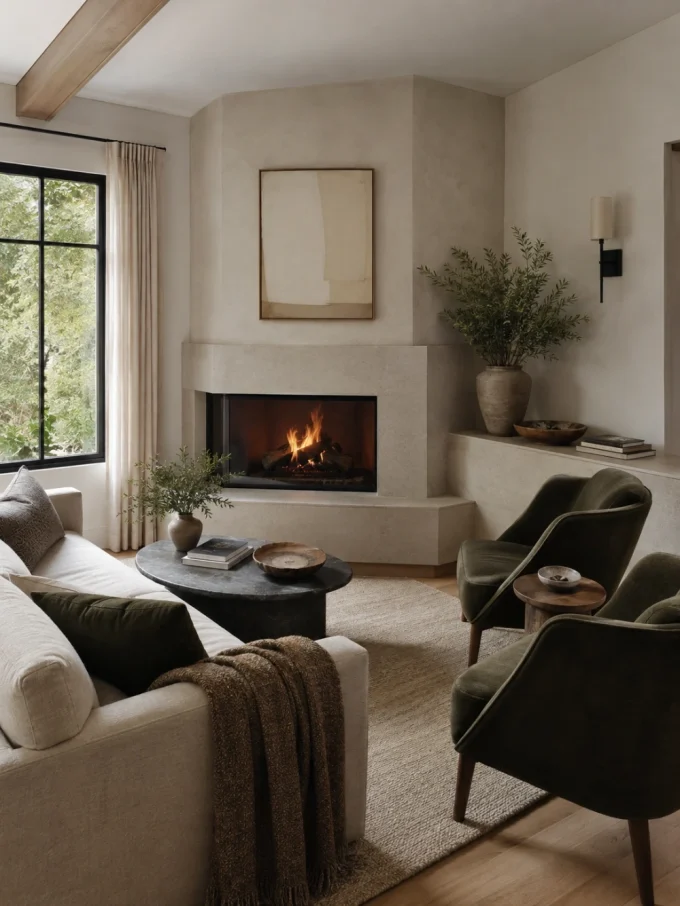
An existing corner fireplace is often treated like an architectural inconvenience.
That usually makes it worse.
If you cannot or should not relocate it, acknowledge the diagonal or corner condition.
Furniture can turn slightly toward it rather than remaining rigidly aligned with another wall. A surround can wrap the corner rather than stopping abruptly at the front face. Artwork and lighting can reinforce the composition.
The important part is not forcing the room to behave as though the fireplace were centered.
A corner element becomes awkward when everything else ignores it.
Once the seating arrangement and surrounding surfaces respond to it, the fireplace can feel much more deliberate.
16. Use a See-Through Fireplace to Connect Two Zones, Not Just to Show Off
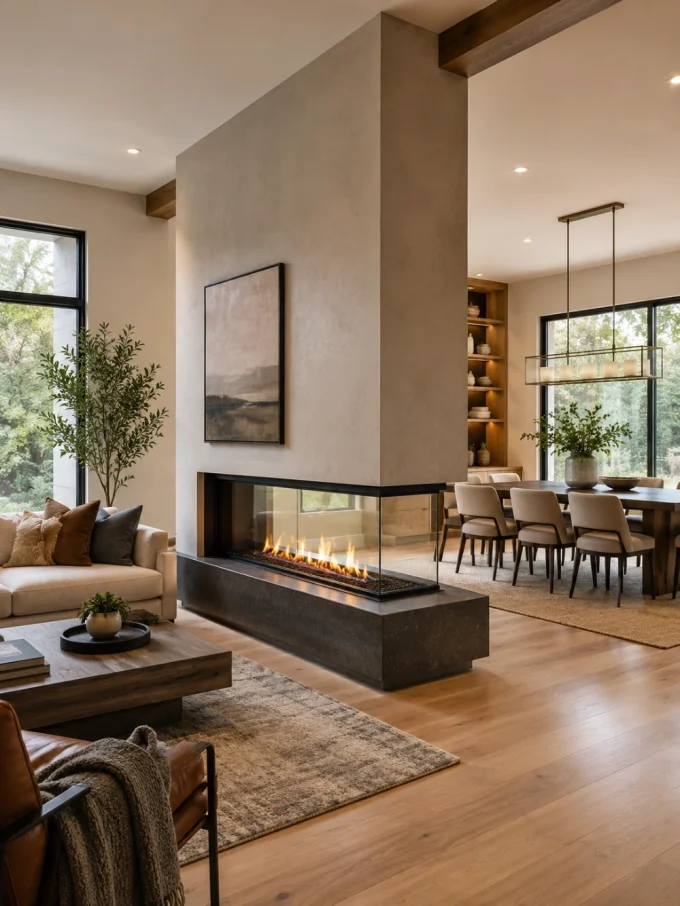
A double-sided fireplace can be visually striking, particularly between an open living area and dining room or between interior and exterior spaces.
But transparency alone is not enough reason to install one.
Ask what it connects.
If the fireplace gives two genuine seating or living zones a shared architectural center, the idea has purpose.
If one side faces furniture and the other side faces an unused circulation route, much of the effect is wasted.
Open-plan homes especially benefit from features that establish zones without constructing complete visual barriers.
If the fireplace is being considered near a combined cooking and living area, DecoralCove’s open kitchen design ideas can help you think about how those adjacent zones should relate before fixing the fireplace position.
Design both views.
A see-through fireplace has two fronts, and both need to make sense.
17. Modernize Existing Brick or Stone Before Deciding to Demolish It
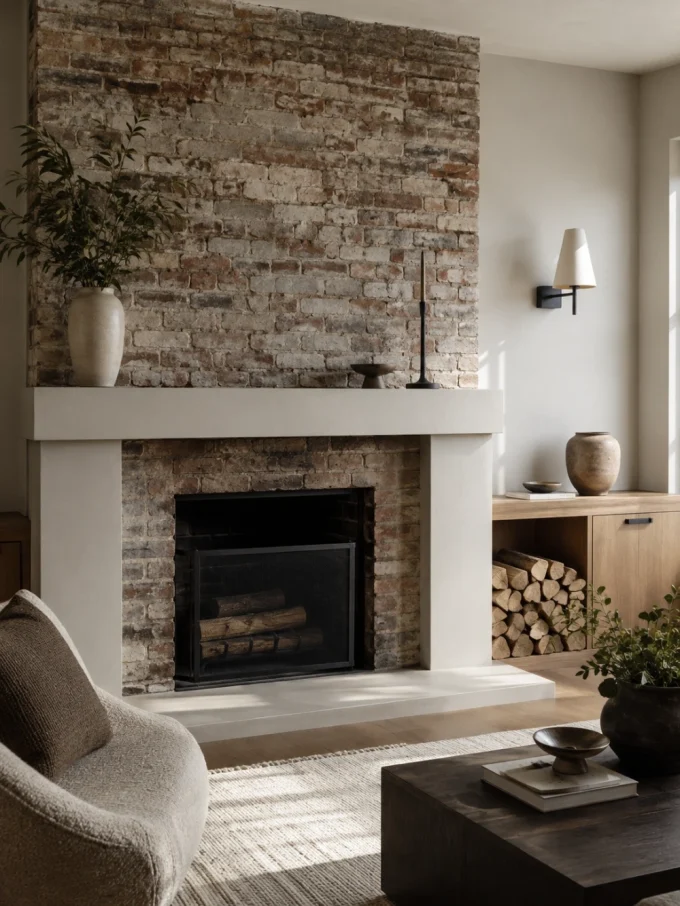
An older fireplace may need less intervention than you think.
First isolate what actually makes it feel dated.
Is it the brick itself?
Or is it:
- a highly ornate mantel;
- yellowed wall paint;
- dated brass doors;
- small tile surrounding the opening;
- crowded mantel decor;
- mismatched adjacent shelving;
- an undersized mirror;
- cool overhead lighting?
Changing two of those elements may make the original masonry feel completely different.
Painting, limewashing, resurfacing, or covering masonry are not universal solutions either. Existing material condition, heat exposure, fireplace construction, and the compatibility of new finishes need to be evaluated before applying a decorative treatment.
There is also aesthetic value in keeping some history.
Recent interior coverage has moved away from sterile, perfectly matched modern rooms toward more material variation, character, and combinations of old and new.
A modern room does not require every old surface to disappear.
18. Finish the Fireplace With Light and Restraint, Not a Mantel Shopping List
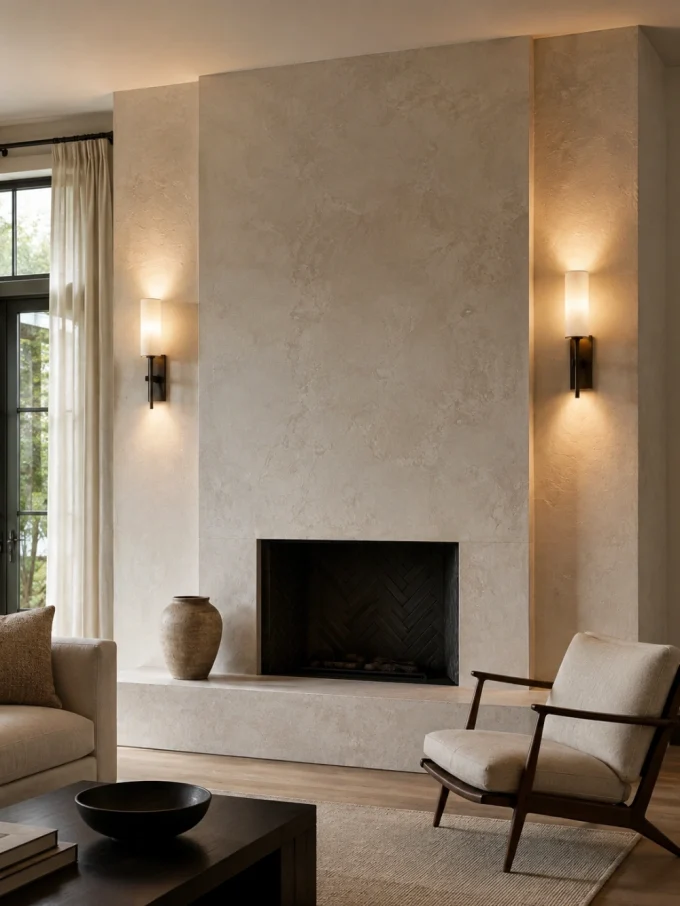
Once the architecture works, the fireplace usually needs less decoration than expected.
Lighting can be more useful than another object.
A pair of wall lights can frame a tall fireplace, illuminate textured stone, or make the wall feel complete after sunset.
If sconces are being considered, browse DecoralCove’s wall sconce light fixture ideas and indoor wall-mounted light fixture ideas for different ways to integrate light into the wall rather than filling the floor with more lamps.
Then edit the surface.
One large artwork may have more presence than six small objects.
A substantial ceramic piece may need nothing beside it.
An expressive stone fireplace may need no mantel decor at all.
Stand at the room entrance and identify what you notice first.
If the answer is stone, flame, artwork, television, shelves, sconces, mantel objects, and cabinetry simultaneously, the wall has not become more interesting.
It has lost its hierarchy.
A modern fireplace should still look considered on an ordinary afternoon when the fire is off.
That is the harder—and more useful—test.
A Short Safety Note Before Changing a Working Fireplace
A fireplace is not simply a feature wall.
If the project changes an active wood-, gas-, or other fuel-burning installation, decorative decisions must remain secondary to the fireplace manufacturer’s instructions, applicable local requirements, and competent installation or inspection.
The U.S. Fire Administration advises maintaining heating equipment and chimneys through professional cleaning and inspection and keeping combustible objects away from heat sources.
For wood-burning systems, EPA guidance also recommends regular appliance and chimney inspection and warns that wood smoke contains fine particles and other pollutants.
Homes with fuel-burning fireplaces should also take carbon-monoxide protection seriously. Current CPSC guidance recommends CO alarms on each level of the home and outside sleeping areas, alongside appropriately placed smoke alarms.
This is why this article deliberately does not give generic fireplace clearances or installation measurements.
Those need to come from the actual system being installed.
What Actually Makes a Fireplace Look Modern?
It is not one material.
A modern fireplace may be made from plaster, stone, brick, metal, tile, or timber accents.
What usually changes the result is how those pieces are handled.
Fewer unnecessary transitions.
The wall reads more clearly when several competing trims and borders are removed.
Stronger proportion.
The fireplace relates to the wall and ceiling rather than existing as an isolated rectangle.
Material confidence.
One good stone, plaster surface, timber element, or dark finish is allowed to do substantial visual work.
Controlled asymmetry.
Storage and architecture respond to the real room rather than forcing perfect balance.
Clear hierarchy.
The television, mantel, artwork, lighting, shelving, and fireplace do not all demand equal attention.
Practical integration.
Heat, maintenance, circulation, storage, and daily use are considered before the photograph.
That is a more durable definition of modern than simply buying the newest linear insert.
Fix the wall first.
Then decide what it actually needs.
8. FAQs
What type of fireplace looks the most modern?
No single fireplace type owns the modern look. Linear gas or electric designs can create a clean horizontal composition, while wood-burning, masonry, and traditional fireplaces can also look contemporary when the surround, proportion, and nearby detailing are simplified. The architecture around the fireplace often has more visual impact than the fuel type.
Does a modern fireplace need a mantel?
No. Mantel-free fireplaces work especially well when a stone, plaster, or tiled surround already provides enough visual structure. A simple timber mantel can still be useful when the room needs warmth or a horizontal transition. Choose it because the composition benefits from it, not because every fireplace is expected to have one.
What material is best for a modern fireplace surround?
There is no universal best material. Stone can add natural variation, plaster can create a quiet architectural volume, tile can introduce pattern or color, and appropriate metal details can sharpen the firebox. Any material near an operating fireplace also needs to be appropriate for that specific installation and used according to the fireplace manufacturer’s requirements.
Can an old brick fireplace be made modern?
Often, yes. Before covering or removing the brick, simplify the surrounding elements. Changing the mantel, wall color, doors or screen, lighting, adjacent built-ins, and mantel decor may substantially change how the brick reads. If modifying the masonry or applying a new finish, verify that the proposed material and method are appropriate for the fireplace.
Should a TV go above a modern fireplace?
Only when the room and fireplace installation make it sensible. Separate walls can produce a cleaner hierarchy and more flexibility with viewing height, but some rooms genuinely have only one practical focal wall. If the TV must go above the fireplace, follow the fireplace and TV manufacturers’ installation requirements rather than relying on a generic online clearance number.
Are linear fireplaces still modern?
Yes, linear fireplaces remain common in contemporary designs, including current 2026 industry and editorial coverage. The more important question is whether the horizontal proportion suits the wall and surrounding furniture.