

Navy blue can make a bathroom feel rich and composed, but it can also become heavy very quickly—especially in a small room, a windowless bathroom, or a space that already has dark flooring, deep timber, or limited lighting.
The solution is not to avoid navy. It is to decide where the color should carry visual weight, how much of it the room can support, and which lighter, warmer, or reflective materials need to balance it.
These 17 navy blue bathroom ideas will show you how to use navy through paint, vanities, tile, ceilings, showers, metals, wood, stone, lighting, and reversible decor—while also explaining which choices work best in small bathrooms, which are expensive to reverse, and where dark blue can become too much.
1. Why 17 Navy Blue Bathroom Ideas Start With the Walls
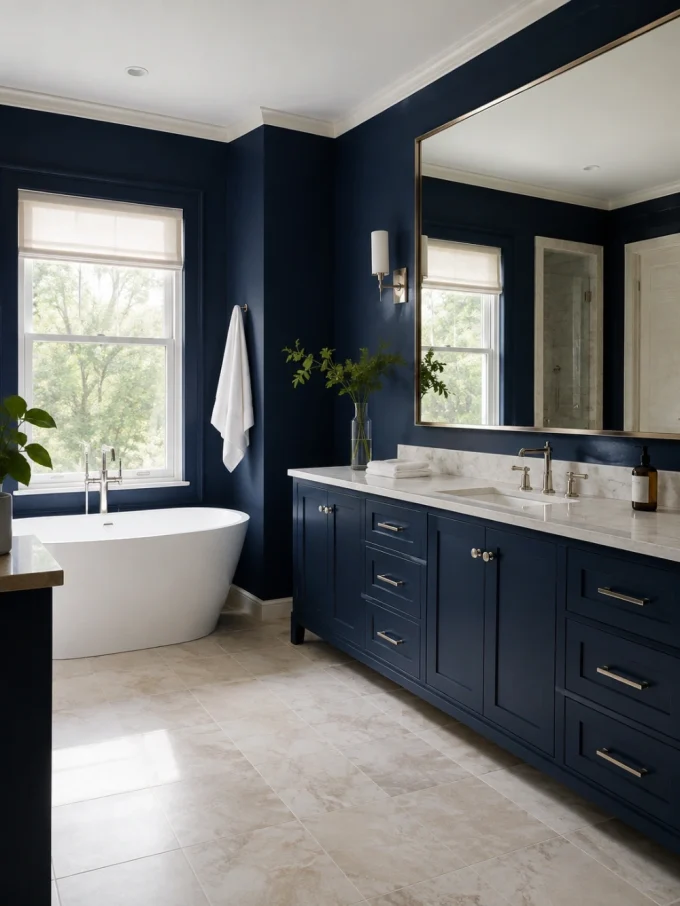
Painting the walls navy is the most direct way to establish the color, but it also gives navy the largest amount of visual territory.
That is not necessarily a problem.
Deep blue walls can give a bathroom a strong architectural outline, particularly when white sanitaryware, pale stone, lighter flooring, or a substantial mirror interrupts the darkness.
Benjamin Moore’s bathroom color guidance includes deeper shades such as navy and indigo when a more dramatic effect is wanted.
The balance matters more than a rule saying that dark paint always needs bright white everywhere.
If the room already contains pale stone, a white tub, light grout, and a generous mirror, navy walls may provide exactly the weight it is missing.
If the floor is charcoal, the vanity is dark walnut, daylight is poor, and the ceiling is low, covering every remaining wall in navy may push the palette too far.
Test the actual color beside the floor, vanity, countertop, and artificial lighting rather than judging one sample in isolation.
Bathrooms also expose finishes to more humidity than many living spaces. Use a coating that its manufacturer specifies as suitable for the intended bathroom conditions rather than choosing solely by color.
2. Make the Vanity the Navy Focal Point
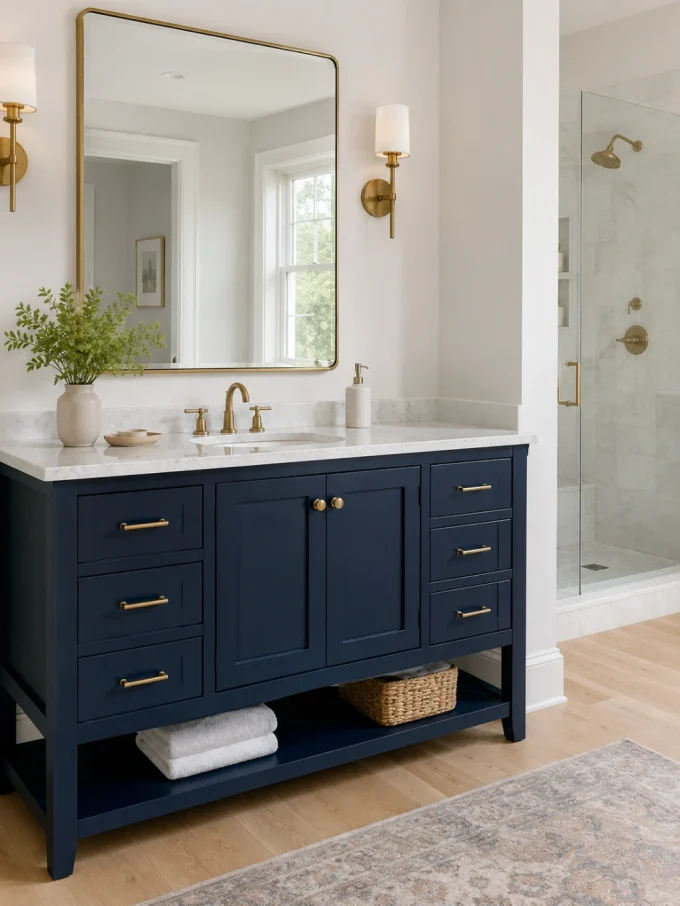
A navy vanity is one of the easiest ways to use a substantial amount of blue without committing the entire room to it.
The color sits low in the composition, visually grounding the sink and countertop.
It works especially well with:
- white or cream stone;
- pale quartz;
- marble;
- warm timber flooring;
- light walls;
- or a large mirror.
A freestanding navy vanity can also read more like furniture than standard white cabinetry.
The practical advantage is control.
If the room already contains expensive neutral tile that you have no reason to replace, the vanity introduces a major block of color without disturbing permanent surfaces.
Architectural Digest has featured navy and tonal-blue vanity treatments as a way to give this functional element more furniture-like presence.
Watch the hardware.
Brass moves the scheme warmer. Chrome or nickel keeps it cooler. Black creates stronger graphic contrast but may add more darkness than the room needs if the vanity, floor, and mirror frame are already deep-toned.
3. Use Glossy Navy Tile Where You Want Light to Move
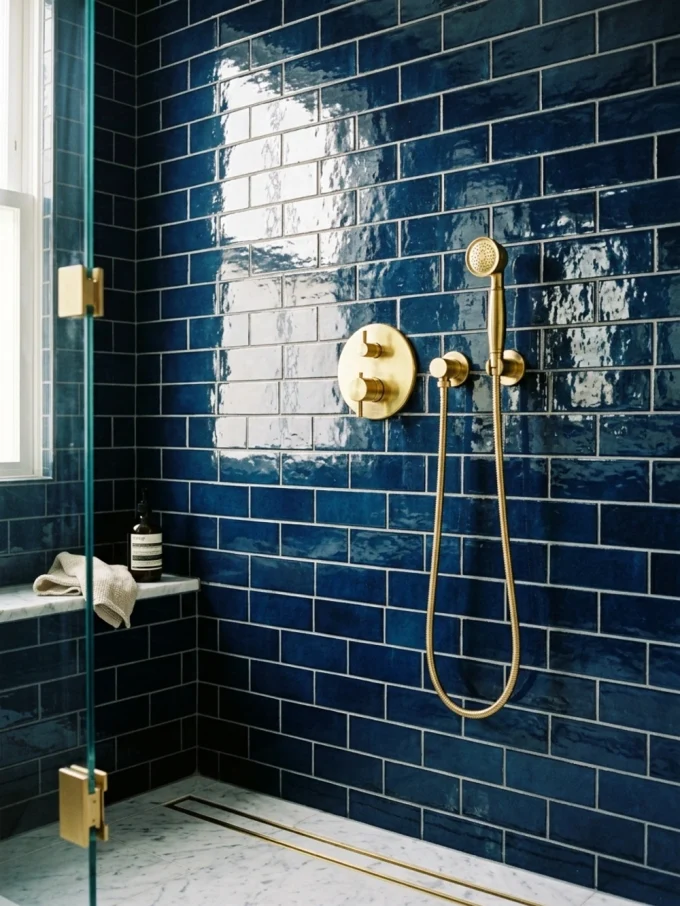
Dark blue tile does not behave like flat dark-blue paint.
Glaze, grout, tile shape, and slight surface variation all change how the wall receives light.
A glossy navy subway, square, narrow-format, or irregular glazed tile can create small highlights across the surface. Instead of reading as one uninterrupted dark plane, the wall changes as daylight or artificial light moves across it.
Architectural Digest’s blue-bathroom examples demonstrate this broader potential of blue tile, including darker and more saturated treatments rather than paint alone.
Useful locations include:
- behind a vanity;
- inside a shower;
- around a bathtub;
- or on one substantial feature wall.
The trade-off is permanence.
Paint can be changed relatively easily.
Tile cannot.
Before ordering a large quantity, view physical samples beside the intended grout, sanitaryware, stone, metal finish, and bathroom lighting.
A tile that looks luminous beneath showroom lighting may appear almost black in a windowless bathroom.
4. Pair Navy With White Without Making the Room Feel Nautical
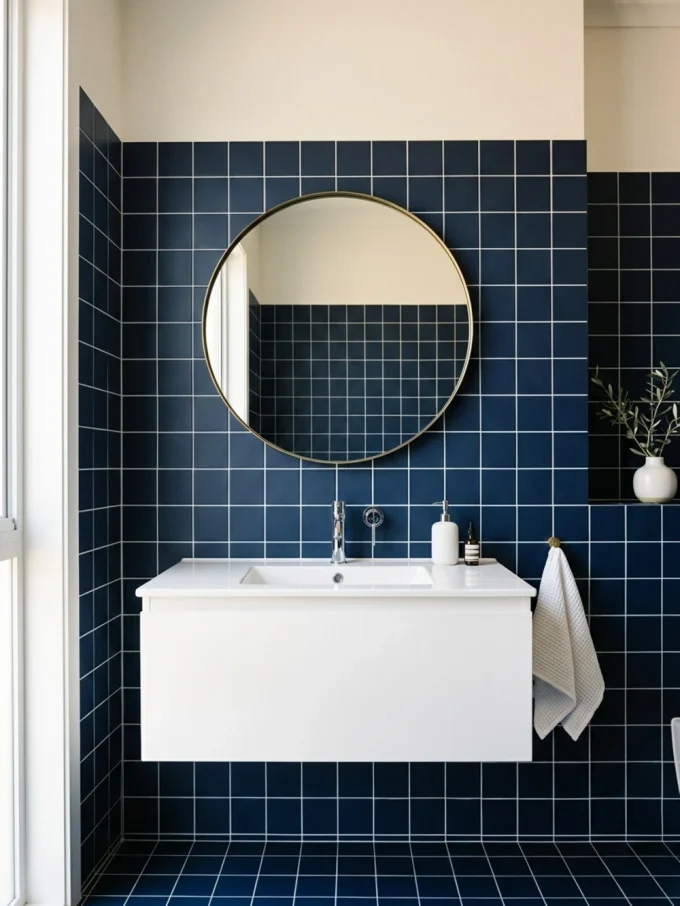
Navy and white is reliable, but it can become overly literal when every element alternates between the two.
Instead, decide which color should dominate.
A mostly white bathroom might use:
- one navy vanity;
- navy shower tile;
- or one deep-blue wall.
A mostly navy bathroom might bring white back through:
- sanitaryware;
- grout;
- countertops;
- towels;
- or the ceiling.
You can also replace stark white with warm white, cream, pale stone, or light timber.
That changes the temperature of the scheme and prevents it from automatically becoming crisp or coastal unless that is actually the effect you want.
The point is hierarchy.
Navy and white usually look more considered when one carries the room and the other interrupts it.
5. Warm Navy With Natural Wood
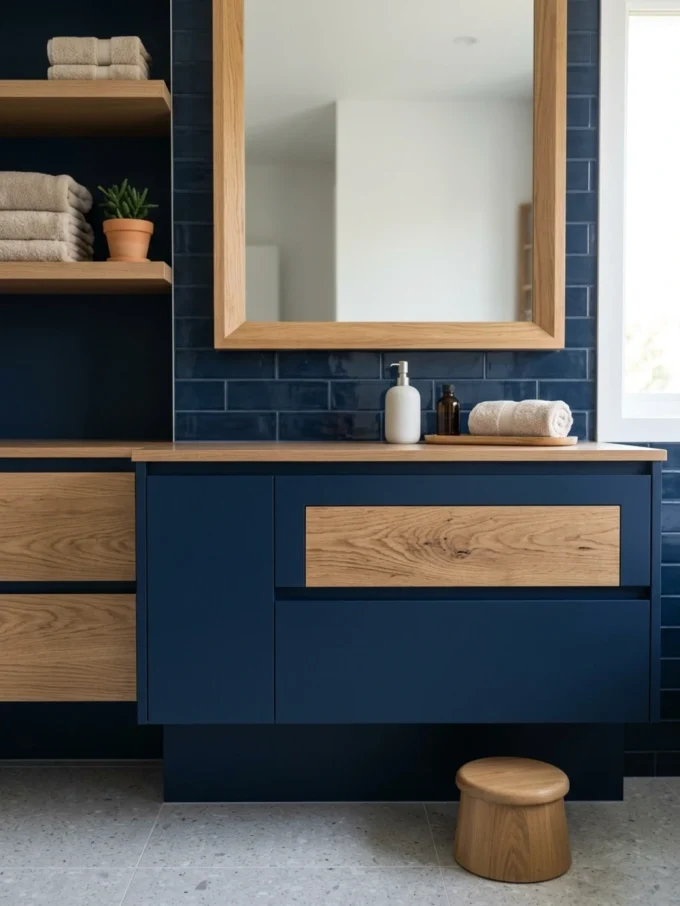
Wood is one of the most useful materials for preventing a navy bathroom from feeling too cool or polished.
The contrast comes from more than color.
Painted cabinetry and glazed tile can look visually smooth. Timber introduces grain, tonal variation, and a warmer material temperature.
Try navy with:
- oak vanity drawers;
- walnut cabinetry;
- a timber-framed mirror;
- wood-toned shelving;
- or a simple stool placed away from direct water exposure.
The wood does not need to be rustic.
Clean flat-front oak cabinetry can make navy tile feel contemporary, while darker walnut pushes the same blue toward a richer and more enclosed mood.
Real timber requires practical judgment in a bathroom. Species, construction, finish, exposure to water, and manufacturer guidance all matter.
If you want a more rugged material relationship around the shower, DecoralCove’s rustic walk-in shower ideas provide additional inspiration.
6. Use Brass or Bronze to Pull Warmth Out of Navy
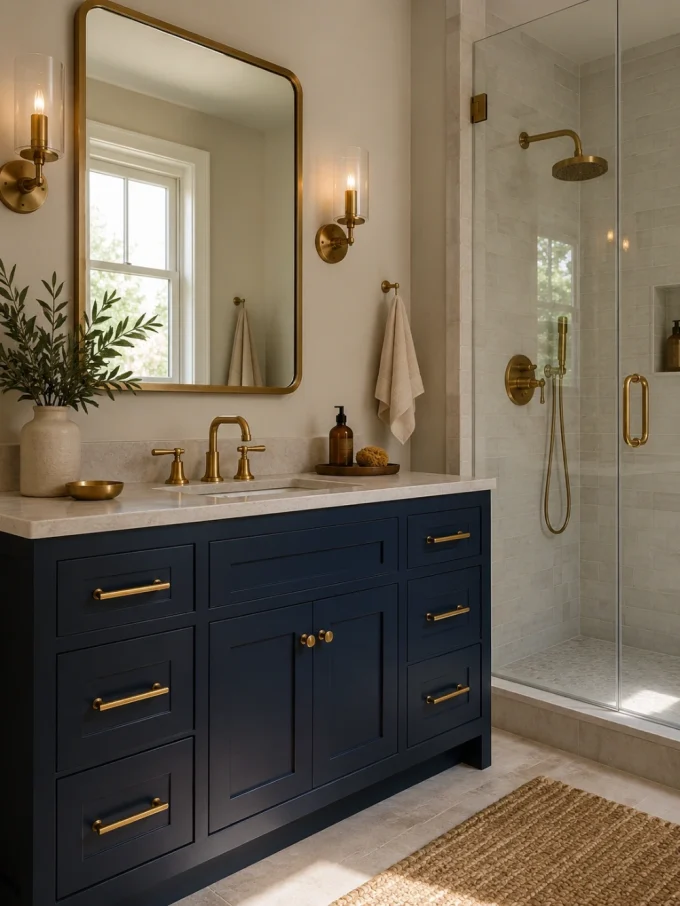
Navy and warm metal create obvious contrast without introducing another large area of color.
A brushed or aged brass faucet against a navy vanity feels warmer than chrome against the same cabinet.
Useful places for repetition include:
- faucets;
- cabinet pulls;
- mirror frames;
- sconces;
- shower hardware;
- and small accessories.
Repetition matters.
One brass faucet surrounded by chrome shower fittings, black sconces, silver pulls, and a bronze mirror can make the metal palette look accidental.
You do not need every metal to match exactly, but one finish should appear often enough to establish a deliberate relationship.
There is no rule saying brass is always better with navy.
If the bathroom already contains beige stone, warm timber, and creamy walls, nickel or chrome may provide the cooler contrast the room actually needs.
7. Use Navy in a Small Bathroom Instead of Automatically Going Pale
Small bathrooms do not automatically need pale paint.
A compact powder room or bathroom can sometimes handle navy particularly well because there is less surface area to coordinate and the deep color gives the room a strong identity.
The useful distinction is between small and poorly functioning.
Paint will not fix:
- inadequate lighting;
- oversized storage;
- awkward circulation;
- or cluttered surfaces.
If those issues are controlled, a deep color can make the room feel deliberate rather than apologetic about its size.
Keep the composition disciplined.
A compact navy bathroom may need only:
- strong wall color;
- white sanitaryware;
- one well-scaled mirror;
- useful lighting;
- and a restrained floor.
Trying to “open it up” with six unrelated pale finishes can create more fragmentation than one coherent dark scheme.
8. Let Marble or Pale Stone Break Up the Dark Blue
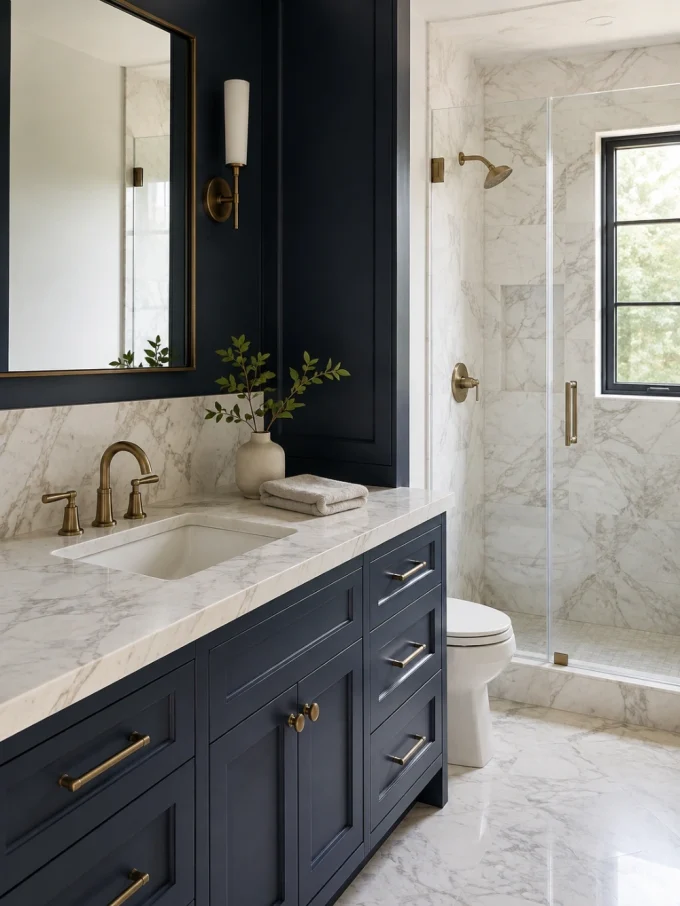
Navy works particularly well beside pale stone because veining and tonal variation interrupt the flatness of a painted or tiled surface.
A marble or quartz countertop above a navy vanity is the obvious application, but the relationship can continue through:
- shower walls;
- floor tile;
- backsplash;
- a stone basin;
- or a tub surround.
Pay attention to undertone.
Some navy shades lean almost black.
Others contain more gray, green, or violet.
Stone also varies widely in warmth.
Place samples together before making an expensive decision.
The objective is not to find an imaginary perfect match. It is to ensure that the bathroom lighting does not make the blue turn the stone unexpectedly yellow, muddy, or cold.
9. Put Navy Wainscoting Below a Lighter Upper Wall
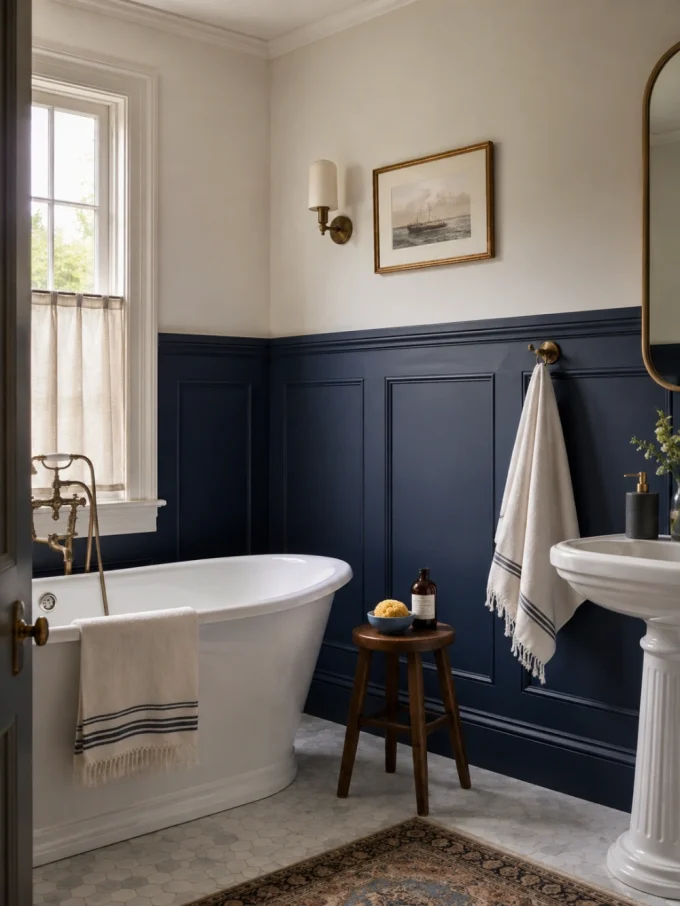
Splitting the wall vertically is a practical way to use navy when a full-height dark treatment feels excessive.
A navy lower wall gives the room a strong base while the upper portion stays visually lighter.
This works particularly well in:
- traditional bathrooms;
- powder rooms;
- bathrooms with freestanding tubs;
- or rooms with higher ceilings.
Proportion matters.
A very low strip of dark paneling can look timid on a tall wall. A more substantial lower section gives the color and architectural detail enough presence to justify themselves.
Do not add paneling merely because a wall feels empty.
In a humid room, the material, joints, paint system, detailing, and installation should suit their location.
For broader architectural treatments, DecoralCove’s unusual wainscoting ideas show how much the proportion and pattern of wall detailing can vary.
10. Take Navy Onto the Ceiling for a More Enveloping Room
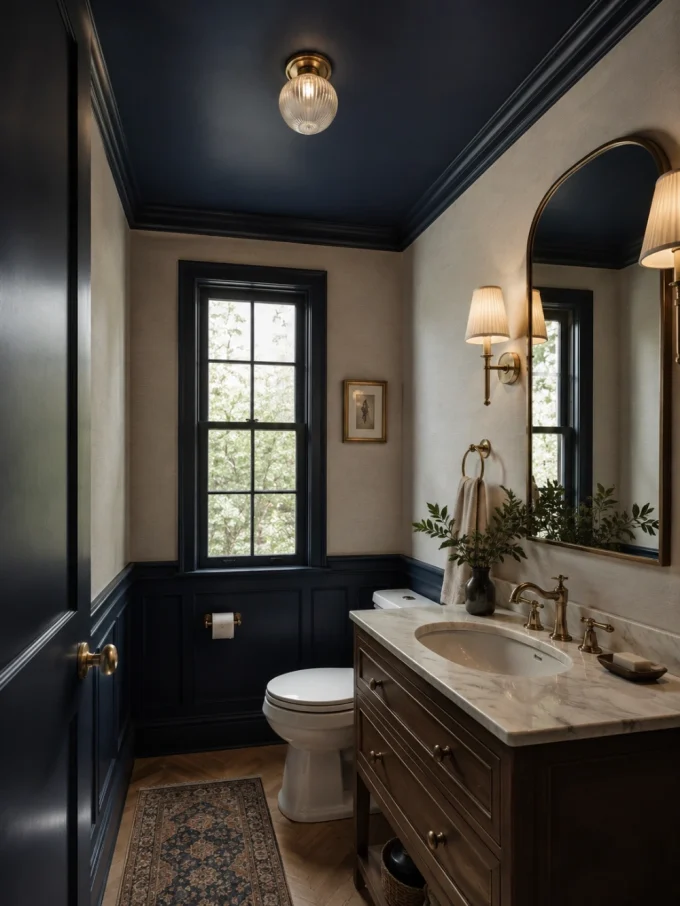
The ceiling is an unexpected place for navy, which is precisely why it can work.
A dark ceiling can make a powder room feel intentional and enclosed instead of leaving one unrelated white plane above an otherwise moody scheme.
Possible approaches include:
- continuing navy walls overhead;
- keeping the walls pale and using navy only above;
- or using two blues with enough tonal difference to remain intentional.
Think about ceiling height and lighting before committing.
A dark overhead plane adds visual weight.
In a room with a low ceiling and weak lighting, that might create the intimacy you want—or make the room more enclosed than expected.
DecoralCove’s modern ceiling ideas provide further examples of treating the ceiling as part of a room rather than leaving it automatically white.
11. Use Patterned Navy-and-White Tile Instead of a Solid Blue Surface
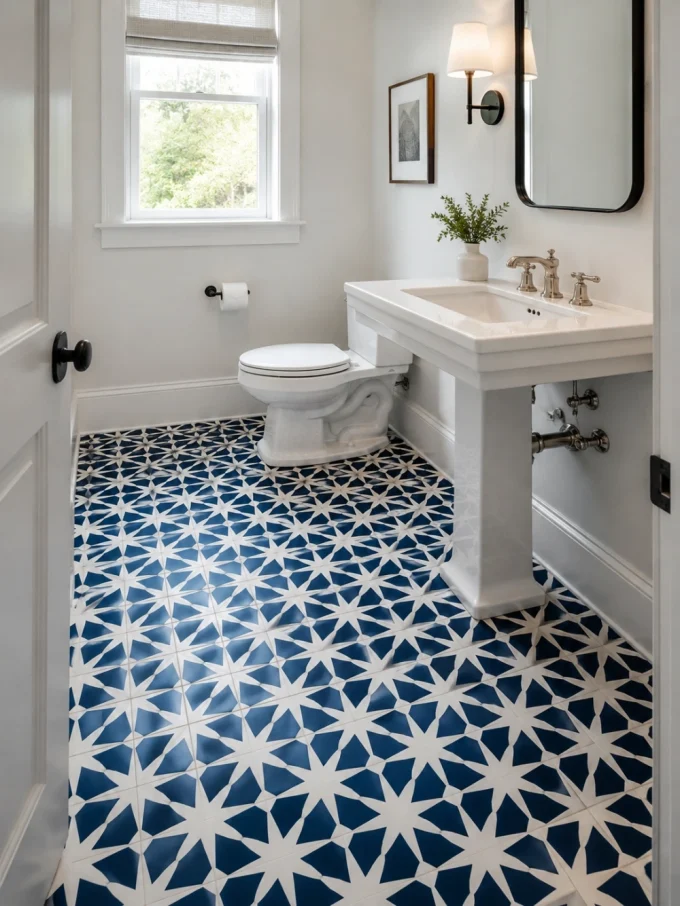
Pattern can introduce navy without making one large surface an uninterrupted block of dark color.
Consider:
- geometric floor tile;
- patterned shower tile;
- encaustic-style motifs;
- stripes;
- floral-inspired tile;
- or a smaller decorative backsplash.
This works particularly well when the vanity and walls remain restrained.
Pattern already creates movement, repetition, and contrast. It usually needs fewer decorative objects around it.
Be careful about combining too many competing surfaces in a small bathroom.
A patterned navy floor, heavily veined countertop, mosaic shower, decorative wallpaper, and strongly grained vanity may each be appealing on their own and exhausting together.
Choose one lead pattern.
Let the other materials support it.
12. Make the Walk-In Shower the Navy Zone
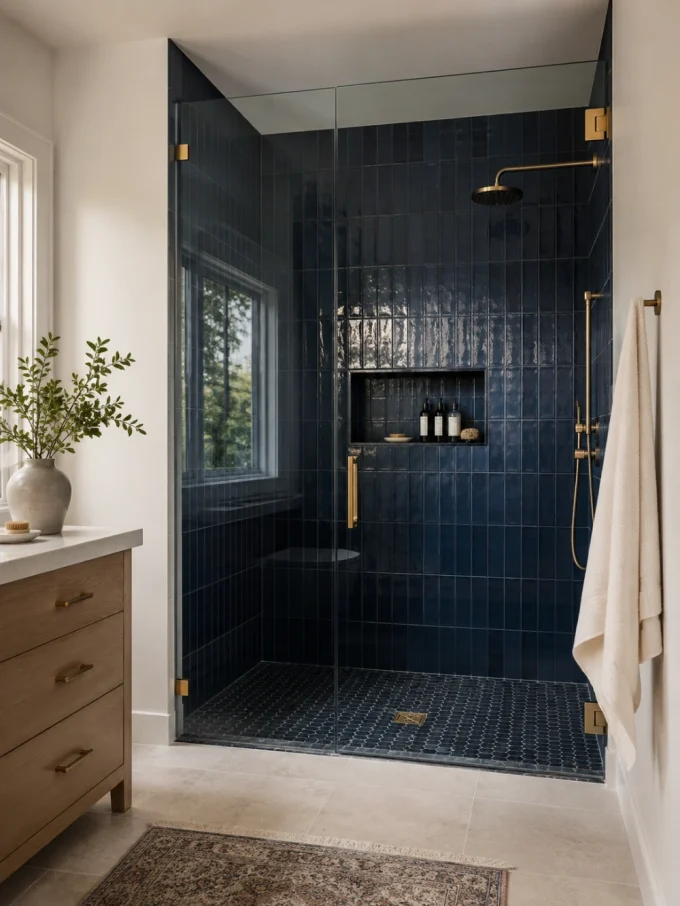
If you like navy but do not want it across the entire room, contain the strongest color inside the shower.
A navy shower wall creates a defined zone while the rest of the bathroom can remain lighter.
Glass helps because the color remains visible from outside the enclosure without physically continuing across every wall.
Possible treatments include:
- full-height navy tile;
- navy only on the back wall;
- darker blue below a lighter tile;
- or tonal blue tile with controlled variation.
This strategy works particularly well when the shower is already the architectural focal point.
Plan practical details at the same time.
Niches, bottles, grout, drains, glass hardware, and shower fittings will all become part of the final composition.
For more shower-specific ideas, see DecoralCove’s rustic walk-in shower ideas.
13. Build a Tonal Blue Bathroom Instead of Stopping at Navy
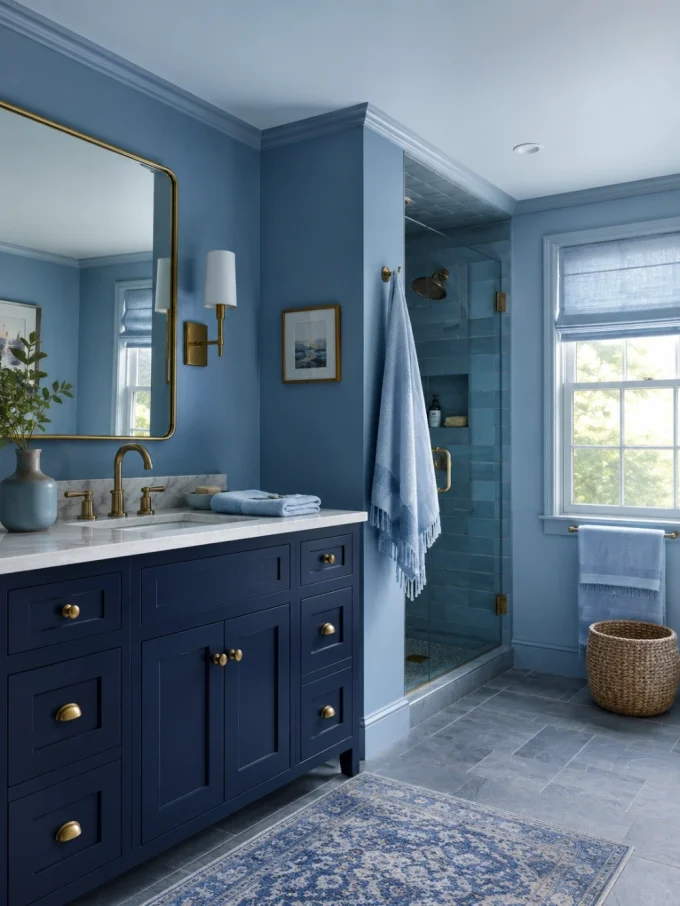
Navy does not need to sit beside white.
Several blues can create a more layered bathroom:
- navy vanity;
- medium-blue wall;
- pale-blue ceiling;
- blue-gray tile;
- or lighter blue textiles.
The important part is separation.
If two blues almost match but miss slightly, the result can look accidental.
Create enough difference in lightness, saturation, material, or sheen that each shade has a clear role.
A matte navy vanity beneath powder-blue walls creates obvious hierarchy.
A navy wall beside blue-gray stone creates a quieter transition.
If you want to compare cooler shades before deciding how broad the palette should become, DecoralCove’s cool blue paint ideas provide additional color directions.
14. Use Navy Wallpaper Where Moisture Exposure Is Sensible
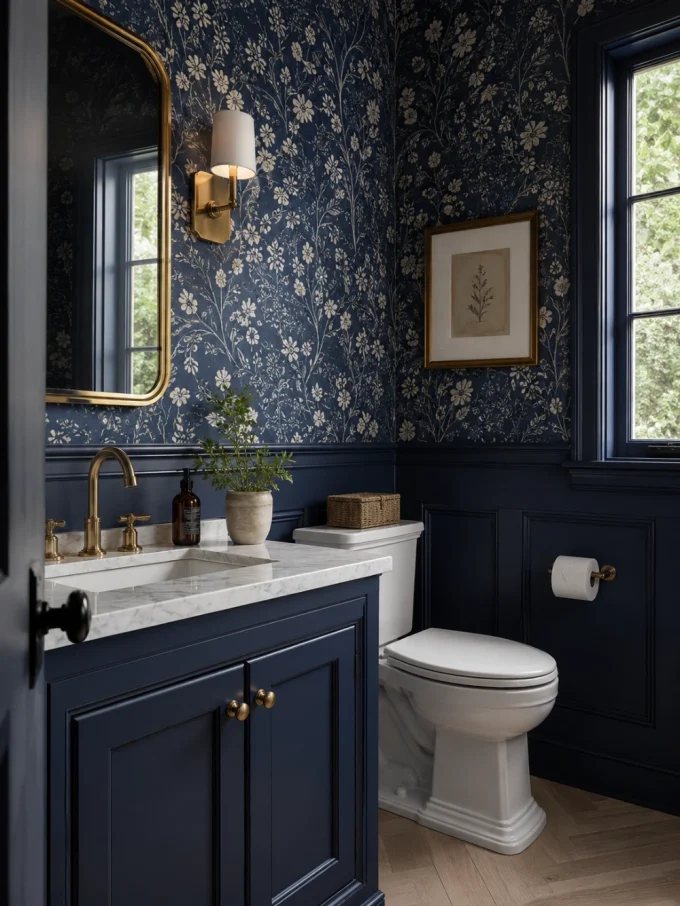
Wallpaper can introduce things flat navy paint cannot:
- stripes;
- florals;
- geometric pattern;
- texture;
- or layered blue-and-white motifs.
It is particularly attractive in powder rooms, where direct wet zones are usually more limited.
A full bathroom requires more caution.
Do not assume every wallcovering belongs beside a frequently used shower or bathtub. Follow the manufacturer’s suitability and installation instructions for the actual environment.
Ventilation matters independently of decoration. The U.S. Environmental Protection Agency specifically notes that ventilation is especially important in bathrooms to remove unwanted moisture and recommends bathroom exhaust that sends air outdoors.
If you prefer surface depth without wallpaper, DecoralCove’s wall texture design ideas offer alternatives.
15. Layer the Lighting So Navy Does Not Become a Flat Dark Mass
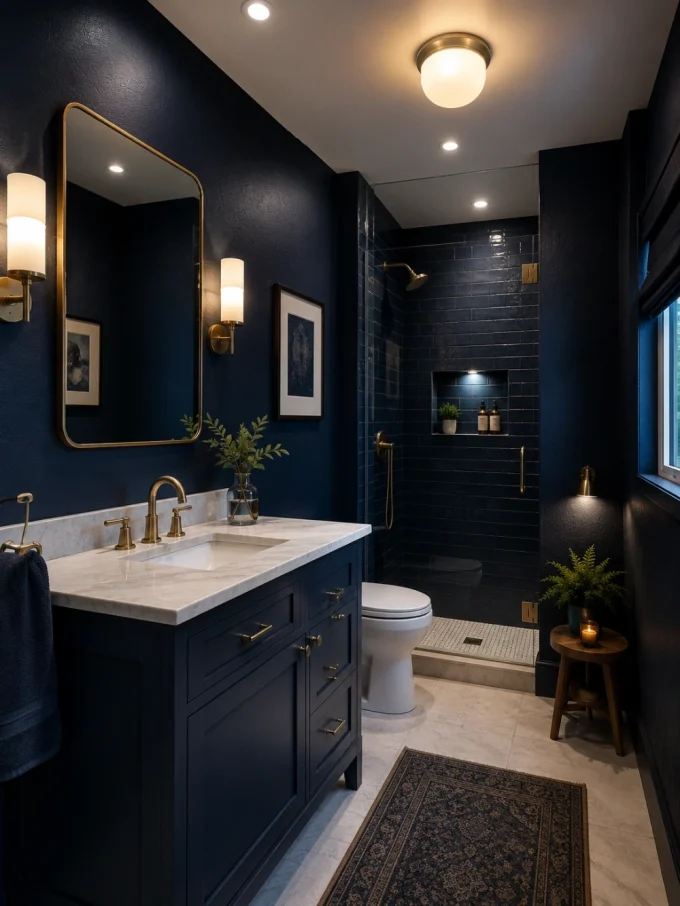
Dark surfaces make lighting decisions more visible.
One central ceiling fixture may provide enough illumination to move around while still leaving the vanity, shower, and corners visually flat.
Think in layers.
Ambient light handles general visibility.
Vanity lighting supports grooming.
A sconce can illuminate a mirror, wall texture, or darker corner.
Lighting also changes how navy appears. A blue that looks crisp in daylight may become nearly charcoal under weak artificial light.
That is why paint, tile, stone, and metal samples should be evaluated under the lighting the room will actually use.
DecoralCove’s wall sconce light fixture ideas and indoor wall-mounted light fixture ideas offer additional lighting directions.
Decorative lighting should not replace adequate functional illumination.
The room still needs to work.
16. Soften Navy With Greenery and Natural Texture
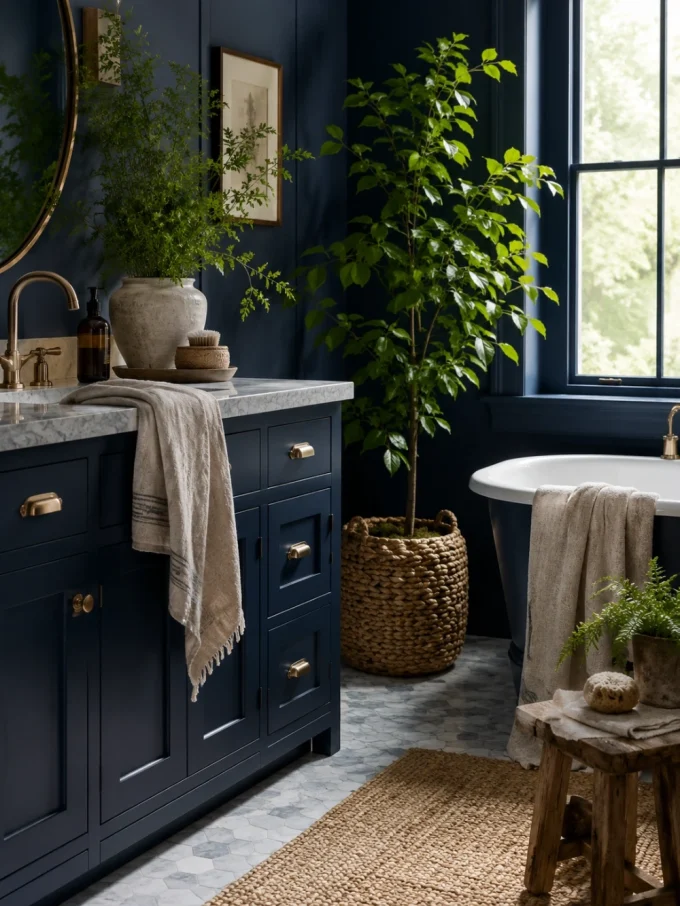
A navy bathroom can become highly polished very quickly:
smooth cabinetry, glass, ceramic, metal, stone.
That can also make it feel hard.
Natural texture interrupts those surfaces.
A small amount may be enough:
- woven basket;
- timber stool;
- linen or textured textile where suitable;
- substantial towels;
- tactile bath mat;
- or a bathroom-suitable plant.
Green foliage creates particularly useful contrast with deep blue because it introduces another dark or mid-tone color without simply repeating navy.
But plants should suit the actual conditions. Light, humidity, species, and care requirements still matter.
DecoralCove’s bathroom plant decor ideas provide a more focused look at using greenery in bathrooms.
17. Build a Renter-Friendly Navy Bathroom With Reversible Layers
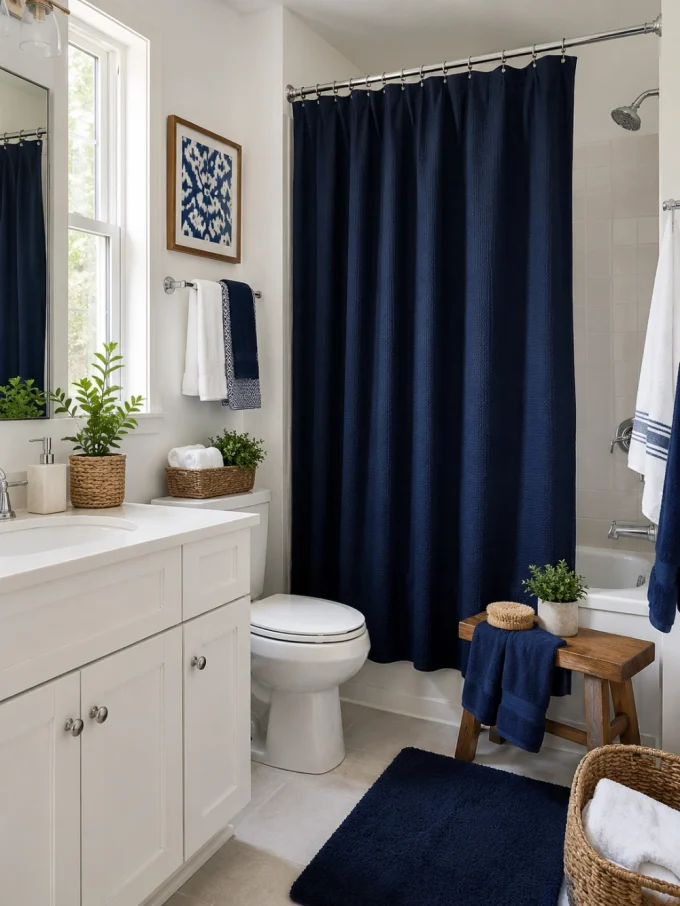
You do not need to paint tile or replace the vanity to make navy a meaningful part of the room.
Renters—or homeowners who simply do not want a permanent commitment—can use:
- navy shower curtain;
- towels;
- bath mat;
- framed artwork;
- storage containers;
- removable accessories;
- or a portable mirror.
A shower curtain is especially useful because it covers a large vertical area while remaining inexpensive and easy to replace compared with tile.
If the room is largely white, navy textiles can change the palette immediately.
Avoid buying every accessory in identical dark blue.
A navy curtain, white towels, timber accessories, and one blue-patterned artwork generally provide more material variation than matching navy soap dispenser, bin, bath mat, storage box, towels, and toothbrush cup.
For more reversible decorating strategies, see DecoralCove’s rental apartment decorating ideas.
Final Thoughts
Navy works best when you decide what job the color should perform before deciding how much of it to use.
If the bathroom feels plain, navy walls may provide the definition it lacks.
If permanent tile is already attractive, a navy vanity may be enough.
If a small bathroom is well lit and uncluttered, deeper color can give it character rather than trying to make every surface visually disappear.
If the room already contains dark flooring, deep timber, and limited daylight, use navy more selectively and let stone, white, glass, lighter wood, or reflective metal provide relief.
For renovations, spend the most time on the decisions that are hardest to reverse:
- tile;
- cabinetry;
- stone;
- plumbing finishes;
- and fixed lighting.
Paint, towels, art, and a shower curtain are much easier places to experiment.
Do not choose navy merely because one current trend report calls it fashionable. Current 2026 design coverage itself is divided on very dark bathroom blues, which is another reason to judge the color against the actual room rather than the trend cycle.
And before styling the final layer, make sure the bathroom functions properly. Moisture control and effective ventilation matter more than another decorative accessory.
Once the room works, navy can do what it does particularly well: give lighter, warmer, textured, and reflective materials something substantial to contrast against.
If the bathroom already feels resolved, stop.
DecoralCove’s home decor mistakes to avoid is a useful next read if you are tempted to add objects simply because a surface remains empty.
Frequently Asked Questions
Does navy blue make a small bathroom look smaller?
Not automatically. Navy adds visual weight, but the result also depends on lighting, contrast, storage, layout, and how much of the room carries the dark color. A compact bathroom with clear surfaces and useful lighting can handle deep blue successfully.
What colors go best with a navy blue bathroom?
White, cream, warm wood, pale stone, gray, muted blue, green, brass, bronze, nickel, and chrome can all work. The right choice depends on whether the bathroom needs greater warmth, stronger contrast, or a cooler finish.
Is navy blue suitable for a bathroom vanity?
Yes. A vanity is one of the easiest places to use navy because it creates a substantial focal point without requiring dark walls or permanent blue tile. Pale stone or quartz can provide useful contrast above it.
Can I use navy blue in a windowless bathroom?
Yes, but artificial lighting becomes central to the design. Test paint, tile, stone, and metal samples under the lighting that will actually be used. Mirrors, glossy tile, pale sanitaryware, and lighter surfaces can help prevent the scheme from becoming visually flat.
Is navy blue still a good bathroom color in 2026?
It can be, but current editorial opinion is mixed rather than unanimous. One 2026 Homes & Gardens trend report identifies rich navy as a notable bathroom color, while another argues that very dark blues are becoming less fresh compared with warmer and more mineral-based palettes.
That makes navy more convincing when chosen because it suits the architecture, light, and existing materials—not because a trend forecast says to use it.
What is the easiest way to add navy without renovating?
A navy shower curtain usually creates the largest reversible color change because it occupies substantial vertical space. Towels, bath mats, artwork, and accessories can add smaller amounts without altering permanent finishes.