

The best chic narrow hallway decor ideas are not necessarily the ones that put the most things into the passage. A beautiful console, mirror, runner, gallery wall, basket, plant, and pendant can each work individually, yet combining all of them in a tight corridor may leave less room to walk and far more for the eye to process.
Treat the hallway as a passage first and a decorating opportunity second. Protect circulation, decide where you want the eye to travel, solve the clutter that actually accumulates there, and then use color, light, artwork, texture, and a few well-scaled pieces to give the space character.
That approach can make even a very narrow hallway feel deliberate rather than under-decorated.
1. Start Chic Narrow Hallway Decor Ideas With Clear Circulation
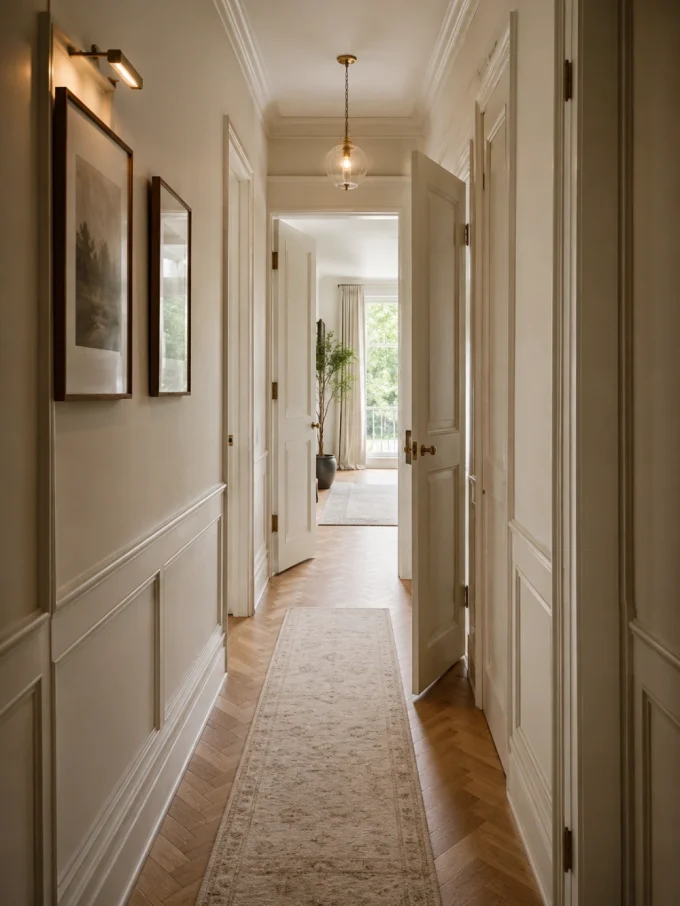
Before choosing artwork or paint, walk through the hallway as you normally use it.
Open every door that swings into the passage. Carry a laundry basket through it. Notice whether coats already project from one wall or whether shoes regularly collect near the entrance.
Those observations tell you more than an inspiration photograph can.
A console may technically fit against the wall while leaving such an awkward passage that people brush it every time they walk past. A decorative floor basket may occupy very little space on paper and still get kicked several times a day.
If the hallway is extremely narrow, accepting that it does not need floor furniture is often the better decision.
Keep the center route open and put the decorative work onto the walls, lighting, ceiling, paint, and floor finish instead.
Where you have more space to work with, DecoralCove’s stunning hallway ideas offer broader inspiration for furniture and decorative combinations.
2. Give the Far End of the Hallway a Strong Focal Point
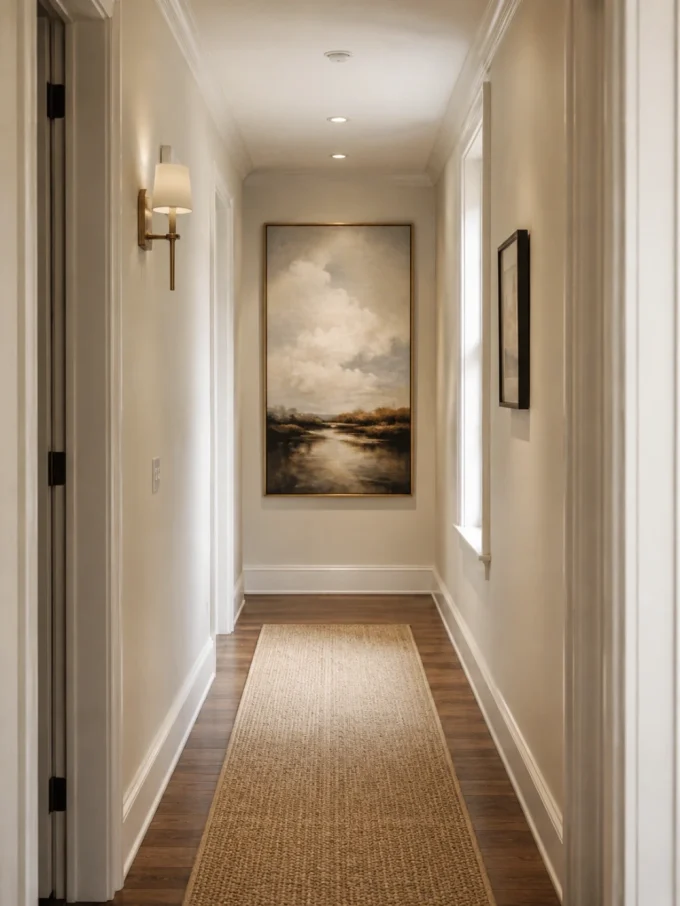
A long hallway creates a natural sight line.
Use it deliberately.
When you stand at one end, notice where your eye lands. A blank end wall can make the passage feel unresolved, while too many small objects along its length can make the eye work unnecessarily hard.
A stronger solution may be one:
- substantial framed artwork;
- tall mirror;
- sculptural wall object;
- distinctive doorway;
- painted end wall;
- or compact furniture piece where the end opens into a wider area.
The purpose is not to fill the wall. It is to create a destination.
Imagine a corridor with small frames covering both side walls and another cluster at the end. Everything asks for attention at once.
Replace the end cluster with one larger artwork and reduce some of the side-wall decoration. The eye now knows where to travel.
That visual hierarchy costs no additional floor space.
3. Use a Runner to Frame the Hallway
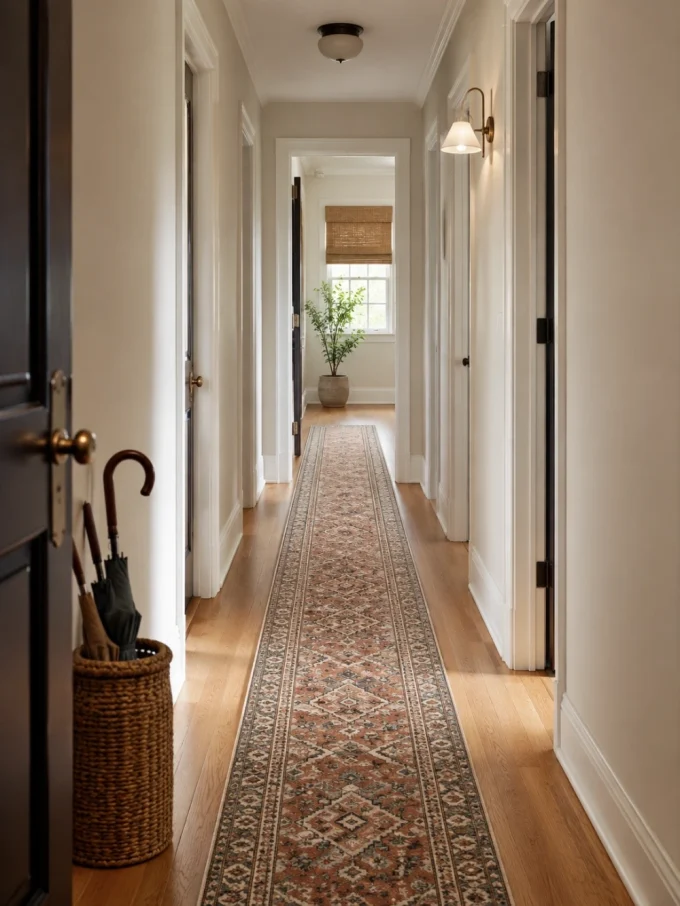
A runner can do several useful jobs at once.
It introduces texture or pattern, softens hard flooring, establishes a direction through the corridor, and visually connects several doorways.
But scale matters.
Avoid choosing a runner that looks squeezed between the walls. Leaving some flooring visible along both sides gives the rug a clear border and helps it read as an intentional layer rather than wall-to-wall carpeting.
Pattern can be particularly effective where the walls are restrained. A stripe can reinforce the hallway’s length, while a vintage-inspired or geometric motif gives the eye detail without requiring more objects on the walls.
Check door movement before buying.
A thick runner can catch beneath a low door even when its width looks perfect.
Maintenance matters in entry halls too. Mud, grit, wet shoes, children, and pet hair may make an easily cleaned construction more useful than a delicate pale textile.
For an active household, practical flooring usually ages more gracefully than a runner selected for photographs alone.
4. Choose a Console by Depth, Not Just Style
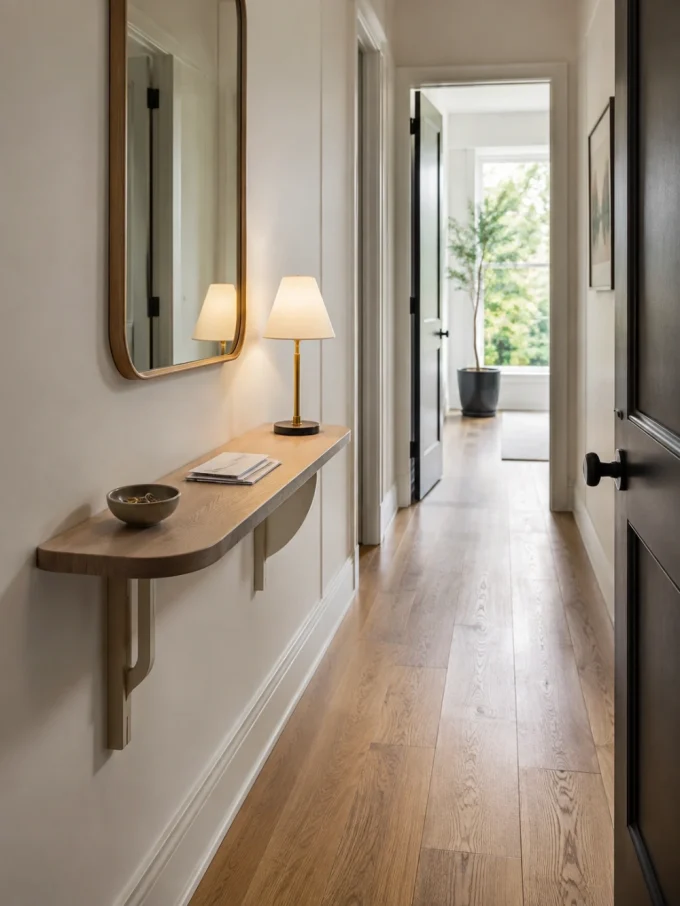
A console table is one of the easiest hallway recommendations to copy and one of the easiest to get wrong.
It can create a useful landing area for keys, mail, a lamp, or a small bowl. It also consumes some of the hallway’s most valuable dimension: width.
Do not judge a console only by how nicely its width fits the wall.
Check the depth.
Before buying, mark the proposed footprint on the floor with painter’s tape. Keep it there while you use the hallway normally.
Do you have to adjust your path?
Does a nearby door feel awkward?
Can you pass comfortably while carrying bags?
If the taped rectangle already annoys you, the furniture will not improve the situation.
Where space permits, open legs, shallow profiles, or wall-mounted designs can reduce visual mass.
DecoralCove’s entryway console table ideas are more useful once you know that the hallway can physically accommodate one.
If it cannot, a small floating ledge may provide enough space for keys without turning the passage into an obstacle course.
Sometimes the right console is no console.
5. Position a Mirror for What It Reflects
A mirror does not automatically make every narrow hallway look larger.
It repeats whatever is opposite it.
Hang one across from an attractive doorway, artwork, window, or bright adjoining room and the reflection can introduce depth, movement, and light.
Hang it opposite an overflowing coat rack and you have doubled the visual clutter.
Before deciding where it belongs, stand against the proposed wall and look directly across the hallway.
That is approximately the scene you are choosing to repeat.
Shape affects the composition too.
A tall rectangular mirror reinforces vertical lines. An arch can soften a passage dominated by straight door frames. A round mirror introduces a contrasting shape without adding another piece of furniture.
One appropriately scaled mirror often contributes more than several small decorative mirrors scattered along the corridor.
6. Layer the Lighting Before Adding More Decor
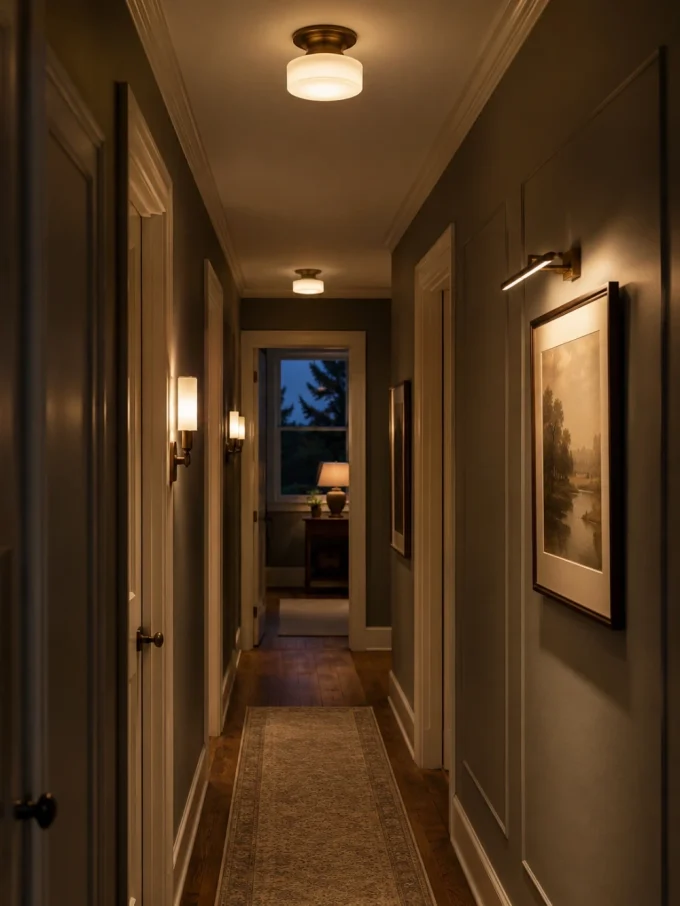
A hallway can have attractive paint and artwork and still feel unfinished if the lighting is flat.
Start by looking for the shadows.
Does one ceiling light brightly illuminate the middle while leaving both ends gloomy? Are framed pieces almost invisible after sunset? Does the paint lose all of its depth at night?
Lighting may be the problem you should solve before buying more decoration.
A hallway can potentially combine:
- ambient ceiling light;
- compact wall sconces;
- picture lighting;
- decorative pendants where ceiling height permits;
- or repeated fixtures down a longer corridor.
Architectural Digest’s hallway coverage highlights the decorative value of repeated pendant or playful light fixtures, while recent Real Simple coverage also recommends moving beyond harsh, one-dimensional overhead lighting where the space allows.
Wall fixtures can be particularly valuable because they add another visual layer without putting a lamp on the floor. Explore DecoralCove’s wall sconce light fixture ideas and indoor wall-mounted light fixture ideas for suitable directions.
Watch how far the fixture projects from the wall.
A deep sculptural sconce can become an irritating shoulder-level obstruction in a genuinely narrow passage. Compact designs generally deserve closer consideration where every inch matters.
Hardwired electrical work is also different from simply styling a room. Electrical Safety First recommends registered electricians for downlight installation and emphasizes following manufacturer guidance.
7. Give Artwork Enough Empty Wall Around It
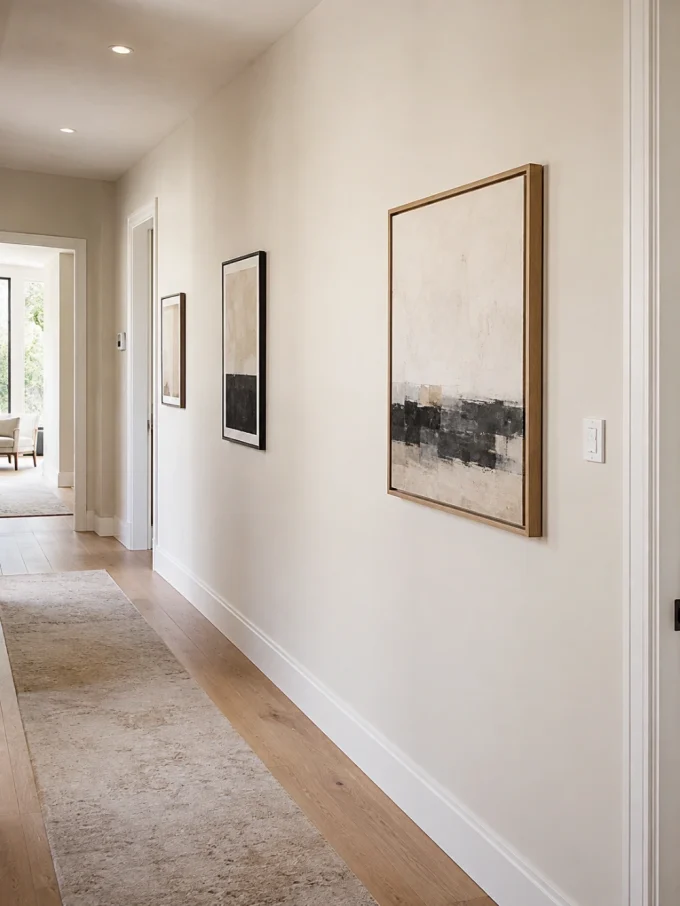
Long hallways tempt people to fill the walls because so much vertical surface is available.
The problem is that walls are rarely as empty as they initially appear.
Door frames, switches, thermostats, sconces, trim, and openings are already part of the composition.
Adding a dense collection of small frames around all of those elements can make a narrow hallway feel more fragmented rather than more interesting.
Consider three approaches.
Use two or three larger pieces with generous space between them.
Create one concentrated gallery on the cleanest uninterrupted stretch of wall.
Or repeat similar frame sizes at a consistent height to establish rhythm along a longer corridor.
Recent designer commentary collected by Real Simple similarly emphasizes that small artwork spaced poorly can feel disconnected and cluttered, while stronger scale or a more cohesive arrangement brings greater clarity.
The empty wall is not wasted.
It is what allows the artwork to register.
8. Use Paint Deliberately Instead of Automatically Choosing White
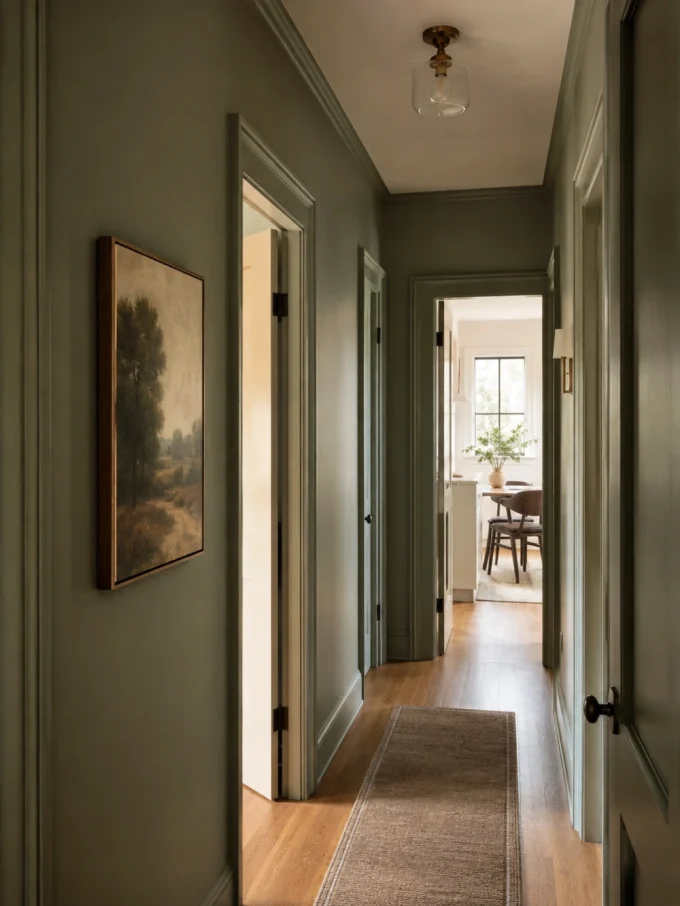
A narrow hallway does not automatically need white walls.
A pale neutral can work beautifully where you want the corridor to feel quiet and connected to brighter adjoining rooms. But a richer color can also give an otherwise anonymous passage a much stronger identity.
Consider:
- muted blue;
- soft green;
- mushroom;
- warm taupe;
- clay;
- deep blue;
- charcoal;
- or another shade that relates naturally to surrounding rooms.
The useful question is not simply, “Which color makes a hallway look bigger?”
Ask what the paint needs to accomplish.
Should it soften a corridor full of doors?
Connect two rooms?
Create a more dramatic transition?
Help artwork stand out?
Give a dark passage more character rather than pretending it receives abundant daylight?
Benjamin Moore notes that there is no single best paint color for every dark hallway and recommends evaluating colors in the actual lighting of the space. Its entryway guidance also recommends testing samples through changing daylight and artificial-light conditions.
That is particularly important in a hallway, where the color may rely heavily on borrowed or artificial light.
If blue works with the surrounding rooms, DecoralCove’s cool blue paint ideas provide additional directions.
9. Let Wainscoting or Wall Texture Do the Decorating
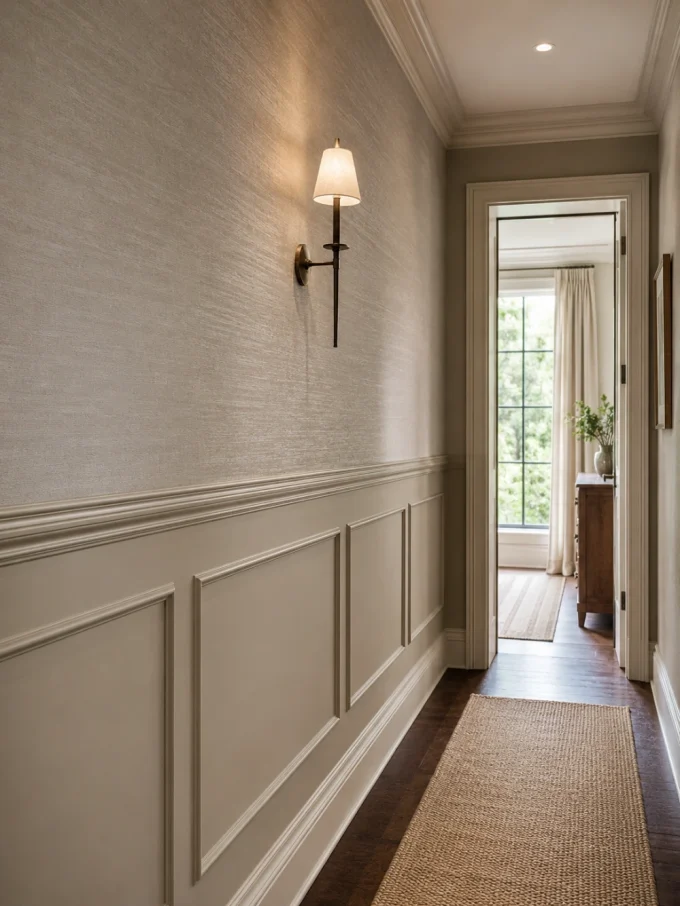
When floor space is limited, the wall itself can become the decorative element.
Wainscoting, restrained panel molding, wallpaper, or a textured finish can give a plain corridor depth without introducing another piece of furniture.
The trick is hierarchy.
If you use detailed paneling, you may not need a complicated gallery wall above it.
If the wallpaper carries a strong pattern, simple lighting and restrained trim can give it enough room to work.
If the wall texture has a pronounced surface, adding multiple small accessories may obscure the material rather than improve it.
DecoralCove’s unusual wainscoting ideas offer architectural approaches, while these wall texture design ideas explore a more material-driven route.
In a very narrow corridor, pay attention to physical projection as well as appearance. Deep applied molding or bulky wall features may consume little space numerically but still make the walls feel physically busier.
10. Use the Ceiling When the Floor Is Already Busy
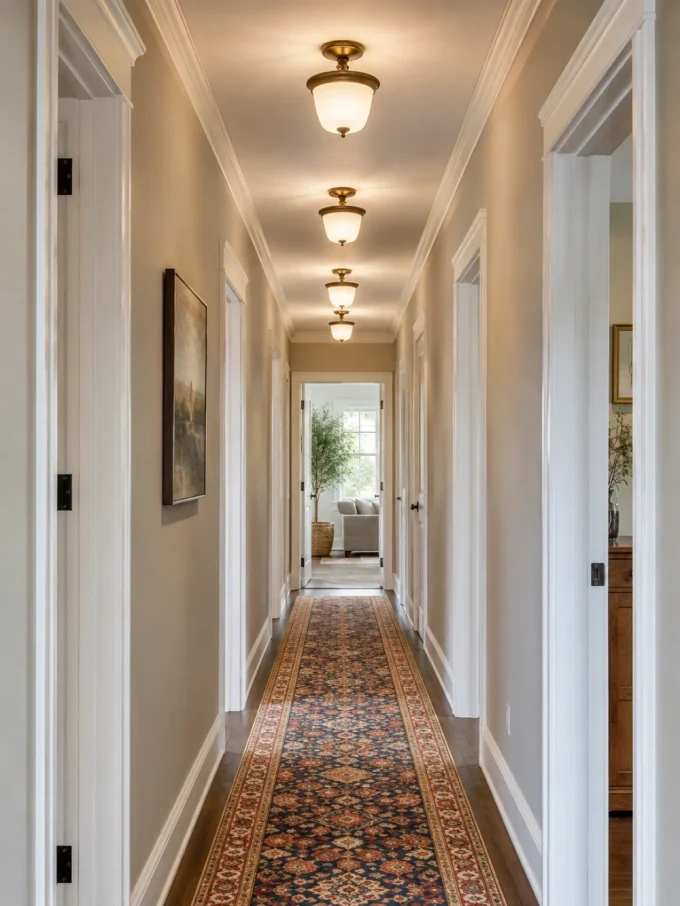
The ceiling is easy to overlook because most hallway advice concentrates on the walls.
Yet in a narrow passage, the ceiling is one of the few surfaces that can carry design interest without reducing walking space.
Possible treatments include:
- repeated compact light fixtures;
- restrained molding;
- a contrasting paint color;
- tonal continuation from the walls;
- or a subtle architectural detail.
A long hallway can particularly benefit from repetition overhead. A sequence of fixtures creates rhythm along the route and reinforces the direction of travel.
If the hallway already has patterned flooring, bold walls, several doors, and significant artwork, however, the ceiling may be better left quiet.
More surfaces do not need to become features simply because they exist.
For additional ways to think about the fifth wall, explore DecoralCove’s modern ceiling ideas.
11. Build Storage Around the Clutter You Actually Have
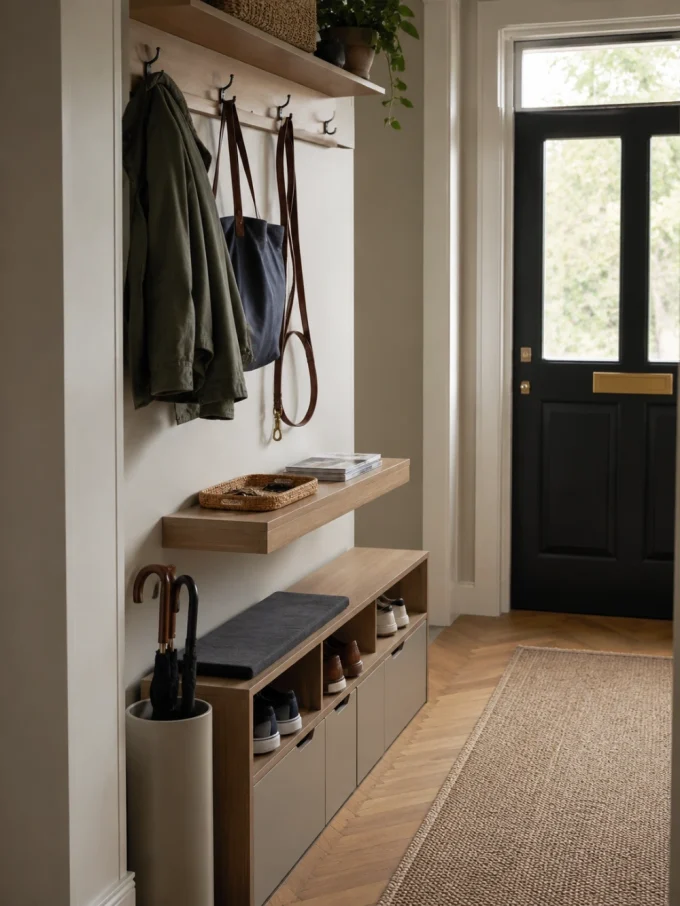
Do not begin with a storage cabinet.
Begin with the mess.
What repeatedly ends up in the hallway?
Shoes?
Keys?
Coats?
School bags?
Umbrellas?
Dog leads?
Mail?
Once you identify the objects, you can choose storage around the problem rather than purchasing an attractive piece that solves the wrong one.
If shoes create most of the mess, place storage close to where they come off rather than farther down the hallway.
If keys and mail are the issue, a shallow wall shelf and small tray may be enough.
If coats dominate, hooks can occupy less physical volume than cabinetry, although they leave the contents visible.
Closed storage creates a calmer visual surface but requires depth.
Open storage can be shallower but shows everything.
That is a real trade-off, not a style rule.
Homes & Gardens likewise emphasizes practical hallway storage and the value of using vertical space or slimline furniture where appropriate.
For wider room-by-room organization and decorating principles, DecoralCove’s best home decor tips can help you decide what should be displayed and what deserves a permanent storage place.
12. Treat Doors, Trim, and Hardware as Part of the Design
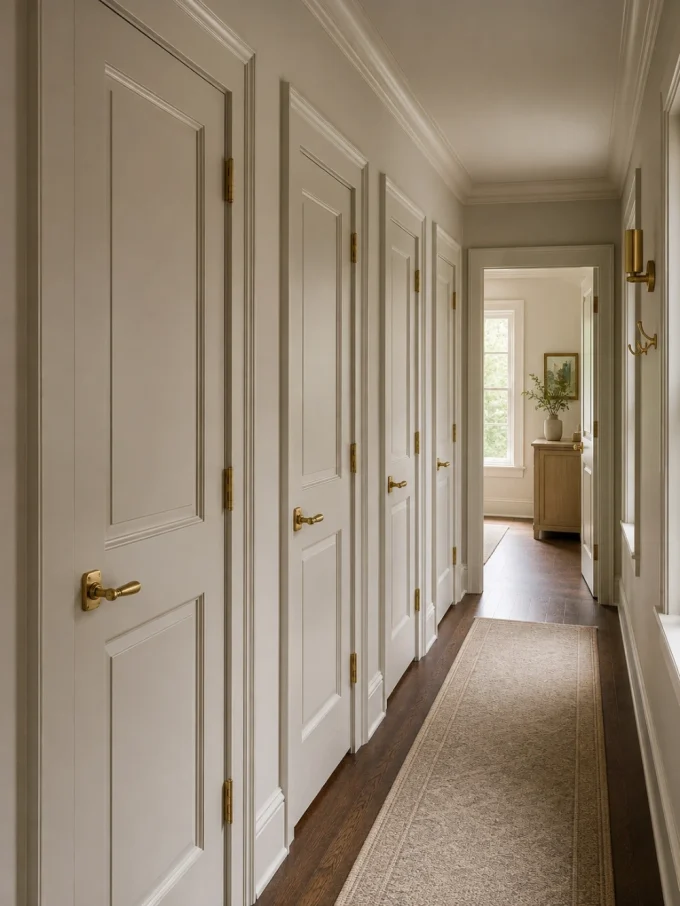
Count how many doors you can see from one end of the hallway.
Four or five doors already create a strong repeated pattern before you add a single decorative object.
Use that architecture.
Painting doors and trim in tones close to the wall color can quiet a corridor that feels visually chopped into sections.
Using a contrasting color can do the opposite and turn the repetition into a deliberate graphic element.
Neither approach is universally better.
Choose according to the problem you are solving.
Hardware matters for the same reason. Door handles, hinges, hooks, and nearby lighting finishes repeat down the passage. When those elements relate to one another, a hallway can feel more resolved without gaining any additional objects.
Before buying more accessories, look at what the architecture is already giving you.
13. Move Useful Elements Up the Wall
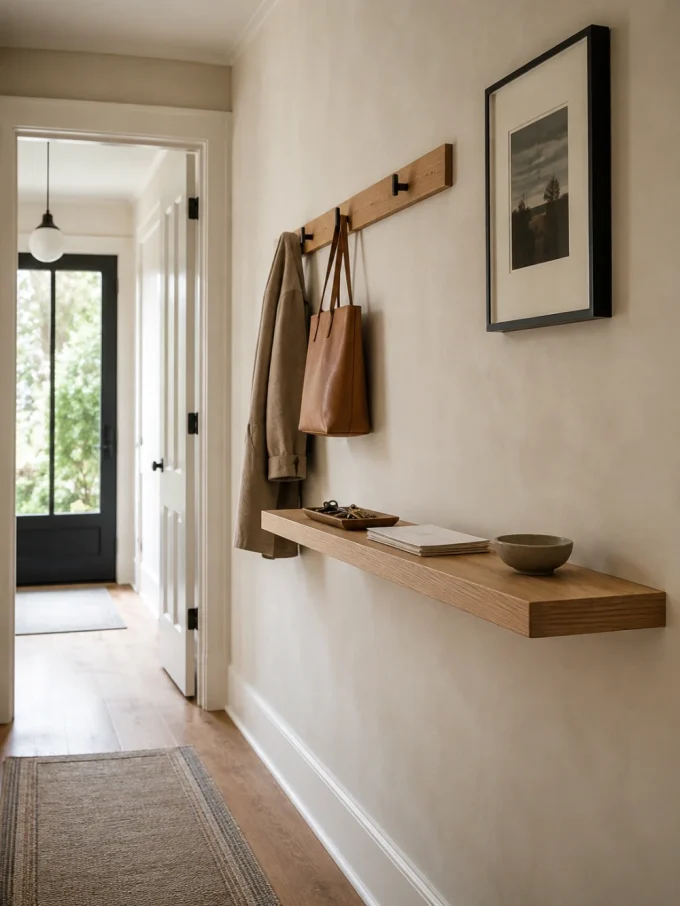
A narrow hallway often needs function but cannot spare much floor area.
Move some of that function vertically.
Depending on the household, that might mean:
- a shallow floating shelf for keys;
- wall hooks for everyday outerwear;
- a picture ledge;
- a compact wall-mounted cabinet;
- or a rail system for small accessories.
The advantage is not simply that wall-mounted pieces appear fashionable.
They can leave more floor visible and reduce the number of legs, baskets, and small objects occupying the walking route.
But vertical storage has its own limitation: projection.
A shelf installed at elbow or shoulder height needs enough depth to be useful without becoming something people regularly bump.
Keep the contents disciplined too. Five thoughtfully placed items can look intentional; a floating shelf loaded with keys, post, receipts, sunglasses, chargers, and loose change quickly becomes airborne clutter instead of a space-saving solution.
If you are choosing small finishing pieces after the practical layout is resolved, DecoralCove’s guide to home decor items can help with more considered accessory choices.
14. Make a Rental Hallway Stylish With Reversible Layers
Renting changes the installation method more than the underlying design principles.
You can still create a strong sight line, introduce color, use a runner, hang artwork where permitted, improve storage, and control visual clutter.
Focus on elements you can remove or take with you:
- a runner;
- framed art;
- portable storage;
- renter-appropriate hanging systems;
- a freestanding or safely installed mirror;
- decorative objects;
- and color introduced through movable pieces.
Do not build the entire room around temporary decorating products simply because they are removable. They still need to suit the proportions and surfaces of the hallway.
For a wider range of reversible strategies, see DecoralCove’s rental apartment decorating ideas.
Renters should also follow their tenancy agreement and property requirements before drilling, painting, replacing fixtures, or making other alterations.
15. Edit the Hallway Before You Call It Finished
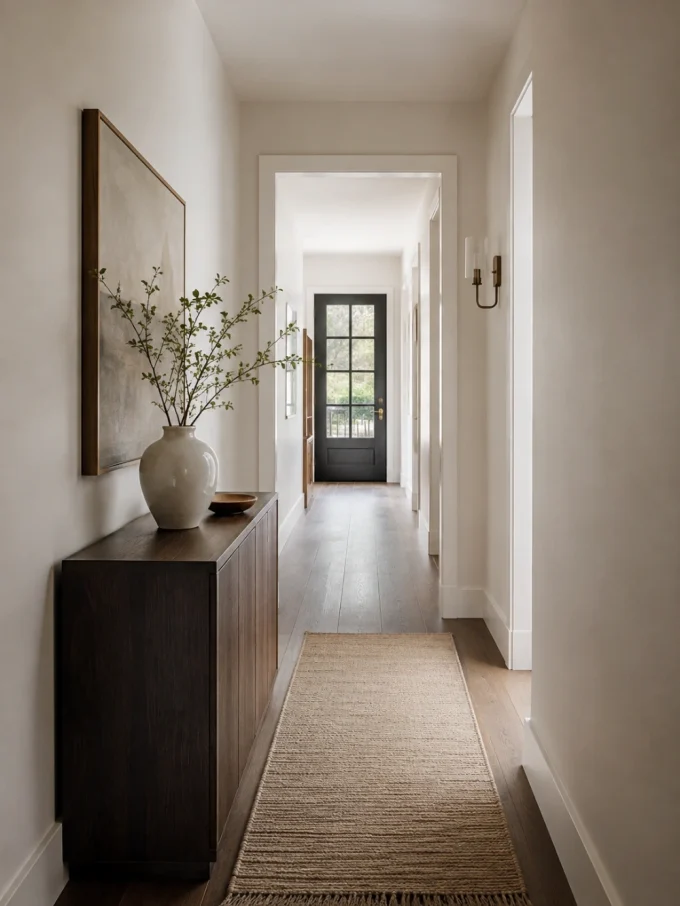
This last idea may change the space more than buying another accessory.
Remove something.
A narrow hallway rarely improves because every attractive object has been given a place.
Look at the finished composition and ask:
Does the console need three decorative objects on top?
Does the gallery wall need another frame?
Does the floor need both a basket and a plant?
Does the mirror need a shelf below it?
Does the patterned runner need bold wallpaper competing beside it?
Can one wall remain relatively quiet?
The problem is often not that an individual piece looks bad. The problem is that several good pieces demand attention simultaneously.
This is where visual hierarchy matters.
A hallway could rely mainly on a patterned runner and artwork.
Another might use a rich wall color and sculptural lighting.
A practical entry passage might rely on closed storage, one mirror, and a durable floor treatment.
They do not all need every ingredient.
DecoralCove’s guide to home decor mistakes to avoid is particularly relevant at this stage because overcrowding often happens one reasonable purchase at a time.
Stand at both ends of the hallway after decorating.
If you can immediately tell what the visual focus is and the route still feels comfortable, you may already be finished.
Final Thoughts
A narrow hallway does not need to disguise its proportions or pretend to be a large foyer.
Work with what the architecture already does well.
Keep the walking route comfortable. Give the long sight line a destination. Use walls and lighting when the floor cannot accommodate furniture. Choose storage according to the objects that genuinely accumulate there, and let one or two strong decorative decisions carry more of the visual load.
Most importantly, stop before every empty surface has been assigned something.
A runner, considered lighting, one good artwork, or a well-positioned mirror can have more impact when it has enough visual space around it.
The chic part is rarely how much you manage to fit into a narrow hallway.
It is how confidently you decide what belongs there.
Frequently Asked Questions
How can I make a narrow hallway look wider?
Start by reducing physical and visual obstacles. Keep floor furniture shallow or remove it entirely, establish a clear walking line, use appropriately scaled artwork, and position mirrors where they reflect an attractive or brighter view. Improving poor lighting can also make the architecture easier to read.
Does a narrow hallway have to be painted a light color?
No. Light colors can create a quieter background, but richer shades can work well when they suit the lighting and adjoining rooms. Test the actual paint in the hallway before committing because daylight and artificial light can change how the color appears.
What furniture works best in a very narrow hallway?
In a truly narrow passage, no floor furniture may be the best option. If there is adequate clearance, consider shallow consoles, wall-mounted shelves, or compact closed storage. Always evaluate depth as well as width.
Where should a mirror go in a narrow hallway?
Put the mirror where its reflection improves the view. A window, bright doorway, artwork, or uncluttered adjoining room is generally more useful to reflect than coats, shoes, or a messy storage area.
What should I decorate first on a small budget?
Fix the largest problem first. If the hallway is dark, improve the lighting. If clutter dominates, solve storage. If it feels visually empty but functions well, paint, a runner, artwork, or one focal point may give you more value than several small accessories.